

-
Home

-
Maritimes NEWS
-
Ports
- maritimes


maritimes
New (amendment) Cyprus Tonnage Tax Legislation: The Merchant Shipping – Fees and Taxing Provisions – Law of 2020

To all Registered Owners, Registered bareboat charterers, Managers and Representatives of ships flying the Cyprus flag, Owners of foreign ships, Charterers and Managers
To all Members of the Cyprus Shipping Chamber To all Members of the Cyprus Union of Shipowners
The Shipping Deputy Ministry (SDM) has already issued a relevant Circular providing official advice on the provisions of the new Law. The renewed Cyprus Shipping Taxation System is valid for another ten years and covers the three major Shipping activities in Cyprus, namely Shipowning, Shipmanagement and Chartering.
1. Further to our Circular No. 1/2020 dated 27 January 2020, I wish to inform you of the enactment of the Merchant Shipping (Fees and Taxing Provisions) (Amendment) Law of 2020 (Law 39(I)/2020) which was published in the Official Gazette of the Republic of Cyprus No 4753, Supplement I(I), dated 16/4/2020) (hereinafter “the Law of 2020”).
2. By virtue of the Law of 2020, the validity period of the Merchant Shipping (Fees and Taxing Provisions) Law of 2010 (Law 44(I)/2010) (hereinafter the “the basic Law”), has been prolonged until 31st December 2029, giving effect to the Decision of the European Commission dated 16 December 2019 (hereinafter “the EU Decision”) to prolong the Cyprus tonnage tax system and to approve it as being in line with the relevant EU policy and Community Guidelines on State aid to maritime transport.
The basic Law together with the amendments introduced by the Law of 2020 are hereinafter together referred to as “the new Law”. An unofficial consolidated translation of the new Law, is available on the web site of the Shipping Deputy Ministry at the following link: www.shipping.gov.cy (click on Info Center / Legislation / Taxation of Shipping Activities).
3. In addition to the prolongation of the validity period, the Law of 2020 has introduced the following amendments to the basic Law, in order for Cyprus to conform with the European Commission’s decisional practice and in particular the EU Decision:
3.1 “Maritime transport”
The definition of maritime transport in section 2 of the basic Law has been amended so as to now include “ancillary activities to maritime transport, provided that the revenues from such activities shall not exceed fifty per cent (50%) of the total gross revenues from the operation of each qualifying ship under tonnage tax by a qualifying owner or qualifying charterer.”
3.2 “Ancillary activities”
In order to give effect to the new definition of “maritime transport”, a new definition “ancillary activities to maritime transport” has also been introduced by the Law of 2020.
By virtue of this amendment, ancillary activities are defined as “i) the activities related to a qualifying ship under tonnage tax, which have a substantial connection with the core maritime transport activities of a qualifying owner or a qualifying charterer but which exclude commercial activities that form part of an operation of a port carried on for profit, or (ii) where the qualifying owner or the qualifying charterer of a qualifying ship under tonnage tax is a member of a group of companies, the activities related to such qualifying ship’s core maritime transport activities provided by another member of that group which is a tax resident of the Republic”.
In accordance with the recent Commission decision practice with respect to this matter and as provided in the EU Decision, core maritime activities comprise notably transport of goods and passengers by sea, crew and technical management of eligible vessels, towage and dredging activity (provided at least 50% of annual operations constitute maritime transport) and by analogy cable laying activities.
A relevant implementing Notification determining such ancillary activities will be issued and published in the Official Gazette in the coming weeks.
3.3 “Qualifying ship”
The definition of qualifying ship in section 2 of the basic Law, has been amended and now includes both a list of eligible vessels as well as a list of the vessels which are excluded from this definition.
The vessel types which are included in the definition of “qualifying ship” in line with the Maritime Guidelines and Commission’s case practice in this respect, include the following vessels: vessels operating maritime transport activities, such as cargo and passenger ships; cable-laying ships, pipe-laying ships; ocean-going dredgers, ocean-going tug boats; crane vessels, self-propelled barges; research vessels; mobile offshore drilling units (MODUS); off-shore support/servicing vessels engaged in petroleum and gas activities; multi-purpose break-bulk and other types of support/ servicing vessels; cruise ships; commercial yachts; rescue and marine assistance vessels; guard vessels for maritime security and environmental clean-up purposes; vessels for raising, repairing and dismantling windmills; ice management vessels; accommodation vessels for housing offshore workers at sea; any vessel engaged in the transportation of any UN/EU humanitarian aid or is involved in any UN or EU humanitarian relief operations. According to the new Law, the above-mentioned list of eligible vessels may be extended following the prior notification approval by the European Commission.
Conversely, the definition of “qualifying ship” expressly excludes the following vessels: fishing and fish factory vessels; private yachts; vessels constructed and used exclusively for inland waterway navigation; fixed off-shore installations and floating storage units which are not used for maritime transport; non-ocean going tug boats and non-ocean going dredgers; floating hotels or restaurants; floating or cruising casinos; non-propelled barges and any other vessels which may be determined as non-qualifying ships, following the prior notification approval by the European Commission.
3.4 Bareboat Charter
In order to give effect to the recent decision practice of the European Commission, section 6 of the basic Law has been amended so that an owner of a ship which is bareboat chartered out shall be deemed to be a qualifying owner, if the ship is bareboat chartered to a charterer forming part of the same group as the owner (intra-group transaction). In other words, with the introduction of this amendment, intra-group transactions are eligible for tonnage tax without restrictions.
As of 1st January 2020, non-intra group bareboat charter agreements will be eligible for tonnage tax provided that they meet the following conditions included in section 6 of the new Law:
(1) the owner demonstrates that the ship was bareboat chartered out due to short-term over-capacity and the term of the charter does not exceed three years,
(2) the temporary excess capacity must be related to the beneficiary’s own shipping services, i.e. excess capacity specifically acquired (bought or chartered) for chartering-out purposes is ineligible for tonnage taxation, and
(3) at least 50% of the tonnage tax fleet must still be operated by the tonnage tax beneficiary.
The above conditions will not apply to existing bareboat charter agreements until their date of expiration or until 31 December 2022, whichever takes place earlier.
3.5 Reduction of Tonnage Tax
Under the Law of 2020, a reduction of up to 30% of the tonnage tax is possible in the case of a Cyprus ship (section 9 of the new Law) or EU/EEA ship (section 13 of the new Law) using mechanisms for the environmental preservation of the marine environment and the reduction of the effects of climate change.
The eligibility criteria for such reduction as well as the level of reduction may be set by a relevant Order of the Council of Ministers published in the Official Gazette of the Republic.
3.6 Tax Exemptions for Seafarers
In accordance with the EU decision, the tax benefits existing for seafarers have been extended to seafarers of Community ships.
More specifically, under section 55 of the new Law the tax exemptions apply to seafarers who are liable to income tax in Cyprus and are employed on board a Community ship which is a qualifying ship engaged in a qualifying shipping activity.
Where the vessels provide scheduled passenger services between ports of the Community, only seafarers who are citizens of the EU/EEA are eligible to benefit from the scheme. In all other cases, the exemptions apply to all seafarers (citizens of a Member State or a non-Member State).
4. Following the set-up of the Shipping Deputy Ministry on 1st March 2018, in addition to the amendments included in paragraph 3 above, certain other minor amendments were deemed necessary to the basic Law in order for the new Law to be in line with the Establishment of a Shipping Deputy Ministry and Appointment of a Shipping Deputy Minister to the President and for Matters Connected Therewith Law of 2017 (Law 123(I)/2017).
More specifically there have been introduced the following new terms and their definitions: “Shipping Deputy Minister”, “Shipping Deputy Ministry”, “Permanent Secretary” and other necessary minor amendments throughout the text of the new Law.
cyprusshippingnews.com
CSSC inks deal for 12 LR2 dual-fuel tankers
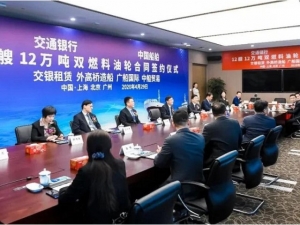
Chinese shipbuilding giant China State Shipbuilding Corporation (CSSC) has won a deal for the construction of twelve dual-fuel tankers.
The order was booked by Bank of Communications Financial Leasing (Bocomm Leasing) which has secured charters for the newbuilds from the energy major Shell.
Shell will charter the 120,000-ton dual fuel LR2 tankers for seven years following their delivery.
The investment is worth whopping 4.6 billion yuan ($657 million) and comes at a very difficult time for the shipbuilding sector which has seen orders dwindle due to the coronavirus pandemic.
Four ships from the batch will be built by CSSC’s shipbuilding arm Waigaoqiao Shipbuilding, and the remaining 8 by Guangzhou Shipbuilding International.
The ships will feature an optimized version of the LNG-powered LRII dual-fuel oil tanker design, developed by the two shipbuilders, and will exceed the IMO TIER III emissions standard, CSSC said announcing the deal.
They are scheduled to be completed and delivered in 2023.
The signing ceremony took place at three different places at the same time and was conducted digitally. The signatories were China Shipbuilding Trading, Shanghai Waigaoqiao Shipbuilding, Guangzhou shipyard International and Bank of Communications Financial Leasing.
https://cyprusshippingnews.com/
Container fleet to shrink with prices and rates on slow recovery from COVID-19
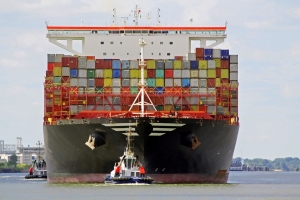
The novel coronavirus (COVID-19) pandemic will lead to a contraction in the shipping container fleet and keep prices and lease rates under pressure in 2020, according to analyst Drewry.
With container supply chains around the world disrupted and depressed demand for vessels and boxes, the container shipping market will be under pressure this year, although better than in 2019.
Drewry’s data showed that first quarter newbuild prices and lease rates for all the main categories of containers were up compared to the fourth quarter of 2019 and 2019 as a whole.
“Primarily, this was the result of improving levels of optimism regarding the outlook for world trade. The US and China signed Phase One of a new trade agreement and the Brexit withdrawal deal was concluded,” wrote Martin Dixon, director, head of research products, Drewry.
“From the container manufacturing perspective, it appeared as if efforts by China’s main box builders to secure minimum prices for their equipment was having some success. Lease rates also hardened, rising between 15% and 20% compared with Q4 2019 for dry freight (20ft, 40ft and 40ft high-cube) equipment,” Dixon said.
But these increases masked “intense volatility” in the market during the period, he observed.
At the beginning of this year, the price of a 20ft standard container stood at about $1,750. By end-February the price rose to as much as $2,150, before a sharp drop to approximately $1,900 in late-March.
The severity of COVID-19 and the lockdown in China and subsequently in many parts of the rest of the world was the cause of the price drop, Dixon said.
“Total box output (dry freight and reefer) in Q1 2020 was one of the lowest in a quarterly period; 33% lower than Q4 2019 and 35% below that of the corresponding period of 2019. The dry box sector was the worst affected with a year-on-year decline in production of 40%. This compared with a 4% increase in the output of reefer containers as the shift of cargo from specialised reefer and air freight services to liner services and containers continued,” he said.
The remainder of the year is expected to be challenging with orders dominated by ocean carriers’ and lessors’ needs to replace ageing inventories.
With few companies expected to expand their fleet this year, Drewry expects the ocean-borne fleet of containers to decrease marginally, though it could be worse depending on the recovery in trade volumes.
“This would represent the first reduction since the financial crisis of 2009 when the pool of equipment declined by 4%,” Dixon said.
“Even though the COVID-19 pandemic will result in a decline in the size of the container equipment fleet in 2020, newbuild prices and leasing rates are expected to firm. A strong recovery in trading volumes in 2021 will reinforce this situation,” he said.
https://www.seatrade-maritime.com/
2020 Bulkers delays delivery of two newbuildings
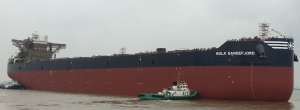
Norwegian shipowner 2020 Bulkers has pushed the delivery dates for the last two of its scrubber-fitted newbuilding bulkers for the first half of June 2020.
The two 208,000 dwt Newcastlemaxes are being built at New Times Shipyard in China and form part of a batch of a total of eight units built at the same yard over the past two years.
The ships were supposed to be delivered by June, however, due to the secondary effects of the coronavirus pandemic and disruption to the supply chain at shipyards their delivery has been somewhat delayed.
The value of the each vessel is around $50 million, based on the estimates from VesselsValues.
Since the beginning of this year, 2020 Bulkers took delivery of two newbuildings, Bulk Shenzhen and Bulk Sydney.
Upon departing New Times Shipyard in January, the Bulk Shenzhen commenced a 11-13 month time charter with ST Shipping, a 100% owned subsidiary of Glencore.
Shortly after Bulk Sydney commenced a 36-month index-linked time charter with Koch Industries.
In February 2020, the company converted the index-linked charter hire for the two ships into fixed rate charter hire at $21,919 per day, gross and $22,673 per day, gross, respectively, for the remainder of 2020.
Glencore has hired two of the company’s ships, while Koch Industries hired a total of four bulkers from 2020 Bulkers.
The two newbuildings remain open for hiring, according to the company’s website.
The bulker owner reported a net profit of $0.3 million and EBITDA of $4.4 million for the first quarter of 2020.
Achieved average time charter equivalent earnings reached approximately $15,600, per day, gross in Q1, while for the second quarter the earnings were higher reaching $18,200.
During the second quarter, the company has also entered into interest swap arrangements for a total of $177 million, securing an all-in interest rate of 3% for the fully drawn amount under the term loan facility.
https://www.offshore-energy.biz/
UNCTAD: Ten-point plan to bolster global transport, ease trade during COVID-1927 April 2020
UNCTAD issues an action plan to tear down barriers to trade and transport and ensure the free flow of goods, food and essential supplies.
As countries adopt radical measures to bring the coronavirus pandemic under control, international trade and transport systems are under tremendous stress.
Early evidence shows that international trade is collapsing, threatening access to goods and critical supplies.
In response, a new UNCTAD policy brief outlines a ten-point action plan to help industries involved in the movement of goods keep free-flowing trade afloat during the COVID-19 crisis and its aftermath.
“Trade facilitation is about keeping goods moving, so we must do our utmost to ensure the crisis doesn’t slow the movement of critical supplies,” said Shamika Sirimanne, UNCTAD’s director of technology and logistics.
“Facilitating trade and the transport of goods has become more important than ever, to avoid logistical obstacles that lead to shortages of necessary supplies.”
The policy brief presents concrete measures to facilitate transport and trade while protecting people from contracting COVID-19.
It echoes an earlier call by UNCTAD Secretary-General Mukhisa Kituyi to keep ships moving, ports open and cross-border trade flowing during this crisis period.
The foundations for recovery from COVID-19 need to be set today. This includes ensuring transport services, ports and border agencies not only remain operational, but are also effectively strengthened to cope with the unprecedented challenges they face.
The action plan is rooted in UNCTAD’s work with both international policy experts and operators on the ground, through its trade facilitation, customs automation and maritime transport programmes.
10 steps to keep trade moving
UNCTAD proposes 10 policy measures to cover maritime transport, customs operations, transit, transparency and legal issues, as well as technology to enhance paperless trade processes. The plan calls for policies that:
1. Ensure uninterrupted shipping
2. Keep ports open
3. Protect international trade of critical goods and speed up customs clearance and trade facilitation
4. Facilitate cross-border transport
5. Ensure the right of transit
6. Safeguard transparency and up-to-date information
7. Promote paperless systems
8. Address early-on legal implications for commercial parties
9. Protect shippers and transport service providers alike
10. Prioritize technical assistance
The policy brief calls on governments to ensure health measures are implemented in ports and border crossings in ways that minimize interference with international traffic and trade.
It also emphasizes the need for people involved in the movement of trucks, ships, and planes to be given the status of critical personnel.
Transport, trade facilitation in developing countries
Developing countries face particularly challenging conditions. They need enhanced support from the development community, as well as cooperation to keep trade moving.
“Even before COVID-19 struck, many developing countries were already confronted with the challenge of having limited resources to make the necessary investments in transport infrastructure and services, and undertake trade facilitation reforms,” said Ms. Sirimanne.
These measures require further investment in human, institutional and technological capacities, and should thus be given priority by development partners.
UNCTAD already works with developing countries to support their trade and transport facilitation efforts. A key example of such initiatives is the ASYCUDA programme, which offers a technology solution for customs automation and a single window for trade.
UNCTAD also trains officials to build port management capacity, works with national trade facilitation committees and provides technical assistance to improve transport transit in developing countries.
The committees enhance inter-agency coordination to facilitate trade flows, especially in emergency situations such as the coronavirus pandemic.
Soon after lockdown measures commenced throughout the world, UNCTAD issued a set of guidelines and recommendations for customs agencies and port operators to safeguard trade and transport while fighting COVID-19.
“The action plan released today, with its 10 measures is yet another concrete step in support of safeguarding trade and development in times of pandemic,” Ms. Sirimanne concluded.
Source: United Nations Conference on Trade and Development (UNCTAD)
The impact of coronavirus on vessel traffic and the shipping industry
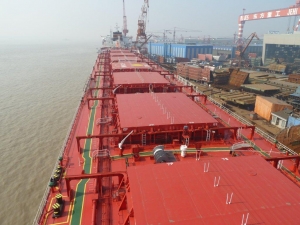
The shipping industry experienced major disruptions in Q1 of 2020 due to both the Coronavirus and the crude oil price crash. As major parts of the global economy shut down, so have pockets of international trade – yet, not all vessel types have experienced the same disruption.
Not all vessel types need a bailout
Our analysis using Vesseltracker shows that cruise ship activity has collapsed in the wake of reduced tourism due to the coronavirus pandemic, with global port calls falling from 900 port calls per week in January to fewer than 100 port calls per week in April, with an overall drop of 35% in total year to date activity compared to 2019.
Other vessel types have fared better than the cruise ship activity but remain at lower levels of activity compared to 2019. We see declines for vehicles roll-on/roll-off (-15%), containers and crude oil (-3%) and bulk (-1%) vessel traffic.
China: how quickly can its vessel activity return to normal?
When will the sector see some relief? We partnered with our sister company, AIR, that pioneered catastrophe modelling since 1987, to shed insight. We project China is past its apex and over four weeks ahead of other countries, so we began to look at how its maritime traffic has recovered using Vesseltracker, the most accurate global shipping database.
The double impact of the coronavirus and the Lunar New Year was felt in Chinese shipping activity. While activity is expected to fall during the holiday, the reduction in container vessel activity was steeper and longer compared to 2019. The full recovery in container vessel activity from the holiday decrease in activity lasted 47 days, compared to 60 days this year.
As the coronavirus spreads globally, global container vessel activity is significantly down from January levels, and the Chinese recovery could provide further guidance on recovery on a global level.
Source: Wood Mackenzie
The 22nd Annual Capital Link Invest in Greece Forum: "A new era for Greece"
The 22nd Annual Capital Link Invest in Greece Forum: "A new era for Greece" will take place at the Metropolitan Club in New York City on Monday, December 14, 2020. This is an International Summit about Greece in New York organized in cooperation with the New York Stock Exchange and major global investment banks. The Forum will feature government and business leaders from Greece, Europe and the United States, and top executives from the investment, financial and business communities.
This Forum will provide the audience with a unique blend of informational, marketing and networking opportunities. With a 22 year track record, the Capital Link Forum is committed to raising awareness about Greece as an investment destination, to a wider investor universe.
With the adequate incentives provided by the new government to international investors for new business in Greece and with the actual new significant investments announced already, within the first two months of 2020, it is obvious that a concrete start has been made for the re-launching of Greek economy. We are confident that this year’s forum too will attract record attendance; it will allow the international investment community to familiarize itself with the priorities of the new government and will highlight further opportunities in Greece and its attractiveness as an investment and business destination.
The conference will feature the developments and reforms in the Greek economy and the new Greek government programme for the economy and investments. Also, the latest trends in the capital markets and specific sectors with topics such as Government and Corporate Bonds, energy, infrastructure development, real estate, tourism, banking, non-performing loans management, and global shipping.
TARGET AUDIENCE:
Management of Top U.S. Corporations with an active interest or involvement with Greece and The Greater Region • Institutional Investors in Greek Equities & Fixed Income Securities • Portfolio Managers & Analysts • Commercial and Investment Bankers • Financial Advisors and Brokers • Financial Media & Press
22nd Annual Capital Link Invest in Greece Forum
Monday, December 14th, 2020
8:00 am – 6:00 pm
Metropolitan Club in New York City
The Forum is organized in cooperation with the New York Stock Exchange.
The Forum concludes with a dinner and a dialogue between business executives & government leaders of Greece and the United States.
2020 Annual Capital Link Hellenic Leadership Awards Dinner
The "Capital Link Hellenic Leadership Award" is presented annually to a person or organization for his outstanding contribution in enhancing the image of Greece and fostering closer ties between Greece and the global business and investment community.
Previous recipients of the award were President & Portfolio Manager - Paulson & Co. Inc., Mr. John Paulson, Chairman & CEO of Mytilineos, Mr. Evangelos Mytilineos, Secretary of Commerce US, Mr. Wilbur L. Ross, Chairman and Chief Strategy Officer of WL Ross & Co, Mr. André Calantzopoulos, CEO, Philip Morris International, Dr. Anthony Papadimitriou, President to the Board of Directors of Alexander S. Onassis Foundation & Managing Partner of A.S. Papadimitriou & Partners Law Firm, Mr. George Logothetis, Chairman & CEO of Libra Group, Mr. John Calamos, Chairman, CEO & Global Co-Chief Investment Officer of Calamos Investments and Mr. Andrew N. Liveris, Chairman and Chief Executive Officer of The Dow Chemical Company
Greek American Issuer Day at New York Stock Exchange
Tuesday, December 15th, 2020
On Tuesday, December 15th, 2020, within the context of the 22nd Annual Capital Link Invest in Greece Forum the New York Stock Exchange is organizing a special ceremony in honor of Greece entitled Greek American Issuer Day where the Greek Delegation, Greek companies listed on the New York Stock Exchange and companies which participate in the forum will ring the Closing Bell at NYSE, an event of unique visibility throughout the world.
ONE-ON-ONE MEETINGS - Listed Companies
As in previous years, the Forum will provide foreign investors with unique networking opportunities through one-to-one meetings with listed and non- listed companies, as well as, with members of the Greek government delegation.
For more information, please contact: Eleni Bej, Director of Event Operations at This email address is being protected from spambots. You need JavaScript enabled to view it. or +1(212)661-7566 in NY or at This email address is being protected from spambots. You need JavaScript enabled to view it. or (+30) 210 6109800-2 in Greece
For sponsorship opportunities please contact: Nicolas Bornozis or Olga Bornozis or Anny Zhu at This email address is being protected from spambots. You need JavaScript enabled to view it. or +1 (212) 661-7566.
BIMCO floating storage clause for tankers: What to cover
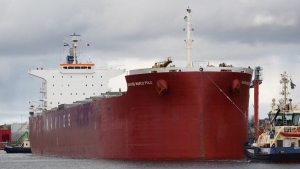
The practice of charterers using oil tankers for floating storage is certainly not a new concept. What’s different with the current demand for storage is the huge number of ships being time chartered for floating storage purposes due to the collapse in oil prices, partly as a result of COVID-19. Therefore, BIMCO is receiving enquiries about “floating storage” clauses and questions about what additional wording owners should consider adding to their time charters.
Under a time charter party, owners place the ship at the disposal of charterers who can then give orders and directions for the employment of the ship, provided those orders are lawful. Within the limits agreed in the charter party, charterers can decide what cargoes are to be loaded and where they are to be loaded and discharged – but they can also instruct the ship to wait, pending further orders.
So, a time charter party can easily be “re-purposed” to enable charterers to use the ship for floating storage. Under time charters, an indemnity by charterers will generally be implied against the consequences of owners complying with charterers’ orders. Some tanker time charter parties include a “storage clause”, but these are often very brief provisions simply conferring an option to use the ship as storage, which they could most likely do anyway without the need for additional wording.
An example of a storage clause is Clause 21 from BPTIME 3 which was jointly developed by BIMCO and BP:
“Charterers shall have the option of using the Vessel for floating storage, but charterers undertake not to use the Vessel for floating storage in areas where additional premiums for War Risks Insurance are charged by the Vessel’s War Risks Insurance underwriters.”
Like most tanker storage clauses, the provision largely relies on other clauses in the time charter to govern the consequences, responsibilities and liabilities of the ship being used for floating storage. However, most storage clauses were not written with long term storage in mind, and the implications for owners could therefore be far reaching. In the present scenario we may be looking at potentially very long periods during which ships will be used to store oil when anchored or drifting.
From an owners’ perspective this gives rise to some important considerations:
Who pays for hull cleaning?
The first is the consequence of marine growth on the hull and other underwater parts while the ship is stationary or drifting. This will have an impact on the ship’s performance and a cost element in terms of cleaning the hull. The usual position under a time charter is that the owners are responsible for maintaining the condition of the hull. However, if fouling occurs as a direct result of charterers’ orders for the ship to wait, then they should be responsible for the consequences – which include a suspension of owners’ performance warranties until the hull is clean, and the obligation to pay for hull cleaning. To address this situation, BIMCO recommends that the BIMCO’s Hull Fouling Clause 2019 is incorporated into the time charter.
Where to wait? Is it safe?
The second is the agreed location for the ship to wait or drift when used as floating storage. It must of course be a safe place for the ship and crew and so we recommend that owners include BIMCO’s War Risks Clause for Time Charter Parties 2013 (CONWARTIME 2013) and BIMCO’s Piracy Clause for Time Charter Parties 2013. These clauses permit owners to require charterers to operate the ship only in areas where there is no actual or threatened war risks and to avoid areas where a threat of piracy exists (recognising that a drifting or anchored ship is exposed to a greater threat of attack than a ship underway).
Caring for the stored cargo
The third consideration is the duration of storage and the impact that extended storage may have on the condition of the cargo and the ship’s tanks, valves and pipework, etc. Proper insurance is an important aspect and both parties should check with their respective insurers (cargo, P&I, pollution, etc) if additional insurance premiums may be required and which party should bear the cost. Owners are contractually obliged to care for the stored cargo, so it is important that the characteristics of the cargo are taken into account and the condition of the cargo closely monitored, bearing in mind that oil products may degrade over time. In addition, there may be an impact on tank coatings and cargo-related equipment due to prolonged idleness which normally fall under owners’ maintenance obligations.
Supplying the crew with necessary provisions
The fourth consideration relates to crew. If the ship is located in a remote area, it may not be possible to obtain provisions and fresh water or to do crew changes (although that is a challenge worldwide at present). Owners may wish to consider a right to deviate the ship to the nearest location where these things can be done and how the costs should be allocated between the parties. BIMCO’s Liberty and Deviation Clause 2010 can be easily adapted for time charters.
Will floating storage impact the engines?
The fifth consideration is that if the ship is to be “re-purposed” as a floating storage unit under the time charter agreement, owners should review the ship’s time charter description in relation to the potential technical impact of the low use of the ship’s engines.
Negotiating a rate of hire for additional days
The sixth and final point for consideration is the rate of hire and duration of the charter. If you fix on a trip charter or short period charter, it could help avoid disputes if owners and charterers agree on what happens in case the charter period is exceeded because there is no suitable market for the oil cargo. A rate of hire for additional days or optional periods could be negotiated up front.
In summary, we recommend the following for tankers being used as floating storage to address the potential additional risks and costs:
- Performance and hull fouling - Incorporate BIMCO’s Hull Fouling Clause 2019 for time charter parties.
- War and Piracy Risks – Incorporate BIMCO’s War Risks Clause for Time Charter Parties 2013 (CONWARTIME 2013) and BIMCO’s Piracy Clause for Time Charter Parties 2013
- Cargo – be aware of risk of cargo degrading over time. Consult with insurers and allocate cost of any additional premiums.
- Crew – making sure the crew obtain provisions – this may require the ship to deviate to a nearest port or place where provisions and other facilities are available. Allocation of costs for deviation. See BIMCO’s Liberty and Deviation Clause 2010
- Ship’s description – owners should look at the time charter description of the ship in the context of the ship being re-purposed for floating storage.
- Hire – agree optional periods or rates of hire for days used beyond the agreed charter redelivery date.
Capital Product Partners L.P. Announces Cash Distribution
ATHENS, Greece, April 28, 2020 (GLOBE NEWSWIRE) -- Capital Product Partners L.P. (NASDAQ: CPLP) today announced that its board of directors has declared a cash distribution of $0.35 per common unit for the first quarter of 2020 ended March 31, 2020.
The first quarter common unit cash distribution will be paid on May 15, 2020 to common unit holders of record on May 9, 2020.
About Capital Product Partners L.P.
Capital Product Partners L.P. (NASDAQ: CPLP), a Marshall Islands master limited partnership, is an international owner of ocean-going vessels. CPLP currently owns 14 vessels, including 13 neo panamax container vessels and one capesize bulk carrier.
capitalpplp.com.
Containerised version of the ERMA FIRST FIT system
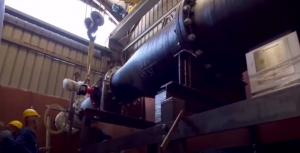
Meet our containerised version of the ERMA FIRST FIT system. A ship owner can now reduce yard installation time and achieve a better control of their budget by ordering a pre-fabricated, pre-installed BWC ERMA FIRST container or deckhouse.
Featured: ERMA FIRST BWTS FIT 1200 EX with FilterSafe Filter Option

Powered by  © Μaritimes 2019