

-
Home

-
Maritimes NEWS
-
Ports
- maritimes


maritimes
RINA publishes new rules for the use of “ammonia as a fuel” and the class notation “Ammonia Ready”

Ammonia represents a viable marine fuel option for shipping's decarbonization
The importance of reducing the impact of shipping on climate is well recognized by the industry and regulatory bodies. It is also the main target of the IMO’s carbon emission reduction strategy. Most experts consider the introduction of alternative fuels as a key success factor.
To date it is not clear which low-CO2 emissions fuel will drive the decarbonization of the marine sector: biofuels, ammonia, hydrogen or nuclear. The final choice will not be made by the maritime industry alone and will be heavily dependent on the evolution of the onshore industry’s decarbonization path.
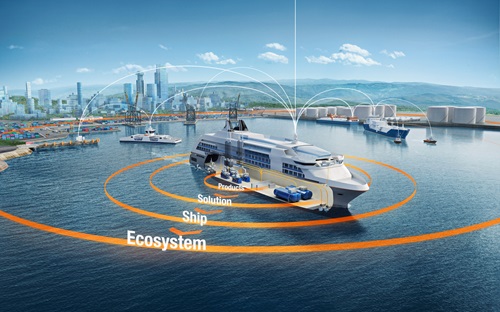 At RINA we are deeply convinced that it is necessary to support the energy transition by offering a comprehensive regulatory framework capable of addressing the technical issues related to each fuel identified as a possible driver of shipping’s decarbonization.
Ammonia may be, to some extent, an interesting future marine fuel option. Nevertheless, many issues remain to be solved before a large-scale introduction, starting from its availability (especially considering its availability from renewable sources) and distribution worldwide.
In the last year, RINA made its own research, started Joint Development Projects with important designers, involving marine equipment Makers and Owners to gather information and knowhow on ammonia as a fuel. Following this work, on May 1st we published a first edition of our rules for the use of “Ammonia as fuel”.
Based on IGF Code where goals and functional requirements are established for ships using gases or other low-flashpoint fuels, the rules follow the same pattern of IGF Code requirements for LNG. They carefully consider the ammonia toxic characteristics and adopt general preventive measures to be confirmed and completed by an extensive risk assessment to be carried out on the specific arrangement under consideration.
Ammonia is not ready for bunkering in all ports as it should be for an immediate and widespread use, but the design of a new ship can already be developed to consider how the vessel can be arranged to be fueled by ammonia. For this reason, in addition to the above-mentioned rules, RINA has also published the requirements to get an additional class notation “Ammonia Ready” on a traditionally fueled ship.
How The Shipping Container Crisis Demonstrates The Risk Of Imbalance In Global Trade
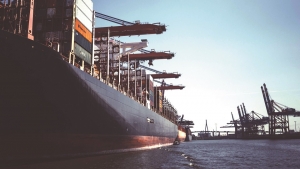
Disruption to supply chains triggered by the impacts of Covid-19 has ignited a worldwide shipping crisis, with prices of shipments skyrocketing due to a shortage of containers. Often headlined as the perfect storm, a combination of pressures has escalated shipping costs to more than four times the normal rate, threatening the stability of businesses that depend on these trade transport lines.
According to the Financial Times, the price of a 40-foot container routed from Asia to Northern Europe has risen from $2,000 to $9,000, while CNBC has reported that the cost of goods transported from Asia to the West Coast of America has increased by 145 percent. At the heart of this issue is the imbalance of global trade, which has been amplified as a result of the pandemic. With China’s trade economy recovering at a rapid rate and an influx in demand for products rather than services, the shortage of containers and soaring freight rates are expected to continue through the first half of 2021.
A Wave Of Pressures
Since July last year, demand for commodities such as medical equipment, home office supplies and computer equipment has forced supply chains to import many products and materials from China to fulfill consumer needs. With the country rebounding from months of suspended trade, this has created an imbalance – exporting approximately three containers for every one imported.
It’s estimated that there are more than 170 million shipping containers across the globe, used to transport around 90% of the world’s goods. Yet, the effects of Covid-19 have left global shipping lines with backlogs and delays due to labor shortages, reduced capacity in logistics systems, congestion at ports as well as quarantined cargo. This means China doesn’t have enough available containers to meet demand. With products piling up in Chinese factories and traders bidding high prices for containers, Reuters claims that “average container turnaround times have ballooned to 100 days from 60 days previously.”
As a result, China is paying premium rates for importers to return the containers, making it more profitable to send empty boxes rather than refilling them. This is clearly a growing problem as the Global Shipping Alliance suggests that “shipping lines are refusing outbound bookings because they want to expedite return of the containers to the Far East.” Bookings are now being accepted based on profitability and strategic importance, and as a result, many small to medium shippers are being sacrificed.
Impact On Global Food Trade
While the globalization of food trade has increased access to a larger variety of goods and opened up trade opportunities, it has become more susceptible to environmental changes and market fluctuations. The shipping crisis is just one example that demonstrates its fragility.
The combination of steep shipping prices and competition for containers has inevitably been felt by the food and agriculture industry, with Bloomberg reporting that food is piling high in all the wrong places. Loading times have been drastically shortened meaning producers are struggling to fill containers fast enough. What’s more, high freight rates have caused retailers to either cancel contracts, bulk buy supplies or delay purchases until prices have balanced.
With the prospect of food shortages escalating prices, increased consumer pressure on the price of food as well as high shipping costs, many buyers are worried about profitability. Purchasing goods at a cheaper rate or selling them at a higher price is not always possible within the existing supply chains so buyers are looking for alternative ways of combating the price fluctuations. In an industry that has typically been reliant on the broker or ‘middleman’ to make the deal, digital solutions offer another path of exploration to help buyers and sellers in the current market.
Digital trading platforms work by connecting buyers with suppliers that are closer to them geographically or with areas where the buying price is significantly cheaper. With either fewer miles to travel or lower initial costs, profitability can typically be maintained and supply almost guaranteed for the ultimate consumer. The buying window can also be reduced because deals can be done remotely without the need for on-the-ground visits. These are done instead by locally situated engagement managers who can provide the guarantees needed by the major buyers. In a world where speed is everything and where the global pandemic has resulted in severe delays to shipping produce, digital solutions are seeking to help the industry remain competitive and responsive to demand.
Transformation In Practice
Digital platforms are in place to help businesses of all sizes. For small businesses looking to find new buyers or suppliers, marketplaces such as Alibaba or connection service providers can assist in helping to secure new business. For larger companies in need of understanding and analyzing the market to make data-based purchasing decisions, data and intelligence providers may offer a more valuable service. However, it is important to ensure the services provided are reliable as the import/export industry is very volatile and information can be fragmented, which can lead to misinterpretation of data.
Ideally, an intelligence service provider directly involved in trading would be in the best position to assist with accurate information. They likely have access to the latest market intelligence from the transactions they are handling and are likely in the position to provide risk-averse buyer/supplier connections and transaction support. An example of this support can be seen in our business when we helped a Mexican avocado supplier to expand their business into 12 new countries with international travel all but banned. Market intelligence, local connections and experience trading combine to make up the characteristics of an ideal provider.
Digital transformation in the food and agriculture industry is already well underway with many platforms available for buyers and suppliers. Yet, trading is one of the most ancient industries and is still dependent on offline practices such as relationship building, physical interactions and trust. Choosing the right support platform will depend on your business goals but you should ensure that a partner can embrace the traditional practices that are still commonplace in the sector in order to capitalize on all opportunities.
Source: Forbes
Baltic index falls for second session on capesize, panamax retreat
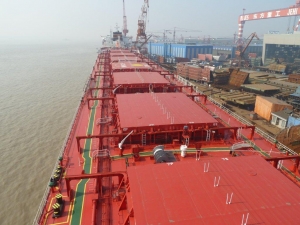
The Baltic exchange’s main sea freight index fell for a second consecutive session on Wednesday on a retreat in rates for the capesizes and panamax vessel segments.
The Baltic dry index, which tracks rates for capesize, panamax and supramax vessels ferrying dry bulk commodities, fell 55 points, or roughly 2%, to 2,754.
The capesize index shed 173 points, or 4.6%, to 3,572, the lowest in over a month.
Average daily earnings for capesizes, which typically transport 150,000-tonne cargoes of coal and steel-making ingredient iron ore, fell by $1,434 to $29,620.
Trading on Wednesday in China began with markets already under pressure on worries about monsoon rains in China’s south and the scorching temperature in the north slowing down construction activity, which could dampen demand for rebar and iron ore. Steel and iron ore prices also tumbled.
The panamax index fell 42 points, or roughly 1.5%, to 2,767, declining for the fourth session.
Argentine port workers said on Tuesday they would hold a 48-hour strike starting at midnight (0300 GMT Wednesday), after paralyzing agricultural exports from the country last week when seven ships, six of them large Panamax vessels, loaded with soymeal, corn and other farm products were moored at Rosario during the work stoppage.
Average daily earnings for panamaxes, which usually carry coal or grain cargoes of about 60,000 tonnes to 70,000 tonnes, fell by $382 to $24,903.
The supramax index rose by 42 points to 2,492.
Source: Reuters (Reporting by Seher Dareen in Bengaluru; Editing by Shailesh Kuber)
Stealthgas inc. reports first quarter 2021 financial and operating results
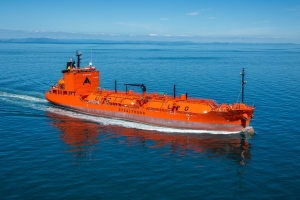
ATHENS, GREECE, May 26, 2021. STEALTHGAS INC. (NASDAQ: GASS), a ship-owning company primarily serving the liquefied petroleum gas (LPG) sector of the international shipping industry, announced today its unaudited financial and operating results for the first quarter ended March 31, 2021.
OPERATIONAL AND FINANCIAL HIGHLIGHTS[1]
Fleet utilization of 98.7% with 50 days of technical off hire mainly as a result of one drydocking completed within Q1 2021.
Operational utilization of 93.1% mainly due to 15 of our ships having a predominant presence in the spot market - equivalent to 31.2% of voyage days.
61% of fleet days secured on period charters for the remainder of 2021, with total fleet employment days for all subsequent periods generating approximately $87 million (excluding vessels in joint ventures) in contracted revenues. Period coverage for the remainder of Q2 21’ is currently 80%.
Sale and delivery in Q2 21’, of the 35,000 cbm MGC vessel, the Gaschem Hamburg (2010 built), owned by our MGC joint venture arrangement, for a price of $34 million generating an aggregate gain, for the Joint Venture, of $7 million.
Voyage revenues of $37.4 million in Q1 21’, an increase of $3.0 million compared to Q1 20’ mostly due to a 58% in the fleet’s bareboat activity where revenues are inherently lower than those earned from time charter and spot activity.
Net income of $0.8 million for Q1 21’ corresponding to an EPS of $0.02 compared to net income of $3.0 million corresponding to an EPS of $0.08 in the same period of last year.
EBITDA of $13.4 million in Q1 21’ compared to $16.5 million in Q1 20’ - due to lower operational utilization as a result of higher spot activity.
Low gearing, as debt to assets stands at 37.7%, and a quarter over quarter reduction in finance costs by $1.1 million.
Total cash, including restricted cash, of $52.9 million with no capital expenditure commitments in the near future.
First Quarter 2021 Results:
Revenues for the three months ended March 31, 2021 amounted to $37.4 million, an increase of $3.0 million, or 8.7%, compared to revenues of $34.4 million for the three months ended March 31, 2020, mainly due to seven vessels, now operating either in the spot market or under a time charter contract which were employed on bareboat charters in the same period of last year.
Voyage expenses and vessels’ operating expenses for the three months ended March 31, 2021 were $6.9 million and $15.1 million, respectively, compared to $2.8 million and $13.2 million, respectively, for the three months ended March 31, 2020. The $4.1 million increase in voyage expenses is attributed to the 260% increase in spot days. Due to our increased spot activity, we witnessed this quarter a sharp increase of both port expenses and bunker costs, particularly as we had two of our product tankers operating in the spot market. The 14.4% increase in vessels’ operating expenses compared to the same period of 2020, is a result of seven fewer vessels on bareboat, which vessels are now operating either on time charter or in the spot market along with an increase of our daily crew costs crew due to the COVID-19 pandemic.
General and administrative expenses: for the three months ended March 31, 2021 and 2020 were $0.9 million and $0.6 million, respectively. This $0.3 milion increase compared to the same period of last year is primarily due to some one–off legal expenses and some management fees to unaffiliated third parties.
Drydocking costs for the three months ended March 31, 2021 and 2020 were $0.6 million and $0.2 million, respectively. Drydocking expenses during the first quarter of 2021 relate to the drydocking of one vessel and to the drydocking preparation of four vessels compared to the drydocking in progress of one vessel in the same period of last year.
Depreciation for the three months ended March 31, 2021 and 2020 was $9.5 million and $9.3 million, respectively.
Interest and finance costs for the three months ended March 31, 2021 and 2020 were $3.1 million and $4.2 million, respectively. The $1.1 million decrease from the same period of last year is mostly due to the decline of LIBOR rates.
Equity earnings in joint ventures for the three months ended March 31, 2021 and 2020 was a gain of $1.1 million and a gain of $0.6 million, respectively. The $0.5 million increase from the same period of last year is mainly due to the profitability of our MGC joint venture arrangement which operated for the full Q1 21’ compared to approximately one month during Q1 20’.
As a result of the above, for the three months ended March 31, 2021, the Company reported net income of $0.8 million, compared to net income of $3.0 million for the three months ended March 31, 2020. The weighted average number of shares outstanding for the three months ended March 31, 2021 and 2020 was 37.9 million and 39.4 million, respectively. This decrease in the number of shares is a result of our share buyback program and the tender offer that was completed in April 2020.
Earnings per share, basic and diluted, for the three months ended March 31, 2021 amounted to $0.02 compared to earnings per share of $0.08 for the same period of last year.
Adjusted net income was $0.6 million or $0.02 per share for the three months ended March 31, 2021 compared to adjusted net income of $3.1 million or $0.08 per share for the same period of last year.
EBITDA for the three months ended March 31, 2021 amounted to $13.4 million. Reconciliations of Adjusted Net Income, EBITDA and Adjusted EBITDA to Net Income are set forth below.
An average of 41.6 vessels were owned by the Company during the three months ended March 31, 2021 compared to 41.0 vessels for the same period of 2020.
Fleet Update Since Previous Announcement
The Company announced the conclusion of the following chartering arrangements:
A one year time charter extension for its 2009 built product tanker the Falcon Mayram, to a Tanker Operator until September 2022.
A one year time charter for its 2008 built product tanker the Magic Wand, to a National Oil Company until March 2022.
A one year time charter extension for its 2015 built LPG carrier the Eco Universe, to an Oil Major until February 2022.
A six months time charter extension for its 2007 built LPG carrier the Gas Flawless, to an International LPG Trader until December 2021.
A six months time charter extension for its 2018 built LPG carrier the Eco Freeze, to an International LPG Trader until October 2021.
A four months time charter for its 2012 built LPG carrier the Gas Husky, to a Major Commodity Trader until September 2021.
A three months time charter extension for its 2012 built LPG carrier the Gas Esco, to an International LPG Trader until September 2021.
A two months time charter extension for its 2016 built LPG carrier the Eco Dominator, to an International LPG Trader until June 2021.
A two months time charter extension for its 2021 built LPG carrier the Eco Blizzard, to an International LPG Trader until June 2021.
A one month time charter for its 2015 built LPG carrier the Eco Dream, to an oil Major until May 2021.
With these charters, the Company has total contracted revenues of approximately $87 million.
Total anticipated fleet days of our fleet is 61% covered with charter contracts for the remainder of 2021.
Board Chairman Michael Jolliffe Commented
Our performance in the first quarter of 2021 was still governed by the COVID-19 pandemic. Although demand for small LPG carriers slightly strengthened and rates seem to have gained a positive momentum these effects began to materialize towards the end of the quarter, thus were not reflected in our results for Q1 2021.
Due to market conditions our presence in the spot market remained high and compared to the last quarter of the year what mostly undermined our spot profitability was the operation of two of our product tankers in the spot market for the whole duration of the quarter- thus incurring high voyage costs against poor freight compensation.
What we find important amidst these market conditions is that we have designed our fleet employment so as to grasp the positive market turn expected with the remission of the COVID-19 pandemic. We have 16 vessels concluding their period employment up until the end of 2021 and along with our ships currently in the spot market gives us the opportunity to re-charter 60% of our fleet at a time when hopefully the market is expected to improve.
Suez Canal chairman discusses stranding compensation with Panamanian ambassador, Maritime Authority chief

CARO – 25 May 2021: Chairman and Managing Director of the Suez Canal Authority Osama Rabie received Tuesday Panamiam Ambassador to Cairo Alejandro Gantes and accompanying delegation that includes Director General of the Panamanian Maritime Authority Rafael Cigarruista to discuss ways of joint cooperation, including a solution to reach an agreement on the compensation sum for the MV EVER GIVEN stranding.
Rabie confirmed that the authority has assumed full responsibility in dealing with the grounding crisis of the of the Panamanian-flagged container ship "EVER GIVEN" since the incident took place, and has harnessed all its technical, human capabilities, equipment, and vessels to successfully complete the refloating operation with the participation of more than 600 members of the Authority’s staff as well as using 15 tugboats, multiple diving and salvage units, service launches, and two dredgers belonging to the authority’s fleet of dredgers, as the authority had to introduce the use of dredging in marine salvage operations, which is not common as it requires high accuracy and adherence to the highest safety standards.
During the meeting that took place in the Suez Canal Authority's headquarters in Ismailiyah, Rabie displayed the Authority’s efforts in completing the salvage operation of the Panamanian-flagged container ship EVER GIVEN, clarifying that despite the success in refloating the Panamanian-flagged ship in record time within only six days and without any damage to the hull of the ship or the cargo on board, the ship-owning company did not show the due recognition deserved, which did not reflect an understanding of the huge losses incurred by the authority due to the incident. That can be seen in the damage to a number of participating vessels and the sinking of one of Suez Canal Authority vessels during the refloating operations, resulting in the death of one of the workers, as well as the material and moral damages that the reputation of the Suez Canal has sustained by the suspension of the navigation traffic. That is in addition to the counter campaign questioning the Suez Canal Authority's ability to solve the crisis and the tendency of some clients to take alternative routes during the crisis, estimated at 48 ships as well as the costs incurred by the authority to combat pollution and treat 9,000 tons of ballast water that was discharged to lighten the ship and facilitate its floatation.
Meanwhile, Rafael Cigarruista, Director General of the Panamanian Maritime Authority, expressed his desire to open new horizons for cooperation between the Panama Maritime Authority and the Suez Canal Authority by holding joint technical meetings to consult in various matters, on top of which is the completion of data related to the incident of the aground Panamanian-flagged container ship EVER GIVEN.
Upon ending the crisis successfully and refloating the container ships, the Suez Canal Authority managed to pursue its operations around the clock to accommodate 422 vessels in four days with an average of more than 100 transits per day, which resembled another challenge that the SCA has tackled successfully to serve the global trade and avoid further disruptions to the stability of global supply chains.
The chairman of the Suez Canal Authority continued, "we adopted on the principle of good intentions when dealing with the ship-owning company as we responded to their request not to take immediate legal measures, and we waited for 11 days during which we did not succeed in reaching an agreement commensurating with the losses we incurred, which forced us to resort to the court to legalize the status of the ship."
Rabie stressed that the authority has spared no effort to make the negotiations with the company that owns the Panamanian-flagged container ship EVER GIVEN work. "The authority approved all the submitted requests and we provided great payment facilitation to the required compensation, and we also reduced the value of the required compensation by 40% from $ 916 million to $ 550 million dollars after we determined the estimated financial value of the goods, as the ship owners claimed that they did not possess such a statement, which forced us to estimate the initial value of the goods on board, the vessel itself, and the container shells at an estimated value in order to submit it to court fulfilling the legal procedures aimed at legalizing the situation of the ship. The total estimated value of the aforementioned items was a lump-sum of $2 billion, and based on that the compensation value was determined before the court at $916 million, which was reduced later during the negotiations after the ship-owning company submitted a statement for the estimated value of the cargo on board," the Egyptian official noted.
According to the data, the value of the compensation requested by the authority is about $550 million, provided that $200 million shall be paid in advance, while the remaining $350 million are paid as letters of guarantee issued by an "A class" bank in Egypt, an offer that was not accepted by the company yet.
Rabie shed the light on the legitimacy of the authority’s request for a salvage bonus as stipulated in Article 305 of the Egyptian Maritime Law No. 8 of 1990, which gives whoever performs any salvage work the right to receive a fair bonus, and the remuneration is determined according to the value of the ship and the value of the goods on-board. The salvage bonus is one of the elements of the compensation value demanded by the Authority, which also includes the costs of salvage work (operating the participating vessels, including tugboats, dredgers, launches, cranes, excavators, winches, and others).
In accordance with this approach, the authority remained flexible with regards to the negotiation procedures with the ship-owning company to maintain extended relations with it considering the ship-owning company as one of the major SCA clients, which explains the continuity of the negotiations to the moment, despite the ongoing litigation procedures to reach an agreement that suits all parties, despite the presence of many violations of the ship-owning company as it did not report the presence of dangerous flammable goods within the cargo on board, which would have had catastrophic consequences had the authority not dealt with it in an appropriate manner.
Admiral Rabie expressed his confidence in the rulings of the Egyptian judiciary, stressing that the authority resorted to litigation procedures for not reaching a joint agreement with the company that owns the ship so far about the value of compensation and not on the principle of the authority's entitlement to compensation, pointing out in this regard that the authority has made the utmost effort to make the negotiations a success and dealt with full flexibility with all the requirements of the negotiation, and with what international norms recognized in this regard.
He stressed that the Suez Canal's Book of Rules is the legal reference specified for the rights and obligations of the Suez Canal towards its clients. The book of rules includes the regulations of transit in the canal and all texts specific to the various responsibilities and requirements for the transit of ships in the canal, including marine, logistical, and salvage services.
The Suez Canal Authority chairman explained that the Canal's book of rules stipulates that the ship or floating unit when sailing through the Canal, bears responsibility for any consequential damage or loss that results directly or indirectly from the ship, the floating unit, or the Suez Canal Authority's staff members.
He pointed out that the investigations of the of the Panamanian-flagged container ship EVER GIVEN incident had proven a mistake in directing the ship, which is the responsibility of the ship’s captain and not the authority’s pilots, as their opinion is advisory and non-binding, and the owners and operators bear any damages that may befall the authority, its property, others or the ship itself, complying with the provisions of the Egyptian Maritime Law No. 8 of 1990 in its articles from Article 282 to Article 290.
The SCA chairman stressed the invalidity of the allegations that the authority is responsible for the occurrence of the incident as a result of allowing the vessel to transit the Canal under unfavorable circumstances, a claim that has nothing to do with the truth, as the navigation traffic in the Suez Canal runs normally even during the bad weather, which is what actually happened on the day of the incident as 12 vessels of the North-bound convoy transited before Panamanian-flagged container ship EVER GIVEN. On the same day, 30 vessels of the South-bound convoy anchored to wait in Lake Timsah and the Great Bitter Lakes area because of the incident, indicating that in this regard, the Suez Canal is accustomed to the bad weather. The bad weather crisis that was in the month of March 2020 was the most difficult ever, and it did not result in any accidents or halting the navigation traffic in the Canal.
At the end of the visit, Admiral Rabie expressed the permanent readiness of the Suez Canal Authority to cooperate with all parties, whether through litigation procedures or negotiation procedures that are still continuing, hoping to resolve the issue as soon as possible and by any means, explaining that the authority has no objection to responding to any requests of the ship-owning company of the Panamanian-flagged ship. That includes the possibility of discharging the ship's cargo into another ship or the procedures for changing crews (except for the captain who is the judicial guardian of the ship). Rabie pointed out that such requests now fall within the jurisdiction of the concerned court only, and the Suez Canal Authority cannot decide on the matter.
https://www.egypttoday.com/
Xinhua Headlines: China's first Mars rover starts exploring red planet

-- China's first Mars rover, Zhurong, drove down from its landing platform to the Martian surface Saturday, leaving the country's first "footprints" on the red planet.
-- With an expected lifespan of at least 90 Martian days (about three months on Earth), Zhurong will record the Martian landscape with high-resolution three-dimensional images, analyze the material composition of the planet's surface, detect its sub-surface structure and magnetic field, search for traces of water ice and observe the surrounding meteorological environment.
-- It is the first Mars rover with an active suspension system. It could help the rover get out of trouble by moving like an inchworm on the complicated Martian surface with both loose sandy soil and densely distributed rocks.
by Xinhua writers Yu Fei, Quan Xiaoshu and Wang Chenxi
BEIJING, May 22 (Xinhua) -- China's first Mars rover, Zhurong, drove down from its landing platform to the Martian surface Saturday, leaving the country's first "footprints" on the red planet.
Zhurong's first successful drive made China the second country after the United States to land and operate a rover on Mars.

The six-wheeled solar-powered rover, resembling a blue butterfly and with a mass of 240 kg, slowly trundled off a ramp on the lander to hit the red, sandy soil of Mars, starting its journey to explore the fourth planet from the sun.
According to the telemetry data, Zhurong set its wheels on Martian soil at 10:40 a.m. (Beijing Time) on Saturday, the China National Space Administration (CNSA) said.
China's Tianwen-1 mission, consisting of an orbiter, a lander, and a rover, was launched on July 23, 2020. The lander carrying the rover touched down in the southern part of Utopia Planitia, a vast plain on the northern hemisphere of Mars, on May 15.
The rover Zhurong is named after the god of fire in ancient Chinese mythology. The name echoes with the Chinese name for the red planet, Huoxing (the planet of fire), while the name of the mission, Tianwen, means Questions to Heaven, the title of a poem by the ancient Chinese poet Qu Yuan (circa 340-278 BC).
With an expected lifespan of at least 90 Martian days (about three months on Earth), Zhurong will record the Martian landscape with high-resolution three-dimensional images, analyze the material composition of the planet's surface, detect its sub-surface structure and magnetic field, search for traces of water ice and observe the surrounding meteorological environment.

It carries various scientific instruments, including terrain camera, multi-spectral camera, sub-surface exploration radar, surface-composition detector, magnetic-field detector, and meteorology monitor.
The orbiter, with a design life of one Martian year (about 687 days on Earth), will relay communications for the rover while conducting its own scientific detection operations.
Compared with China's lunar rover Yutu (Jade Rabbit), Zhurong has a similar speed of about 200 meters per hour, but the height of the obstacles it can surmount increased from 20 cm to 30 cm. It can climb slopes up to 20 degrees. Zhurong's six wheels are independently driven, according to its designers.
The United States has deployed five rovers on Mars. As a latecomer, Zhurong has unique characteristics.
It is the first Mars rover with an active suspension system. It could help the rover get out of trouble by moving like an inchworm on the complicated Martian surface with both loose sandy soil and densely distributed rocks, said Jia Yang, deputy chief designer of the Tianwen-1 probe, from the China Academy of Space Technology.

Zhurong can also walk sideways like a crab. Each of its six wheels can turn in any direction, which could be used for avoiding obstacles and climbing slopes.
Mars is farther away from the sun than Earth and the moon, and the Martian atmosphere also reduces sunlight, so the solar panels of the Mars rover are about twice that of the lunar rover. They need to be rotatable to follow the sun, said Geng Yan, an official at the Lunar Exploration and Space Program Center of the CNSA.
Zhurong's solar panels were specially designed to adapt to the sunlight on Mars, which has a spectrum different from that on the Earth's orbit, Geng said.
Mars is notorious for its sand storms, and the dust could reduce the efficiency of power generation. The specially processed solar panels make it difficult for dust to accumulate, just like the water drops on the lotus leaf, which can be blown away by the wind, Geng said.
Part of the power generated by the solar panels during the daytime will be used for work, and the rest will be stored in batteries for night use.
In addition, the designers creatively installed heat collection windows on the rover, which could absorb solar energy in the daytime and release heat at night to help the rover survive the freezing temperatures which could plunge to over 100 degrees Celsius below zero before dawn.
The robotic Zhurong will operate with a cycle in the order of environmental perception, scientific exploration, and movement, according to Geng.
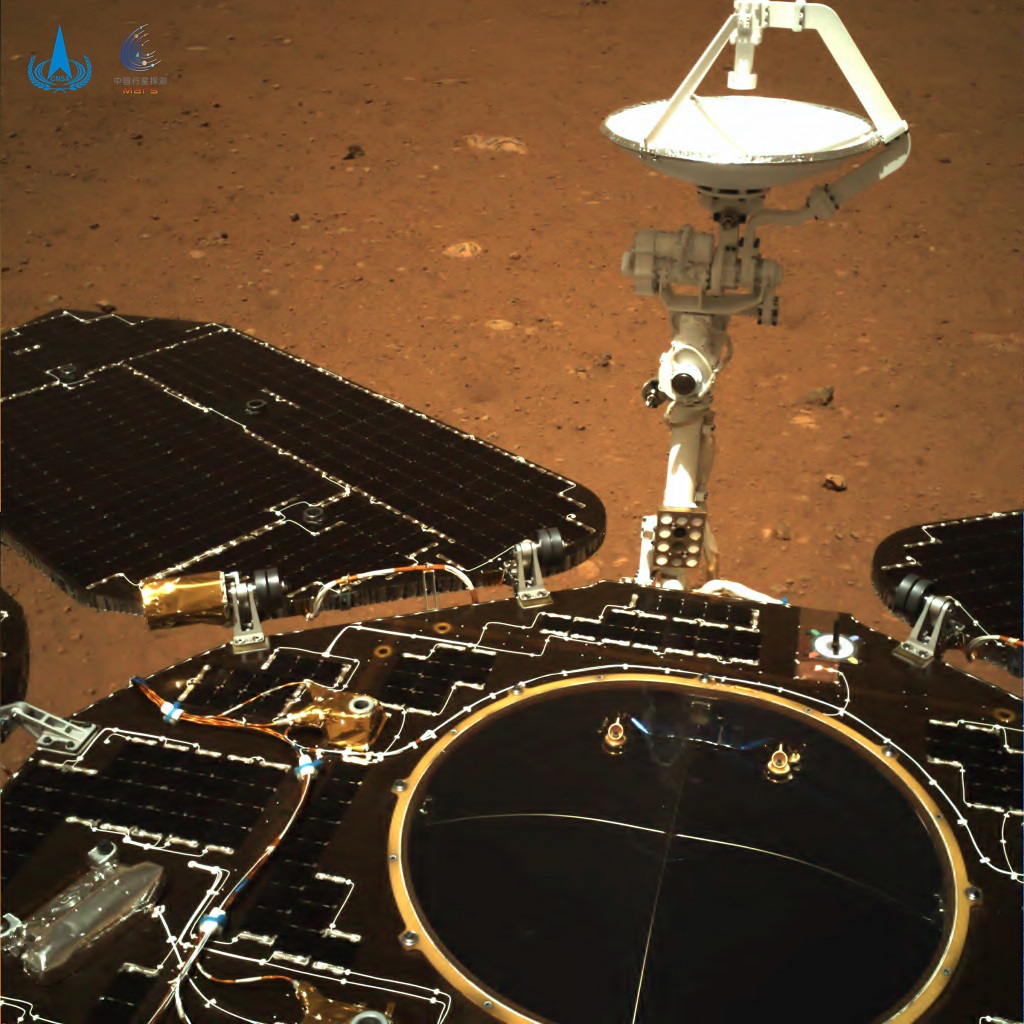
The one-way communication time delay of about 20 minutes between Earth and Mars due to the long distance between the two planets requires the Mars rover to operate and deal with complex problems autonomously since ground control may not be timely.
For instance, it can independently plan the route from one position to another, judge whether it can pass an obstacle, and choose the best way to avoid it, said Jia.
In the case of a sandstorm, Zhurong can decide when to cancel its work and "go to sleep" autonomously and wake up when sunlight is sufficient again.
The Mars rover is a new platform for the mobile exploration of an extraterrestrial object, with many novel technologies applied in spacecraft for the first time, said the designers.
"When designing the Mars rover, we had many rounds of brainstorms to create a powerful and pretty rover that could represent the best level of Chinese space engineers," said Jia.
The artist Su Dabao created a pattern featuring the Chinese character "fire" by combining Chinese calligraphy and seal cutting. The decorative pattern was installed on the "head" of the "god of fire" before it was launched.
(Yang Lu and Chen Gang also contributed to the story. Video reporter: Yang Zhigang. Video editor: Zhu Cong) ■
World Insights: China-Pakistan Economic Corridor bears fruit amid 70th anniversary of ties
by Li Hao, Deng Kaiyin and Jiang Chao
ISLAMABAD, May 20 (Xinhua) -- Since the establishment of their diplomatic relations on May 21, 1951, China and Pakistan have forged an all-weather friendship and conducted all-round cooperation.
As an important pilot project of the China-proposed Belt and Road Initiative and one of the main platforms for deepening bilateral cooperation, the China-Pakistan Economic Corridor (CPEC) has been bearing fruit.
For 32-year-old Zulqarnian Khan, working as a geological engineer in the Suki Kinari hydropower station, only about 10 km away from his home, is what makes him and his family elated.
"My parents are happy. They know I will have a bright future as I can learn lots of advanced techniques from my Chinese colleagues with a handsome income here," he told Xinhua.
Located in Pakistan's northwestern Khyber Pakhtunkhwa province, the 884-megawatt hydropower station is a major CPEC energy project, with construction in full swing.
"Our project currently has around 5,000 Pakistani employees, and over 60 percent of them are from nearby areas of the station," said Deng Siwen, general manager of the project. "Since the start of construction four years ago, I have seen shops and hotels mushroom near our construction site, and many of our Pakistani colleagues began to afford a motorbike for commuting."
Having been working for the project for three years, Khan is joining hands with his Chinese and Pakistani colleagues to smoothly reach each milestone in the construction, including the second-stage river closure achieved in late April.
When starting commercial operation, the project is expected to generate some 3.21 billion kilowatt-hours of clean electricity annually to provide sufficient power supply and further improve Pakistan's energy structure while a number of CPEC power plants under operation have already made great contributions to solving the electricity shortage in the country.
"The CPEC energy projects have added thousands of megawatts of installed capacity to the grid of the country, and the electricity shortage which was there for the last 20-25 years is no more," Mushahid Hussain Syed, chairman of the Pakistani Senate's standing committee on foreign affairs, told Xinhua.
The sufficient energy supply has paved the way for the boom of Pakistan's economic and social activities, enabling the country to embark on a path of clean and green development.
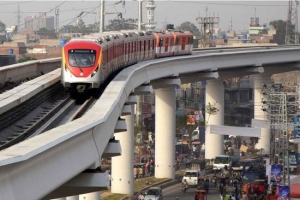
In Pakistan's eastern historic city of Lahore, the launch of the South Asian country's first-ever metro train service last October has provided a modern, comfortable and eco-friendly way of traveling for over 11 million residents in the city.
Adopting the Chinese standard, technology and equipment, the electricity-driven Orange Line metro train under CPEC has become a popular choice among local commuters and is expected to facilitate the traffic and reduce air pollution in the city.
"Earlier, it used to take me an hour via three different kinds of transport to reach my destination and I had to suffer dust since the rickshaw I used to take was open," said Lahore resident Tariq Siddiqui. "Now I am just using this one which takes me only 20 minutes. It's a very good facility for the public."
Meanwhile, CPEC's other transport infrastructure projects including the Karakoram Highway Phase Two and the Sukkur-Multan Motorway "have connected different provinces of Pakistan in a modern and better way, facilitating transportation, trade and people's travel," Syed said.
Facing the Arabian Sea, Gwadar port, one of the pillars of the CPEC, in Pakistan's southwest Balochistan province, has made a series of achievements including the inauguration of liner services, Afghan transit trade and liquefied petroleum gas business, and is sailing towards the dream of becoming a "New Dubai" in Pakistan.
Launched in 2013, the CPEC is a corridor linking Gwadar port with Kashgar in northwest China's Xinjiang Uygur Autonomous Region, which highlights energy, transport and industrial cooperation.
According to the data recently released by the Chinese Embassy in Pakistan, a total of 46 CPEC projects are under construction or have been completed, and the corridor has brought 25.4 billion U.S. dollars in foreign direct investment to Pakistan and created 75,000 jobs for the locals, serving as a focal point for China and Pakistan to drive practical cooperation.
In late April, Pakistani Prime Minister Imran Khan said in a meeting with the country's high-level officials reviewing progress on CPEC that the corridor is a testimony to the time-tested and deep-rooted Pakistan-China friendship.
"After 70 years of development, this iron-clad friendship exists not only between the two governments, but has also become a broad consensus among the two peoples, which is what I feel after working in Pakistan for 13 years," said Deng.
Last year when the COVID-19 epidemic was raging across Pakistan, batches of Chinese engineers and workers took chartered flights back to Pakistan to join their Pakistani counterparts in the CPEC construction, for the common goal of completing the construction on time.
With fruitful achievements, the CPEC has entered a new stage of high-quality development, focusing more on industrial, agricultural and socio-economic cooperation. The Pakistani government plans to develop nine special economic zones across the country under the CPEC to promote its industrialization.
As the first one of its kind being implemented, the Rashakai special economic zone in Khyber Pakhtunkhwa province is pushing forward its construction and inviting investors, along with the building of the first factory invested by a Chinese company in the zone.
"We are inviting investors from all over the world to come and put up industry in those special economic zones. This will help increase our exports, help our economy and give more jobs to our youth," Chairman of Pakistan's CPEC Authority Asim Saleem Bajwa said.
Pakistan also pins high hope on the CPEC and Gwadar port in particular to transform itself into a regional trade hub.
The improvement the CPEC has brought to Pakistan's transport infrastructure and Gwadar port can facilitate trade with Afghanistan and Central Asian countries, which will in turn tap the full potential of the corridor, Badiea Shaukat, an economic consultant, told Xinhua.
Hailing the CPEC as a far-sighted project, Pakistani President Arif Alvi said that the Gwadar port can provide Central Asian countries with ideal access to the sea, which will further strengthen interconnectivity and cooperation for common development of the whole region. Enditem
First freight-train service launched between Greater Bay Area, ASEAN
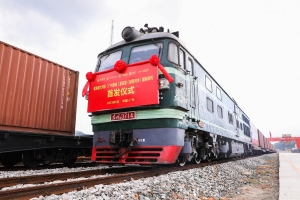
GUANGZHOU, May 25 (Xinhua) -- The Guangdong-Hong Kong-Macao Greater Bay Area launched its first freight-train route to ASEAN countries on Tuesday.
A freight train loaded with goods worth about 94,400 U.S. dollars departed from Guangzhou, capital of south China's Guangdong Province, on Tuesday. The train will take about four days to reach its destination, the Vietnamese capital Hanoi.
Sinotrans Ltd., one of the route's operators, regards the international freight-train service as an important channel to ensure the smooth operation of the global supply chain during the COVID-19 pandemic.
In 2020 alone, the company conducted 1,580 freight-train trips, carrying 157,000 twenty-foot equivalent units (TEU) of goods, with cargo volume up 23 percent, according to Sinotrans.
As the first freight route between the two regions, the new service is also expected to boost the high-quality development of countries and regions along the Belt and Road, the company said. ■
China accelerates construction of integrated big data center
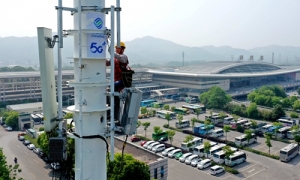
GUIYANG, May 26 (Xinhua) -- China has officially kicked off the construction of computing power hubs for an integrated national big data center as the country seeks to tap the value of massive data resources more efficiently, an official with the country's top economic planner said Wednesday.
China had earlier released a guideline on the relevant construction in eight key regions including the Beijing-Tianjin-Hebei region, the Yangtze River Delta, the Guangdong-Hong Kong-Macao Greater Bay Area, and Guizhou Province.
China aims to promote the distribution of big data centers to regions where renewable energy is abundant and climate and geological conditions are favorable, and strengthen network transmission capacity between national hubs, said Shen Zhulin, with the National Development and Reform Commission, at the opening ceremony of the China International Big Data Industry Expo 2021 held in Guizhou.
"China will build a number of big data industrial clusters at national hubs to accelerate the exploration of energy-saving technologies, energy recovery, and renewable energy utilization in big data centers, and promote green and high-quality development," Shen said.
The construction of a national integrated big data center will become a new base for the development of China's digital economy, and national hubs will become new drivers of economic growth, he added.
The status of data as a national strategic resource has become increasingly prominent in recent years, with the average annual growth rate of data increment in China exceeding 30 percent.
The number of data centers in the country has increased from 1.24 million in 2015 to 5 million in 2020, and China has become one of the countries with the most active and optimal environment for big data applications in the world. Enditem
Chinese-built Lamu Port in Kenya starts operations
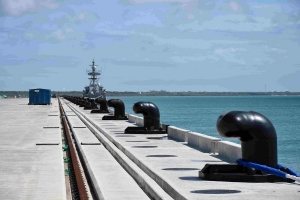
With the arrival of two ships, Kenya's Lamu seaport built by a Chinese firm starts operations Thursday.
LAMU, Kenya, May 21 (Xinhua) -- With the arrival of two ships, Kenya's Lamu seaport built by a Chinese firm starts operations on Thursday.
The ships arrived from Mombasa and Dar-es-Salaam ports and docked at the new harbor, marking a major milestone for the regional Lamu Port-South Sudan-Ethiopia Transport Corridor project (LAPSSET) launched in 2012.
Lamu Port, which is being built by China Communications Construction Company, is part of Kenya's bid to become the major trade hub in East Africa. It can handle large vessels with a carrying capacity ranging from 12,000 to 18,000 twenty-foot equivalent units (TEUs).
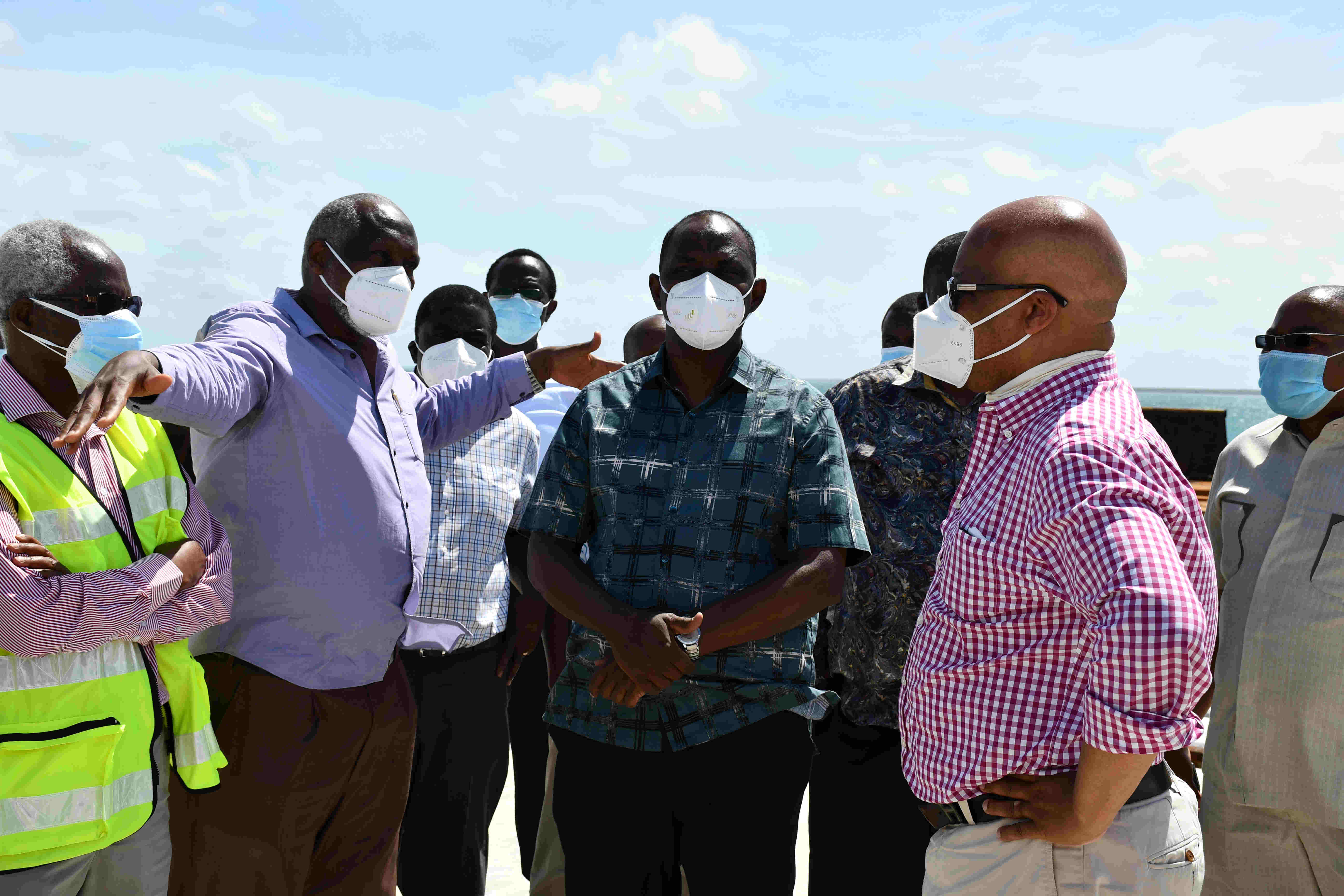
President Uhuru Kenyatta who presided over the operationalization of the first berth of the new deep-water port also witnessed the docking of Maersk-operated MV Cap Carmel and MV Seago Bremerhavel, the first and second vessels to dock at the new port respectively.
He said the new port will position Kenya's economy on the continent and globally, aiding the country's post-COVID recovery.
Kenyatta said the Lamu Port is strategically located at the convergence of major shipping routes, saying its operationalization will open up northern Kenya to international trade, thereby fortifying the country's position as a top economic gateway to Africa.
"With one of the deep-water harbors on the east coast of Africa, Lamu Port has the potential to become a premier transshipment hub for all cargo destined for the continent. Furthermore, Lamu now joins Mombasa Port as a key entry and exit point of cargo, deep into and out of Africa's hinterland," he said.
Kenyatta said Lamu Port reflects Kenya's boldness and clarity of vision as it strives to become a prosperous and newly industrialized, middle-income country by the year 2030.
When completed, the 310 billion shillings (2.86 billion U.S. dollar) port will have 32 berths, 29 of which will be financed by the private sector, making it the largest seaport in Sub-Saharan Africa.
If all the proposed berths are completed, the regional project will include roads, oil, and fiber-optic lines, a 1,500 km railway, an airport, and a refinery, and will require an investment of 23 billion dollars. ■

Powered by  © Μaritimes 2019