


National Fleet Growth: What’s On The Menu?
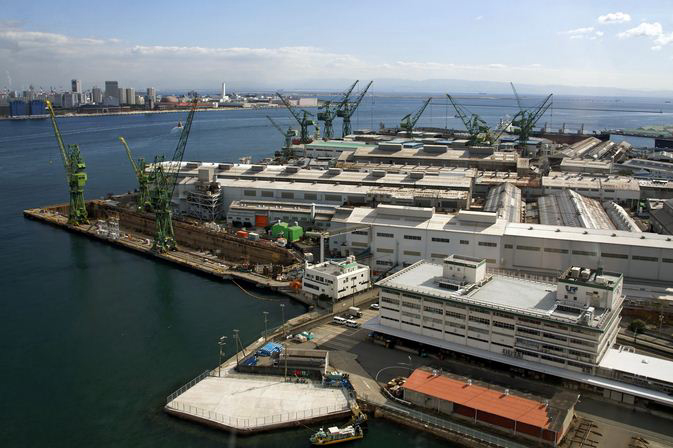
However, the composition of fleet growth has been diverse. Faced with a varied selection of newbuild and secondhand vessels, Greek, Japanese and Chinese owners have each opted for different recipes.
Preparing The Ingredients
 |
Greece-ing The Pan
The Greek owned fleet has grown the most of any owner nation since January 2010, with 90.0m GT of tonnage added, an increase of 59\%. Greek owners have traditionally been the biggest players in the secondhand market, reflected in the composition of recent fleet growth. Since the start of 2010, ‘net purchases’ (total reported secondhand purchases minus secondhand sales) by Greek owners have totalled 33.6m GT, equivalent to 37\% of total fleet growth. However, Greek net purchases fell to less than 2.0m GT in 2016, with deliveries making up a larger share of fleet expansion.
No Need For Seconds
Japanese owners have opted for a very different mix, with much lower overall fleet growth than among Greek or Chinese owners. Japanese owners have taken delivery of 69.4m GT since the start of 2010, while ‘net sales’ have totalled 43.0m GT. As a result, although the Japanese owned fleet grew by 26.6m GT from 2010 to 2012, it has since only increased by 6.0m GT. However, this trend looks set to change, following 429 orders of 21.9m GT by Japanese owners in 2015. This was driven by a sudden increase in orders for large boxships and tankers, predominantly due for delivery in the remainder of 2017 and 2018.
Chinese Owners Still Hungry
Growth in the Chinese owned fleet slowed from 17.6m GT in 2010 to 2.4m GT in 2014, before accelerating again in 2015. The slowdown mirrored a drop in newbuilding activity, following 50.9m GT of deliveries in the period 2010-13. Recently, secondhand activity has been more important, with ‘net purchases’ by Chinese owners reaching 3.4m GT in 2016, the highest total of any owner nation. Bulkers and containership accounted for 66\% and 21\% of total secondhand purchases respectively in GT terms.
So fleet growth has been driven by different blends of activity across nations, with Japanese owners more focussed on newbuildings and Greek owners on secondhand purchases. These trends can impact on the extent of expansion in a owner country’s fleet too, but also illustrate that, for owners, there’s clearly more than once choice available on the menu.
Source: Clarkson Research Services Limited
UGS: Extraordinary General Assembly Meeting of 26 June 2017
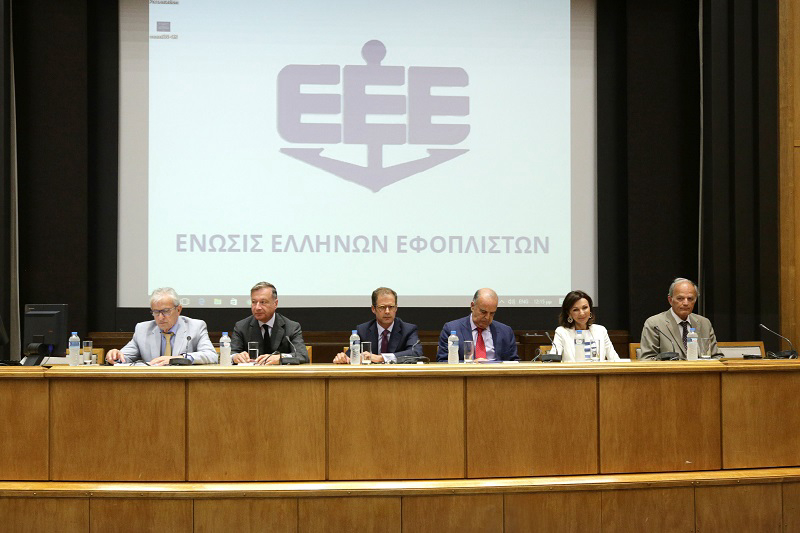
It is recalled that this Memorandum of Understanding was an initiative of the Union of Greek Shipowners, to which the Greek shipping community, in its vast majority, responded positively, demonstrating once again the unity and solidarity of the sector, as well as its desire to support its homeland during difficult times.
In addition, the UGS members were briefed about the course of the negotiations in the pending case of the informal investigation of the Greek shipping institutional framework by the Directorate – General for Competition of the European Commission.
The President, Mr. Theodore Veniamis, expressed the conviction that a mutually acceptable agreement between the Greek state and the European Commission will soon be reached on the issue, which will in any case respect the fundamental principles of the Greek shipping institutional regime of greek-owned shipping and, especially, its constitutional guarantee.
allaboudshipping.co.uk
 |
| l to r: Theodore E. Veniamis, Michael D. Chandris, Antonis P.N. Lemos, Dr. Mattheos D. Los, Melina Travlos and Yiannis Platsidakis |
 |
PPA S.A. Annual General Assembly
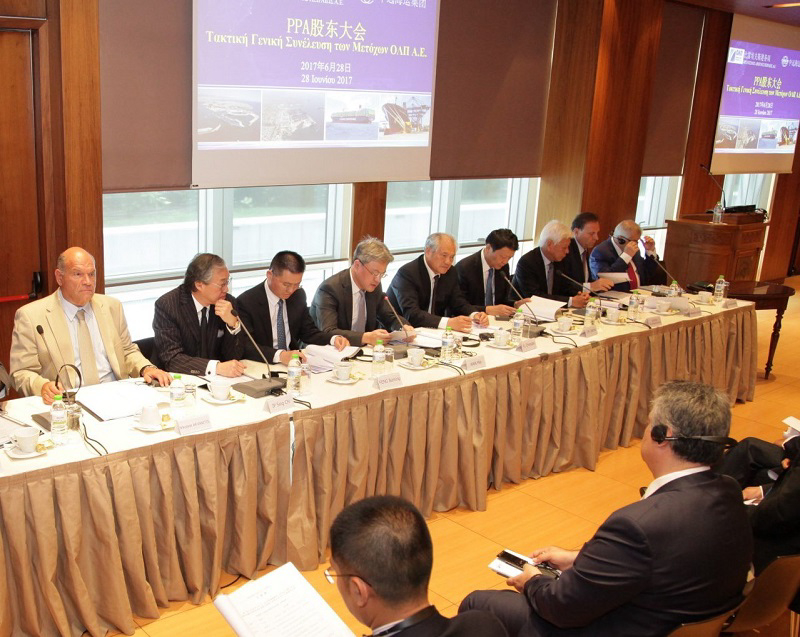
As the Chairman of PPA SA Mr. WAN Min noted during the presentation of the results:
"The year 2016 it is definitely a milestone for PPA SA as 51\% of its shares transferred to COSCO Shipping Group. The turnover amounted to € 103.5 million showing an increase of 3.6\%, the earnings before taxes amounted to € 11.0 million and the net result is improved in almost all of the Company's operations despite the negative economic environment".
As the CEO of PPA SA Capt. Fu stated:
"In 2016, the new PPA Management ensured the smooth transition and reorganization of the Company, preparing the implementation of the Investment Plan. The 2017 is the first year of building and developing the new PPA ".
 |
 |
| (LtoR) Chairman of PPA SA Mr. WAN Min,CEO of PPA SA Capt. Fu |
The role of the Hellenic shipbuilding sector in the LNG era
The event, which took place today at the Conference Hall of PPA, gathered representatives from Hellenic shipyards, project partners and delegates from the marine sector.
 |
Could LNG as fuel choice contribute to the rival of the Hellenic shipbuilding sector? How the Hellenic shipyards could be “LNG ready”? What kind of support could Poseidon Med II offer? These questions were set in the microscope of the event, during of which speakers highlighted Poseidon Med II scope and activities, as well as the under development designs of vessel retrofits and new buildings within Poseidon Med II. The establishment of Revithoussa terminal as LNG hub for the regional supply chain and the Europa Ship Plan, an initiative of the Hellenic Shortsea Shipowners Association, introducing a sustainable financing strategy for the renewal of the Short Sea Shipping fleet, were also presented. Specific emphasis was given to the Poseidon Med II shipyards’ assessment regarding their “readiness” for LNG as fuel era, as well as the role of the professional chambers.
At the event opening, Mr Dimitrios Spyrou, Consultant in PPA’s Strategic Planning & Marketing Department noted: “the adoption of LNG as marine fuel will create fertile ground for sustainable development of the Greek shipbuilding sector and employment opportunities, which are vital for Greece. Piraeus Port Authority’s new floating dock with carrying capacity 80,000 tons and the four existing extensively repaired docks will definitely contribute to this end”.
What is Poseidon Med II project?
Poseidon Med II project is a practical roadmap which aims to bring about the wide adoption of LNG as a safe, environmentally efficient and viable alternative fuel for shipping and help the East Mediterranean marine transportation propel towards a low-carbon future. The project, which is co-funded by the European Union, involves three countries Greece, Italy and Cyprus, six European ports (Piraeus, Patras, Lemesos, Venice, Heraklion, Igoumenitsa) as well as the Revithoussa LNG terminal. The project brings together top experts from the marine, energy and financial sectors to design an integrated LNG value chain and establish a well-functioning and sustainable LNG market.
The American Club Reports Solid Progress In 2016 Despite Challenging Business Climate
 |
Club tonnage had grown substantially during 2016 – P & I entries by 16\% and FD & D business by 19\%. 2017 had also started well in this respect, both tonnage and premium having grown by 6\% over the four months since renewal. It was also encouraging that the business renewed by the Club continued to enjoy a favorable risk profile, with a trailing five-year loss ratio of only 51\%.
The results of the financial year to December 31, 2016 disclosed a small operating loss of just under $2 million. Total premium was up 17\% for the year at $95.3 million, as were net investment income and net realized investment gains which, at just under $7 million, were about 13\% higher than 2015 ($6.2 million). However, losses and other expenses had risen from $83.3 million to $108.5 million, mainly due to two claims of unusual severity during the course of the 2016 policy year. This, combined with a small unrealized loss on investments of $2.9 million, had generated a total Members’ Equity at year-end of $51.4 million, just under $5 million less than it had been at the end of 2015.
Encouragingly, however, the Club’s surpluses had risen substantially as of March 31, 2017, by which time the balance of premium for the 2016 policy year had been fully recognized. The Club’s GAAP surplus had grown over the quarter by 17\% to $60 million, a figure about 9\% above that recorded twelve months earlier. Its statutory surplus also rose by nearly 10\%, to $72.8 million.
Loss development continued to follow the favorable trends of recent years. Claims for 2015 were still at comparatively low levels and had moved the year into respectable surplus. Attritional exposures for the 2016 policy year were developing at a level largely the same as they had been for 2015 at a similar stage. Claims for the 2017 policy year, albeit at a very early point of development, were following the positive emergence of 2015 in particular. Losses within the International Group’s Pool also continued to develop favorably.
The Club’s investments had generated an overall return of some 2.4\% during the period against a blended benchmark of 2.2\%. This was a substantial improvement on the previous year’s return of only 28 basis points. It was a creditable result given the market uncertainties which prevailed during most of 2016.
The Club’s Eagle Ocean Marine fixed premium facility had performed strongly in 2016, and into the early part of 2017. With an aggregate combined ratio of just over 60\%, the facility was making a very healthy contribution to mutual results.
Taking all these circumstances into account, the Club’s Board resolved formally to close the 2014 policy year without call in excess of the original forecast. At the same time, in view of its continuingly positive development, it was decided to reduce the release call margin for the 2015 policy year from 15\% to 10\%.
A highlight of 2016 had been the licensing of American Hellenic Hull by the Cypriot authorities. Fully capitalized and compliant under the Solvency II insurance regulations of the European Union, American Hellenic Hull had made excellent progress to date. Some 1700 vessels are now insured by the new company which continues to gain market share and promises to make a significant contribution to the Club’s business from a variety of perspectives over the years ahead.
On the service front, the Club’s Managers had opened an office in Houston, Texas in July, 2016 in order to extend the Club’s capabilities in the US Gulf and beyond.
In assessing the condition of the Club’s affairs in its centennial year, the Club’s Chairman, Arnold Witte of Donjon Marine Co. Inc., said: “2016 was yet another challenging period for the shipping industry and all those who serve its interests. But it was also a year of achievement for the American Club across a wide spectrum of activity. The Club remains well placed to exploit opportunities in the future. In this special, centennial year, my fellow Directors and I wish to thank the Members, and all those who act on their behalf, for their continuing support as we move into our second century of service to the global maritime community.”
 |
| Joe Hughes, Chairman and CEO of the American Club’s managers, Shipowners Claims Bureau, Inc. |
He concluded: “As we reflect on the American Club’s first century, we will continue to exploit the energy and enthusiasm which have driven its recent progress, fortifying the Club’s prospects for further success over the years ahead.”
 |
| Arnold Witte, Chairman of the American Club, Donjon Marine Co., Inc |
The retirement of Mr. James P. Corcoran, an independent member of the Board, and a former Superintendent of Insurance for the State of New York, was also noted. Mr. Corcoran was thanked most warmly for his outstanding contribution to the Club’s affairs over many years of diligent service.
PPA docks in full operation
 |
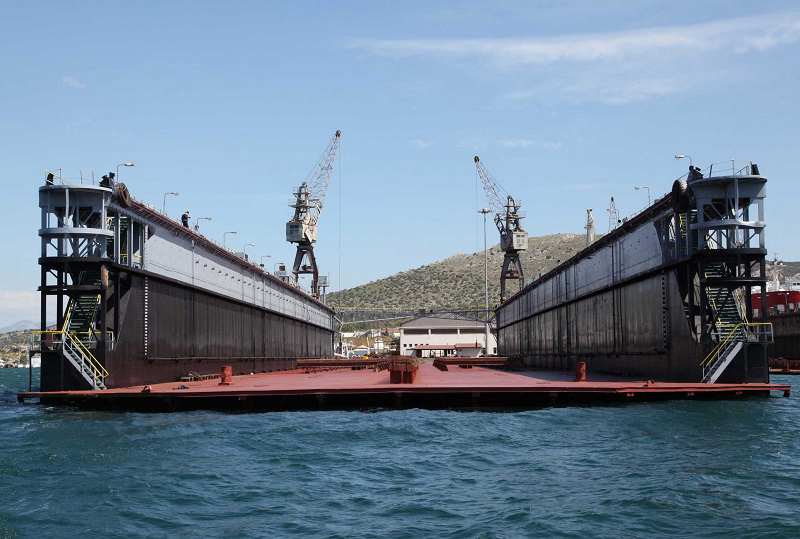
Upon its completion, all four existing docks are in full operation after the extensive maintenance works and all relevant permissions and certifications acquired by the responsible organization Hellenic Register of Shipping.
In addition, in November 2017, a new floating dock is expected to begin operations for ships with carrying capacity of 80,000 tons, length of 240m, inner breadth of 35m, lifting capacity of 22,000 tons and full crane equipment. The new floating dock supplements the existing infrastructure, aiming to attract more ships to the Perama Ship Repair Zone from the wider Mediterranean region and will give a boost to the Perama Ship Repair Zone by creating new working positions.
Brief description of the existing docks with full crane equipment:
• “Piraeus I” floating dock for ships with carrying capacity up to 40,000 tons, 202 m long, 31 m inner breadth and lifting capacity of 15,000 tons.
• “Piraeus II” floating dock for ships with carrying capacity up to 7,000 tons, 113 m long, 18,5 m inner breadth and lifting capacity of 4,000 tons.
• Large dry dock in Akti Vasiliadi for ships with carrying capacity up to 15,000 tons, 150m long and 21m inner breadth.
• Small dry dock in Akti Vasiliadi for ships with carrying capacity up to 3,000 tons, 90 m long and 13, 5 m inner breadth.
For docking places the interested parties should send their requests in writing to the following e-mail address: This email address is being protected from spambots. You need JavaScript enabled to view it., carbon copy to: This email address is being protected from spambots. You need JavaScript enabled to view it.
or by fax to: 210 4060894 and / or 210 4550427.
Telephone numbers for further information and / or clarifications: 210 4550381 and / or 210 4060892.
Honey, I’ve sold the fleet,’ may not work in Greece
 |
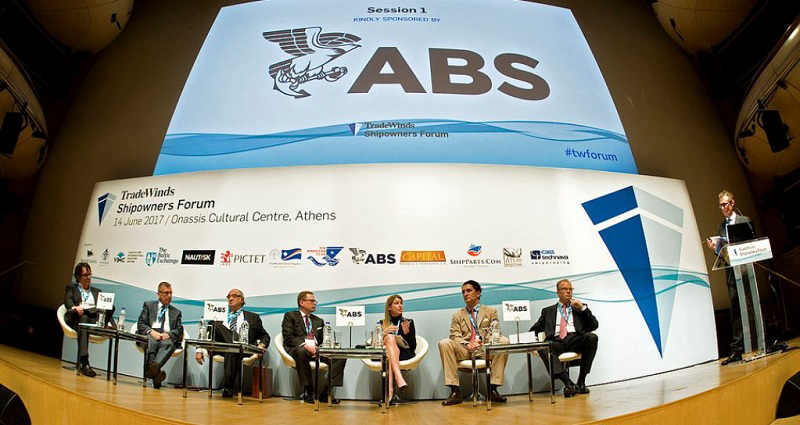
Click here to view the photos from the Forum
Click here to view the coverage in TradeWinds
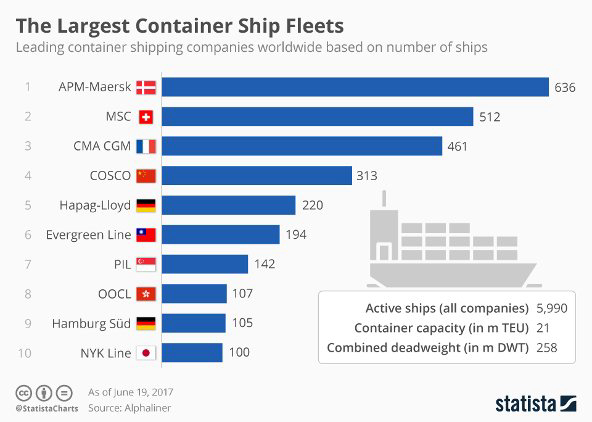
Top 10 Largest Container Ship Fleets
 |
The leaderboard may be changing soon as its been reported by The Wall Street Journal that OOCL is planning to take over Cosco in a $4 billion deal.
There have also been unsubstantiated claims that Taiwanese compatriot Evergreen may be planning a merger with financially troubled Yang Ming.
Industry consolidation has also meant that many of the top 10 companies have been merged and aquired by others on the list, or combined forces to form alliances, in an effort to fight oversupply in the sector and remain profitable.
A merger between Japanese carriers NYK, MOL and K Line is currently trying to set sail for April 1, 2018.
It must first pass anti-trust reviews before the Ocean Network Express (ONE) can be formed and topple Hapag-Lloyd to become the fifth largest company, if no changes to the order book take place by 2021.
Hapag-Lloyd is the latest company to merge after completing a deal with United Arab Shipping Company.
Maersk grew considerably this year after it finalised its purchase of container shipping line Hamburg Süd from the Oetker Group and formed the 2M Alliance with Mediterranean Shipping Company (MSC) and Hyundai Merchant Marine (HMM).
Infographic: Will 2M Defeat Largest Alliance?
Mediterranean Shipping Company (MSC) has also partnered with China Cosco Shipping, Evergreen Line, and Orient Overseas Container Line to form the Ocean Allaince — the largest container shipping allaince in the world.
The total number of active vessels stands at close to 6000 worldwide and can move close to 21 million TEU, according to data provided by Alphaliner.
In 2005, the the top five container shipping companies held around 37\% of the world’s containership fleet.
Drewry recently reported that the same bracket of companies will control a little under 60\% of the world’s containership fleet by 2021.
The consultancy also claimed that the top 10 lines will control 80\% of the fleet by 2021, an increase of 25\% on 2005, while Maersk Line, MSC and CMA CGM will raise the 2005 figure of 26\% to 42\%.
Technical Paper: Liner Shipping in 2025
www.porttechnology.org
Digital Ship announces the maritime cio forum Rotterdam with a special focus on the digital supply chain and logistics market

 |
Digital Ship's 4th Annual Maritime CIO Forum Rotterdam will investigate how we can harness all these opportunities and will debate which are going to stick and make a difference. We will ask how can we identify the real digital legacy in front of us and truly re-define digitalisation in maritime and transport.
This high-level Forum will look at issues in digital transformation and innovation in shipping, and this year – owing to the strategic location of Rotterdam – we will place an additional emphasis on the digital supply chain and logistics market, and integration with maritime transportation.
Sessions will include:
The Maritime Satcom Summit
For the maritime sector, broadband connectivity is becoming an increasing priority as routes diversify and technology advances. End to end connectivity is a requirement from an operational, regulatory and crew perspective to ensure continued efficiency and performance consistency. This session will focus on investigating the evolution of maritime mobility and connectivity.
Special Focus Session - Blockchain and its Impact on the Maritime Industry It is widely anticipated that blockchain is the key to transforming the maritime industry by reducing the complexity of maritime transactions and maintaining security. Whilst the benefits are widely realised, the sector is some way from adopting the technology: there is a continued lack of understanding how to fully deploy it, how to overcome potential liabilities and how to navigate the regulatory landscape.
The Big Data Revolution: Redefining Digitisation in Maritime
This session will focus on the top Big Data trends shaping the maritime industry. It will assess the supply chain as a whole and assess where the adoption of Big Data will have the greatest impact. Although Big Data applications have distinct operational advantages, some fundamental data issues need to be overcome if a Big Data revolution is to be achieved.
Roundtable Discussion Groups
Discuss top challenges in small groups with your peers. Brainstorm some of the cutting-edge issues impacting the industry and work together to develop long term solutions.
Speakers and Panellists will be announced soon.
ABOUT DIGITAL SHIP
For 17 years Digital Ship magazine has provided the digital community of the world's maritime industry with the latest news and developments, including satellite communications, software, navigation and electronics, to help keep shipping operating with maximum safety, efficiency and crew comfort.
CONTACT:
Cathy Hodge, Event Director, Digital Ship
+ 44 7956 965 857 |email: This email address is being protected from spambots. You need JavaScript enabled to view it. | www.thedigitalship.com
Qatar Crisis: The Effect On Shipping
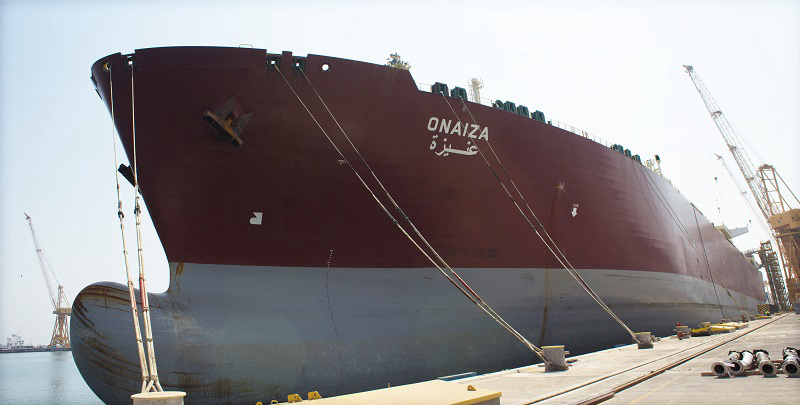
In addition to the severing of diplomatic relations, various bans have been imposed on land, sea and air travel as well as movement of goods into and out of Qatar. There have also been implications for non-diplomatic Qatari nationals in these countries, with the UAE, for example, requiring all Qatari nationals to leave within two weeks.
What we know so far as regards shipping
● Immediate bans were imposed on ports in Saudi Arabia, the UAE and Bahrain accepting Qatari flagged and/or owned vessels. These vessels are also excluded from the territorial waters of Saudi Arabia, the UAE and Bahrain.
● Furthermore, a ban has been imposed in certain ports on vessels of any flag arriving from, or bound for, Qatari ports. Currently, the ban relates only to the last/next port, for example a vessel transiting via a third country such as Kuwait or Oman would not be refused entry. There remains some uncertainty as to whether non-Qatari flagged and/or owned vessels carrying Qatari cargo will be granted entry.
● The UAE seems to have tempered this ban already in Fujairah and it now seems to apply only to Qatari-owned and flagged vessels and to discharge of cargo loaded in Qatar or loading of cargo bound for Qatar. This modification clearly seeks to protect the bunkering business in Fujairah in particular, and recognises that charterers could, in any event, reschedule Qatari loading to take place after bunkering and/or co-loading with other AG cargoes.
● Saudi Arabia has issued a ban on discharging any goods of Qatari origin in its ports.
● Given that Egypt imports a large amount of its LNG from Qatar, less drastic measures have been imposed there. Qatari LNG cargoes have successfully been delivered to Egypt.
● Importantly, the Suez Canal remains open to Qatari-flagged vessels and vessels carrying Qatari cargoes through the canal has continued uninterrupted.
● To date, Qatar and Qatari ports have not declared any reciprocal restriction or ban on any vessel arriving from, or proceeding to, Saudi Arabia, the UAE or Bahrain.
Additional banking and finance restrictions
● In terms of financing and banking-related matters, we are seeing a requirement for enhanced customer due diligence and compliance as regards accounts held by certain designated Qatari banks (namely Qatar National Bank, Qatar Islamic Bank, Qatar International Islamic Bank, Masraf Al Rayan, Barwa Bank and Doha Bank) and nationals. However, this is not a requirement to freeze accounts nor is it a prohibition on doing business with Qatari institutions.
● While there seems to be no formal basis for this, there appears to be a general ban on Qatari riyal transactions.
● There is also a list of 59 prescribed individuals and 12 organisations allegedly involved in terrorism-related activities, and transactions with these organisations and individuals are prohibited.
● Some more general pronouncements have been made, notably in the UAE, where the central bank has asked its commercial banks to assess their exposure to Qatar.
The implications for shipping
● There was a fear that some ports would lose some of their bunkering business to ports outside the region, although for Fujairah this seems to have been addressed by a modification to the ban on vessels going to, or coming from, Qatar.
● There will be implications for crewing and companies may need to make alternative arrangements where crew are joining or leaving vessels that are indirectly arriving from or bound for Qatar.
● While a rise in charterparty disputes might be expected, in practice, owners and charterers are likely to work together to avoid the risk of a ship being refused entry into Saudi, Bahraini and UAE ports by deviating laden ships and calling at intermediate ports, such as Oman, for example to take on board fresh water, before bunkering in Fujairah.
● Shipping companies may have to vary their trading patterns to take into account the inability to trade into and out of Qatar. We have seen container lines suspend services to Qatar and then reinstate them having re-routed through countries that have not taken the same measures such as Oman and Kuwait.
● In relation to Qatari exports – and this applies primarily to LNG and crude exports – it may be necessary for ships to re-route their passage within the AG to avoid the territorial waters of the countries taking these measures but the Strait of Hormuz remains open to Qatari flag and/or owned vessels as things stand.
● Financing documents will now routinely contain sanctions-related provisions. The measures in place at present seem to fall short of what would constitute default or prepayment events under most sanctions provisions as we would expect them to be drafted in the context of cross-border financings
The situation is evolving and changing constantly and a clearer picture will no doubt emerge as to the position beyond the immediate term as the whole situation continues to unfold.
Source: Watson Farley & Williams

Powered by  © Μaritimes 2019