Thursday, April 30, 2026

The Environment Committee (ENVI) of the European Parliament adopted today its report on the revision of the EU Emissions Trading System (ETS).

MEPs agreed on a compromise text for shipping, which puts pressure on the International Maritime Organisation (IMO) to have a system comparable to ETS operating for global shipping as from 2021. If that is not the case, then shipping will be included in the European ETS as from 2023. Part of the revenues generated from ETS will be channeled through a Maritime Climate Fund to improve energy efficiency and invest in innovative technologies for ports and short sea shipping.

“The report ignores and undermines the roadmap that was agreed at IMO end of October”, said ECSA Secretary General Patrick Verhoeven, “We find this very disappointing, but it does not change our resolve to make the IMO roadmap a success. We agree that the shipping sector must further reduce its CO2 emissions with a comparable level of ambition as the rest of the world economy to contribute its fair and proportionate share in meeting the Paris’ climate target. But this can only happen effectively in a global context. Threatening with regional measures under unrealistic deadlines is a very counterproductive move.”

The IMO roadmap has a two-staged approach, with an initial strategy to be decided in 2018, and a final plan to be adopted in 2023, taking into account real emission data that will start to be collected as of 2019. The IMO plan is entirely consistent with the Paris Climate Agreement of 2015. It is a logical follow-up to technical and operational measures taken earlier such as the Energy Efficiency Design Index (EEDI) and Ship Energy Efficiency Management Plan (SEEMP) adopted in 2011 to ensure that ships will be more CO2 efficient in the future.

The ENVI report needs to be confirmed in a plenary vote in the beginning of next year. Negotiations will then start with Member States and the Commission. “We hope the unhelpful position of the ENVI Committee can be overturned in this process”, said Patrick Verhoeven, “The EU should engage in the global dialogue, not undermine it.”

Including shipping in the EU ETS scheme, either directly or indirectly through a European Climate Fund, would not only seriously endanger international progress. It would inevitably also lead to carbon leakage and have negative effects on trade and jobs. The proposed Maritime Climate Fund furthermore raises a host of legal and competition issues. Establishing such a fund will be a contentious and protracted process, taking several years. In the timeframe needed to reach political agreement on such a fund, the IMO will be perfectly able to set its own strategy. Paradoxically however, the threat of a European fund – or any unilateral EU measure – will prevent this.

ECSA

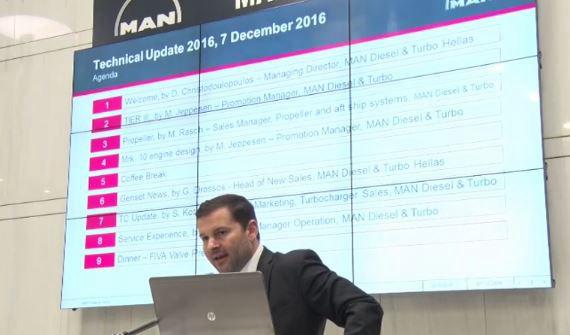
On Wednesday 7 December 2016, MAN Diesel & Turbo Hellas held the “Technical Update 2016” for the Greek Shipping Market in the premises of MAN PrimeServ Academy Piraeus.

More than 90 customers, including Technical Managers and Superintendent Engineers joined the event, which begun in the early evening.

The event commenced with a speech by the Managing Director of MAN Diesel & Turbo Hellas – Mr. Dionissis Christodoulopoulos who welcomed the participants and led them through the happenings of the evening. He informed them about the FIVA Valve demonstration and also referred to eLearning, which is the future of MAN PrimeServ Academies, informing participants that tablets would be available later on for a module on Fuel Specifications.

Presentations by Michael Jeppesen and Morten G. Rasch took place on TIER III, propellers and the Mk. 10 engine design. After a short break, George Drossos, Sephardim Koblenz and Peter Nerenst presented, respectively, Genset news, a Turbocharger update, and Two-Stroke Service Experience.

Attendees actively participated in what was a lively event and posed many questions to the presenters.

The event concluded with a three-course dinner at Piraeus’ PrimeServ Academy during which participants tried the Fuel Specifications eLearning module and intently watched a demonstration of the workings of a FIVA valve.

MAN Diesel & Turbo Hellas looks forward to hosting such events in the near future.

The European Parliament’s Environment Committee voted for the inclusion of the shipping emissions in the EU ETS “in the absence of progress at international level” as from 2023 and the establishment of a maritime climate fund.

Shipping being a global industry and climate change being a global challenge, ESPO strongly believes that IMO is by far the right level to address the issue and to find a solution. In that respect, ESPO believes that the roadmap agreed on at the IMO MEPC meeting last October is a starting point. The IMO needs to rump up its efforts and submit an initial reduction target to the stock-take process of the Paris Agreement in 2018. This should be accompanied by short-term measures. By 2023, IMO should set an emissions reduction target and have the necessary measures to realise this target spelled out.

ESPO believes that a 6-year period gives to IMO enough time to put forward an emissions reduction target and measures to implement it. 2023 must therefore be seen as a milestone. In case this deadline is not met, EU measures will have to be introduced. It should however be clear that in case of an international agreement by 2023, the EU measures are to be repealed.    

The Paris Agreement has sent a strong signal that international cooperation can deliver tremendous results. The IMO is the right place to address shipping emissions. There is already a coalition of the willing in IMO and Europe should increase the pressure on the IMO to step up its efforts and make progress. It is becoming clear that if the IMO will not deliver an emissions reduction target and measures to implement it by 2023, an EU approach seems unavoidable. We therefore hope that the IMO will demonstrate the same level of ambition when addressing climate change as it did on the global air pollution cap agreed last October”, says ESPO’s Secretary General, Isabelle Ryckbost. 

The EU and national climate measures that are currently being developed to implement the Paris Agreement, will oblige ports to reduce the carbon footprint of their land-based activities. These efforts should be accompanied by measures covering emissions generated at sea. The environmental image of the maritime and port sector is at stake.  Besides, ports in Europe are literally on the first row when it comes to facing the consequences of Climate Change[1].

Last October, IMO MEPC 70 agreed on a roadmap towards the development of a comprehensive strategy on the reduction of GHG emissions from ships. 2018 has been set as a milestone for defining an initial IMO strategy. This initial strategy will allow international shipping to take part in the first stock-taking meeting under the Paris Agreement in 2018 where all national reduction targets will be tested whether they are fit for purpose. This initial strategy would subsequently be adjusted based on the analysis of available data, and a revised strategy envisaged for spring 2023 will be finally adopted.

The roadmap does not however make any commitment to setting an initial emissions reduction target as part of the strategy[2].


[1] In advance of IMO MEPC 70 meeting in October 2016, ESPO called on the IMO to deliver progress and take concrete steps so that shipping contributes its share to the global emissions reduction effort.

[2] http://www.imo.org/en/OurWork/Environment/PollutionPrevention/AirPollution/Pages/GHG-Emissions.aspx

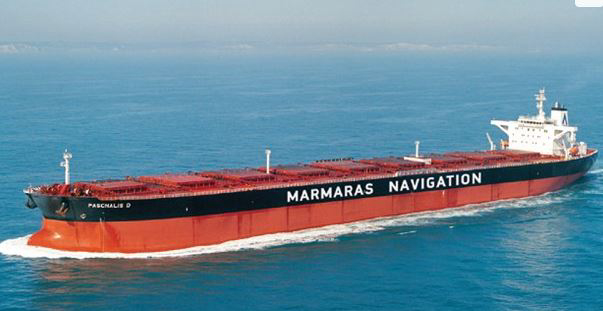
Singapore-based shipping company GC Tankers has sold two very large crude carriers (VLCC), which are being built by China’s shipbuilder Jinhai Heavy Industry, to Greek shipowner Marmaras Navigation, VesselsValue’s data shows. 

The price of the two 320,000 dwt newbuildings was not disclosed.
The market value of each of the two vessels stands at USD 61.64 million, according to VesselsValue.
The two 160,000 gross ton VLCC will feature a length of 333 meters and a width of 60 meters each.
The construction of the newbuilds, Hull 2082 and Hull 2083, will be completed in July and August 2018, respectively.
GC Tankers has another 320,000 VLCC on order at Jinhai shipyard and its construction will be done in March 2017, according to VesselsValue.

The European Parliament adopted today a report on the Regulation establishing a framework for the organisation of port services and financial transparency of ports presented by the rapporteur MEP Knut Fleckenstein.

The proposal was originally put forward in 2013 but stalled due to the European Parliament elections in 2014 and then picked up again by the same rapporteur. It was the subject of intense discussions and long negotiations.

ECSA’s Secretary General Patrick Verhoeven commented: "ECSA has deplored throughout the discussions that this proposal does not address some of the market access problems in ports shipowners face. However, now that after 15 years of discussions we finally have a first EU law on ports, we should build on this and see it as a first step towards a genuine motorways of the sea in which ports are key points."

He added: "Especially for short sea shipping operators, who make frequent port calls and for whom by consequence well performing port services are proportionally extremely important, we call upon the European Commission to take now further efforts to ensure this sector can deliver its potential."

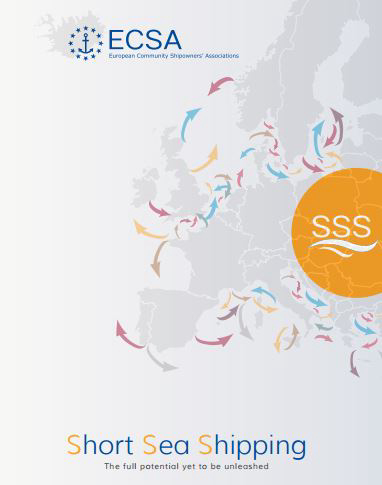
ECSA highlighted its priorities for an EU short sea shipping agenda earlier this year with the adoption of its SSS brochure.

The Council is expected to give soon its green light to the ports regulation proposal and in this way the text will be adopted as EU law.

ECSA

By anyone’s standards 2016 has been a dramatic year for container shipping.

A long forecast wave of consolidation finally happened on an unprecedented scale as a result of a combination of mounting cumulative losses for many, a dramatic collapse in markets from the second half of 2016 and ensuing price war, and smaller players struggled under the huge investments required to be a part of the ultra-large containership age.

The result has been five M&A transactions and the bankruptcy of a Top 10 container line – Hanjin Shipping.

In this white paper Seatrade Maritime News analyses what started out 2016 as the top 20 container lines in turn, and where the future lies for those that survive as we move into 2017. The White Paper splits into six sections -

-       The consolidators - and the lines acquired or merged with

-       The organic growth players

-       A death in the family – Hanjin Shipping

-       The future of the mid-sized container line

-       The wild card

-       What next?

DOWNLOAD HER

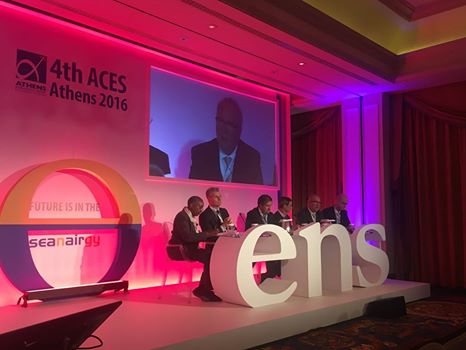
Represented by their Association, cruise ports in the Mediterranean and the adjoining seas were among the keynote guests at the 4th Airport Chief Executives' Symposium that took place in Athens Greece.

Organised by the Athens International Airport this year’s edition of the platform for the exchange of ideas among high-level airport executives was devoted to the search for synergies – or SEAnAIRgies – between airports and cruise ports and their impact on the destinations they serve.

In front of the esteemed representatives from air transport, but also from the tourism, financial, international banking, and public sectors, Mediterranean ports, presented the value that this collaboration might produce for all parties involved and the broader economy.

MedCruise Secretary General Thanos Pallis, delivered a keynote speech presenting those challenges and opportunities that cruise ports in the Med and airports can address together. He also introduced the findings of the MedCruise fact-finding report “Ports Together” that was published earlier this year, examples of existing initiatives aiming to smooth operations and increase the contribution to local communities.

Following a viable discussion and most interesting panels participants recognised the need for the different cruise stakeholders to set up a cruise supply chain approach and so as to together and achieve desirable, and sustainable growth. 

MedCruise Honorary President Stavros Hatzakos, (General Manager, Piraeus Port Authority S.A.) was also on stage, sharing the platform with the CEOs of the airports of Athens, Hamburg, Aeropuertos Españoles, Fraport Regional Airports S.A., as well as Mrs Angela Gittens, Director General, Airports Council International, World, to discuss and the potential impact of several airports & ports synergies on linked destinations.

For MedCruise ports and associate members, cooperation is part of their culture. We work closely with the association of cruise lines, CLIA, and we are already engaged in talks with major airlines. Collaboration with airports is the natural next step. We would like to congratulate the initiative of Airport executives to search for SEAnAIRgies together. Discussion shed light to many local initiatives, and seems that we are all now ready to further actions so as to achieve concrete results” - Thanos Pallis, MedCruise Secretary General.

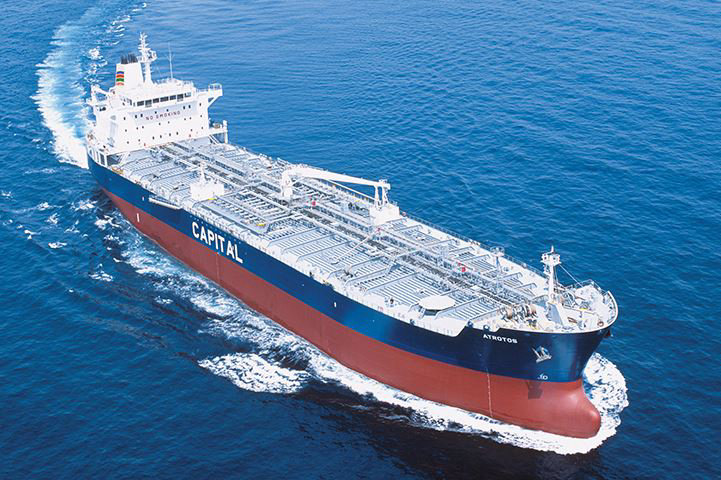
Capital Ship Management Corp. received a Lloyd’s Register Quality Assurance (LRQA) Statement relating to Capital Ship Management Corporation’s environmental performance data within the Corporate Environmental Report for the calendar year 2015.

The assurance engagement covered Capital’s operations of its managed fleet direct emissions from propulsion at sea, in laden condition, for the calendar year 2015 and specifically evaluated the accuracy and reliability of the following selected environmental performance data: Carbon dioxide (CO2), Carbon monoxide (CO), Nitrogen oxides (NOx) and Sulphur oxides (SOx). The verification procedure was based on current best practice, was in accordance with ISAE 3000 and ISAE 3410, using  the principles of AA1000AS (2008) - inclusivity, materiality, responsiveness and reliability of performance data.


About Capital Ship Management Corp.

Capital Ship Management Corp. is a distinguished oceangoing vessel operator, offering comprehensive services in every aspect of ship management, currently operating a fleet of 56 vessels with a total dwt of 5.63 million tons approx. The fleet under management includes the vessels of Nasdaq-listed Capital Product Partners L.P.

Capital Ship Management Envronmental Report 2015 LRS Assurance Statement.pdf 

Capital Ship Management Corp

Indications have emerged that more mergers and acquisitions of shipping companies would be sealed in 2017, just as the cost of operations keep soaring.

Besides, growing level of merger of shipping firms showed that the worth of the container consolidation among the five majors currently estimated at $33.4 billion will soon soar with more agreement coming on stream in the New Year.

A recent Fitch Rating showed that muted demand growth would exacerbate overcapacity for the shipping sector in 2017, putting pressure on freight rates and driving further consolidation and defaults.

Fitch expects performance in all segments to be under pressure and has therefore maintained its negative outlook for the sector.
With the persistent crash in the container shipping business, world biggest shipping companies are losing billion of dollars. While some (including Hanjin Shipping) have liquidated, many more firms are finding solace in mergers.

The consolidation moves will further strengthen the capacity of the shipping firms and allow them to stay afloat in business. However, a number of seafarers will be layed off in the repositioning process.

Meanwhile, tanker shipping will face slightly less stress than dry bulk and container shipping, according to Fitch.Many container shipping and tanker shipping companies had sufficient cash to cover short-term maturities at their most recent reporting date, but they are still reliant on uninterrupted access to bank funding to cover negative free cash flow. This funding is even more critical for companies that are not able to cover their upcoming maturities.

Therefore, the filing for receivership in August by Korea-based Hanjin Shipping, the seventh-largest container shipping company in the world, may have far-reaching ramifications, according to Fitch.

In particular, creditors’ withdrawal of support may indicate a reassessment of the financing landscape, where secured bank funding for new vessels has remained relatively accessible even as market conditions have deteriorated.

Fitch expects more Mergers And Acquisitions (M&A) activity and defaults in the short and medium term. But these will only restore equilibrium and boost freight rates if they prompt capacity reduction.

In container shipping Fitch expects consolidation to affect companies across the entire segment, with smaller operators focusing on survival through increasing scale while market leaders such as Maersk Line defend their market position through M&A.

The latest statistics revealed by Vessle Value tagged: “2016 Container Consolidation” stated that these top five fleets are currently worth $33.4 billion and account for 33 per cent of the entire container fleet.

Senior Analyst at Vessel Value, William Bennett, gave the breakdown as; Moller Maersk AS/ Hamburg SUD has total value of $49.9 billion with 319 vessels holding 9.7 per cent of the total global fleet; China Cosco Holdings Co. is valued $47 billion with 190 vessels and 6.9 per cent market fleet; CMA CGM/APL is valued $46 billion with 150 vessels and six per cent market fleet. Also is Hapag-Lloyd/ UASC/ CSAV worth $5.4 billion with 123 fleets and 5.3 per cent of total fleet; and MOL/NYK Line/ K Line valued at $5.1 billion with 129 vessels and 5.2 per cent of market fleets.

According to the statistics, Maersk has paid roughly $4 billion for Hamburg Süd whose fleet is worth $1.5 billion. The deal is expected to complete end 2017. Entry of Hamburg Süd into the 2M alliance will put the alliance into the lead with 15 per cent of global capacity.

The Chinese state cabinet approved the merger of COSCO and China Shipping back in December of 2015. China COSCO Holdings have the largest fleet on order with 29 ULCVs and 4 post-panamax containerships. The Chinese owned container fleet is the most valuable at $17.6 billion and accounts for around 17 per cent of the market.

The largest acquisition in the French giant’s history, CMA CGM acquired Singaporean company. Recently it was also confirmed that APL would join CMA CGM in the Ocean Alliance which will subsequently represent 14 per cent of global container capacity, second only to the 2M alliance. The acquisition will make the combined fleet the 3rd most valuable in the industry.
Hapag-Lloyd completed their integration of Chilean line CSAV earlier this year. The new merger will bring Hapag-Lloyd’s average age down to 7.8 years from 8.7 years. Hapag-Lloyd and UASC will be the fourth most valuable fleet up from 10th and 8th, respectively.

One of the more recent mergers to be announced is that of MOL, NYK and K Line. Only the container businesses of these companies will merge and the consolidation is expected to be complete by 2018. The most valuable Japanese container fleet is Shoei Kisen valued at USD 3.0 billion and ranked 8th. In comparison, none of the other Japanese entities feature in the top 10 most valuable container fleets. The merger shows that consolidation can be used very effectively in the container industry to create a large footprint with only mid-size lines. The new arrangement makes the merged entity the 5th most valuable at $5.1 billion.
Source: The Nigerian Guardian

Ocean freight rates for cargo moving under contracts on the major East-West trade routes saw a reversal of trend in 4Q 2016, according to Drewry’s Benchmarking Club, a closed user group of 50 multinational retailers and manufacturers who closely monitor their contract freight rates.

The Drewry Benchmarking Club Contract Rate Index, based on average Transpacific and Asia-Europe contract freight rate data provided confidentially by shippers, increased by 3\% in the latest quarter, after having fallen for more than 6 consecutive quarters.

“2017 will be the first year of increasing contract rates since 2010 and this could come as a shock to some logistics managers who had got used to deflationary international transportation costs year after year,” said Philip Damas, head of the logistics practice of Drewry.

Drewry notes the paradox that rates will increase despite shipping over-capacity continuing to be severe in 2017. But factors such as the higher prices of fuel, the previously unsustainable level of rates and the Hanjin bankruptcy are now weighing heavily on pricing.

Some of Drewry’s BCO customers are concerned that the rapid consolidation of the ocean carrier industry – which has moved from the “top 20 global carriers” to a smaller group of “top 14 carriers” – will substantially change the bargaining power of carriers.

However, Drewry’s e-Sourcing Ocean Freight SolutionTM and benchmarking tools have enabled exporters and importers to mitigate increasing ocean transportation costs and carrier financial risks.

Many European importers have received annual carrier bids for contracts effective from January, with higher fixed rates than in 2016.

“We expect that ocean contract negotiations in the next few months – including the transpacific ones in March-April – will be tougher for shippers and also more complex, so exporters and importers need to be equipped with the best data, sourcing technology, practices and market insight,” Damas said. Some of the challenges for exporters and importers will include increased carrier instability, the uncertainty of future alliance services and the impact of big ships on port performance, to name a few.
Source: Drewry

Page 56 of 354

logo

Subscribe to our Newsletter