

-
Home

-
Maritimes NEWS
-
Ports
- maritimes


maritimes
Maritime decarbonization efforts propelled as orders for alternative-fueled vessels grow

The latest stats from DNV’s Alternative Fuels Insight (AFI) platform found that a total of 298 ships with alternative fuel propulsion were ordered in 2023 – an 8% increase year on year. The year also saw methanol go mainstream, with a sharp increase in orders (138), putting it neck and neck with LNG (130). Additionally, 2023 marked a breakout year for ammonia, with 11 orders for vessels run on this fuel, and more in the pipeline.
Faced with increasing pressure to reduce greenhouse gas emissions, including stricter targets set by the International Maritime Organization (IMO) in July 2023, the maritime sector is considering a range of decarbonization options. Through its AFI platform DNV registers the industry’s efforts related to newbuild vessels and retrofitting with 298 orders for vessels able to run on alternative fuels logged in 2023, and a total of 1281 ships overall.
Knut Ørbeck-Nilssen, CEO Maritime at DNV, said: “As we navigate towards a greener maritime future, the growing demand for alternative-fueled vessels speaks volumes. These orders send pivotal signals to fuel providers and other important partners on shipping’s decarbonization journey. While it is clear that the maritime fuel technology transition is already underway, we now need to ensure the fuels powering these engines become available.
“It is however crucial to emphasise that focusing solely on fuels may divert our focus from achieving a significant impact in this decade. What is required are concrete measures that actively lower emissions. Energy efficiency initiatives can yield decarbonization outcomes both now and leading up to 2030.”
By a small margin, methanol proved the most popular alternative fuel choice in 2023 with 138 ships ordered (excluding methanol carriers), a steep increase compared to the 35 ordered to run on this fuel the year before. The dominating segment for this fuel was container ships (106), followed by bulk carriers (13) and car carriers (10).
The second alternative fuel of choice in 2023 was LNG with 130 vessels ordered, down from 222 in 2022. However, when looking at newbuilds alone LNG would be in the lead as a considerable proportion of methanol orders were for retrofits. Last year also saw LNG finally break the 1000 vessel barrier (excluding LNG carriers), showing the fuel's continued importance in the maritime energy transition. In 2023, the containers segment was the most active (48) for LNG, followed by car carriers (40), and tankers (30). The year also saw the first orders for vessels due to run on ammonia (11) come through, whereas with just five orders, hydrogen was a less popular choice compared to the previous year (18).
Martin Wold, Principal Consultant in DNV’s Maritime Advisory business, commented: “Investments in alternative-fueled vessels have been heavily driven by the container and car carrier newbuild boom over the last three years. It remains to be seen if this trend continues into 2024.”
Proven MAN EGR Incentivises Continuous ME-GA Engine Orders

Demand for engine continuously strong since market introduction
Nippon Yusen Kaisha (NYK), the major Japanese shipping company and among the world’s largest owners and operators of LNG carriers, has ordered 4 × 2 × 5G70ME-GA Mk. 10.5 engines in connection with the construction of 4 × 174,000 cbm. LNG carriers. All eight engines will feature MAN Energy Solutions’ proprietary EGRBP (Exhaust Gas Recirculation ByPass) emissions-reduction technology.
Bjarne Foldager, Head of Two-Stroke Business, MAN Energy Solutions, said: “We developed this engine for easy application to most contemporary LNG carrier designs and, indeed, all ME-GA orders to date have been exclusively for this segment. Demand for the engine has been continuously strong since its introduction, especially due to its accompaniment by our self-developed EGR system that comes proven by more than a decade of in-service, operational experience and optimisation.”
Thomas S. Hansen, Head of Promotion and Customer Support, MAN Energy Solutions, said: “We have now logged more than 278 ME-GA engine orders since May 2021. Of these, seven vessels have already entered service with a total of 14 ME-GA engines on board. We have obtained ME-GA engine orders from both Korean and Chinese shipyards, but this is the first order from this prominent owner and we are thankful for NYK’s trust in our product. We have a strong and long-lasting relationship with NYK and are happy to now count it among our ME-GA customers.”
About ME-GA
The MAN B&W ME-GA engine delivers a low CAPEX solution aimed at LNG carriers that are able to use ‘boil-off’ gas as a source of fuel.
Based on the well-proven MAN B&W dual-fuel design with minimal installation requirements, the MAN B&W ME-GA uses an efficient ignition concept and unique gas-admission system that delivers safe and reliable operation.
The ME-GA furthermore features minimal operational costs, simple supply and purging concepts, and low maintenance costs for its fuel-gas supply system. It joins the well-established ME-GI Diesel-cycle engine in MAN Energy Solutions’ two-stroke-engine portfolio, which now offers both low- and high-pressure, dual-fuel solutions for operation on LNG.
About EGR
MAN Energy Solutions’ EGR reduces methane-slip emissions compared to first-generation, Otto-cycle engines without EGR.
EGR enables the significant reduction of methane slip, while simultaneously improving fuel efficiency in both gas and fuel-oil operation. Ultimately, EGR actively reduces emissions and improves efficiency in both Tier II and Tier III.
MAN Energy Solutions’ proprietary EGR system began development more than a decade ago and was applied to a commercial project for the first time in 2013. Initially focused on achieving NOx Tier III compliance, the system has since matured into a robust, engine-tuning tool that today has accumulated orders for more than 278 engines.
2nd LD Writethru: Xi says achievements in China-U.S. relations primarily attributed to collective efforts of two countries' people
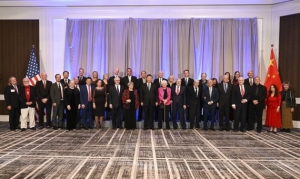
BEIJING, Jan. 10 (Xinhua) -- The achievements in China-U.S. relations are primarily attributable to the collective efforts of the people of the two countries, Chinese President Xi Jinping has said.
Xi made the remarks in his reply on Thursday to a letter from Sarah Lande, a friend of his in the U.S. state of Iowa.
In his letter, Xi said that since the establishment of China-U.S. diplomatic ties 45 years ago, bilateral relations have gone through the tests of winds and rains and grown into a towering tree, bearing the fruit of cooperation and delivering benefits to both countries and the rest of the world.
For China-U.S. relations to advance, he said, it hinges more on the two peoples.
The future of the China-U.S. relationship depends on the youth, Xi said.
Citing a Chinese saying that "Read 10,000 books and travel 10,000 miles," the Chinese president announced that China will invite 50,000 young Americans to China on exchange and study programs in the next five years, voicing hope that more young Americans will visit China, observe China with their own eyes, listen to China with their own ears, and measure China with their own footsteps, so as to have a glimpse of a real China in a multi-dimensional and comprehensive manner and build more bridges of close affinity between the two peoples.
"I welcome the students of Muscatine to participate in this project," Xi said.
Noting that China is the largest developing country and the United States the largest developed country in the world, Xi said the future of this planet needs stability and improvement of China-U.S. relations.
Xi also said China is ready to work with the United States to push for steady, sound and sustainable development of bilateral relations, so as to bring more benefits to the two peoples, provide more public goods for the international society, and build a clean and beautiful world featuring lasting peace, security for all, common prosperity, openness and inclusiveness together.
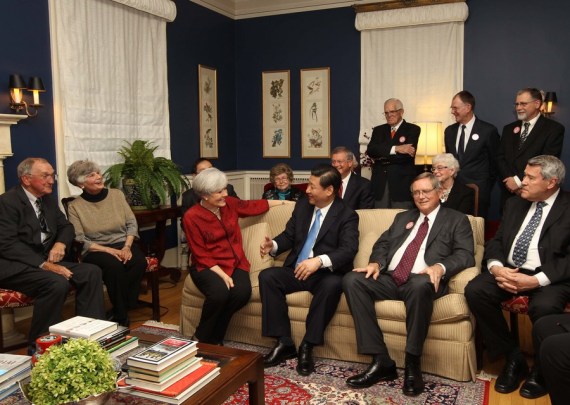
This photo taken on Feb. 15, 2012 depicts then Chinese Vice President Xi Jinping (3rd R, front) joining dozens of ordinary Americans for tea at a local house owned by his old friend Sarah Lande (3rd, L) in Muscatine, a small city in Iowa, the United States. (Xinhua/Lan Hongguang)
Recently, Lande wrote a letter to Xi, saying that Xi's speech in San Francisco at the welcome dinner by friendly organizations in November last year is widely welcomed and inspiring.
Noting that China's project to invite 50,000 young Americans to China on exchange and study programs in the next five years is encouraging, she expressed her hope that Muscatine High School can participate in it.
She said that the United States and China are both major countries and should jointly address issues of common concern including climate change, food security, drugs and regional conflicts so as to contribute to the well-being of humanity. ■
InPics: Highlights of China's thriving logistics sector

BEIJING, Jan. 10 (Xinhua) -- China's logistics sector has produced robust performances in recent times, mirroring warming consumption demand and firmer economic dynamics.
Let's have a look at some of the highlights generated by the country's logistics sector.
-- The courier sector was predicted to see its annual delivery volume reach 132 billion parcels in 2023, up 19.5 percent year on year, according to the State Post Bureau.
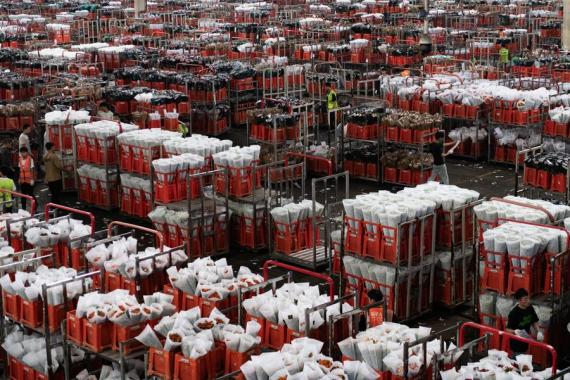
-- On Dec. 4, 2023, a parcel consisting of flowers sent from Kunming to its buyer in Chengdu became China's 120 billionth express mail of the year, setting a new record in terms of its annual express delivery volume.
-- The 120 billion parcels of this period of 2023 amounted to 63 percent of the world's total in 2022, and was 5.5 times, 13.3 times, and 23.5 times that of the United States, Japan and the United Kingdom, respectively.
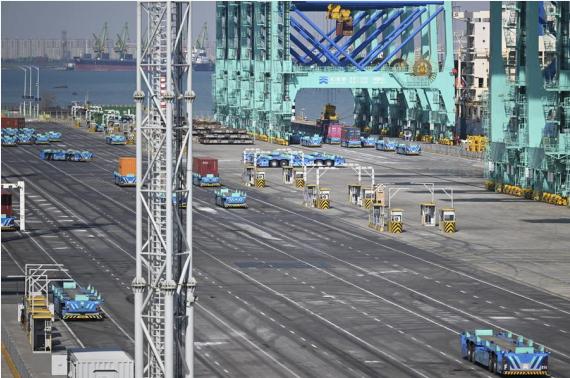
-- On Dec. 8, 2021, China's courier sector reached the landmark of handling 100 billion parcels in one year or less for the first time, and it has since taken increasingly less time every year for the country's parcel volume to surpass the 100 bln mark. This milestone fell on Dec. 1 in 2022 and on Oct. 23 in 2023.
-- China's annual average logistics performance index stood at 51.8 percent in 2023, above the boom-bust line of 50 percent and 3.2 percentage points higher than the previous year, data from the China Federation of Logistics and Purchasing (CFLP) showed.
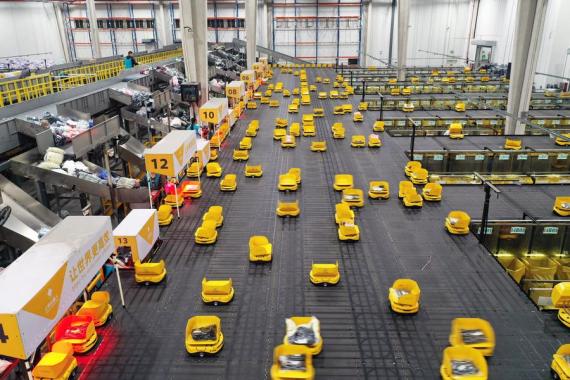
-- The December 2023 index reading grew 0.2 percentage points month on month to reach 53.5 percent, with most of the sub-indices in expansion territory, indicating that this robust trend of the logistics sector is likely to extend into 2024, according to the CFLP.
-- China's e-commerce logistics index averaged 110.1 points in 2023, 4.2 points higher than 2022, and during the annual "Double 11" online shopping spree about 7.51 billion packages were sent across the country from Nov. 1 to 16, 2023, representing 30.9 percent growth year on year.
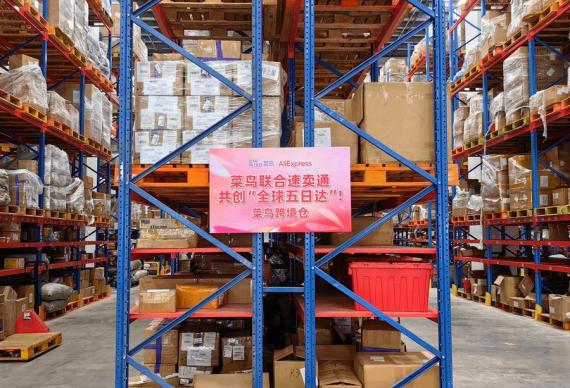
-- The infrastructure that supports China's logistics sector has also been improved. Currently, the country has over 400 express delivery logistics parks, more than 3,000 distribution centers and about 278,000 village-level express delivery stations.

-- Consistent pursuit of innovation is also an important contributor to the booming logistics sector. In November 2023, transport orders related to equipment manufacturing and high-tech manufacturing sustained rapid growth, up by 9.8 percent and 6.2 percent year on year, respectively, data revealed.
-- Green energy-related logistics activity remained considerable as well. In November 2023, logistics demand in the new energy vehicle and solar cell sectors increased sharply, with their growth rates above 35 percent year on year.■
China's top diplomat presents diplomatic goals for 2024
BEIJING, Jan. 9 (Xinhua) -- Chinese Foreign Minister Wang Yi on Tuesday presented China's diplomatic work for 2024, saying that China will always be confident and self-reliant, and fulfill its duties as a responsible major country.
Wang, also a member of the Political Bureau of the Communist Party of China Central Committee, made the remarks when addressing a symposium on the international situation and China's foreign relations in 2023.
Wang said China will give full play to the strategic leading role of head-of-state diplomacy and make every effort to ensure the success of events including the Forum on China-Africa Cooperation, the Boao Forum for Asia, the China International Import Expo and the Forum on Global Action for Shared Development.
China will firmly safeguard its sovereignty, security and development interests, and strive for a favorable external environment for building a new development pattern and achieving high-quality development, Wang said, adding that it will firmly assume its responsibilities on major issues concerning the unity, cooperation and legitimate rights of developing countries and major issues concerning the future and destiny of mankind and the direction of world development.
Wang said China will remain committed to openness and inclusiveness and strengthen and expand the network of global partnerships.
Specifically, Wang said China will implement the consensus reached by the two heads of states of China and the United States in San Francisco, and deepen strategic mutual trust and mutually beneficial cooperation between China and Russia to consolidate their comprehensive strategic partnership of coordination in the new era.
China will increase high-level exchanges and strategic communication with the EU to promote the steady and sustained growth of their relations. The country will continue to increase friendship, mutual trust and convergence of interests with its neighbors, work hand in hand with other developing countries, unite with the BRICS countries, and promote the building of a new type of international relations, he said.
China will also actively implement the Global Civilization Initiative, promote the common values of mankind, promote exchanges and mutual learning among civilizations, and advance mutual understanding and friendship among people of all countries.
Wang said China will always uphold fairness and justice, advocate the building of an equal and orderly multi-polar world, practice genuine multilateralism, promote democracy in international relations, and uphold the equality of all countries.
Calling on all countries to jointly uphold the purposes and principles of the UN Charter, safeguard the universally recognized basic norms governing international relations, and participate in the reform and construction of the global governance system, Wang said China will fully implement the Global Security Initiative, uphold fairness and justice, actively promote peace talks, take a constructive part in resolving the Palestinian-Israeli conflict, the Ukraine crisis and other global and regional hotspots, and provide more public goods conducive to world peace and development.
Wang said China will continue to pursue win-win cooperation and actively promote inclusive economic globalization that benefits all, pledging to firmly oppose all forms of unilateralism, protectionism and anti-globalization, continue to promote trade and investment liberalization and facilitation, strive to solve structural problems hindering the sound development of the world economy, and maintain the stability and smoothness of global industrial chains and supply chains.
China will promote the implementation of the Global Development Initiative, increase its input on global development cooperation, help developing countries improve their capacity for independent development, make globalization more open, inclusive, beneficial to all and balanced.
It will also fully implement the outcomes of the third Belt and Road Forum for International Cooperation, upgrade the quality of cooperation, expand cooperation areas, and continue to provide new opportunities for the world with China's new development, he said. ■
China's top diplomat summarizes six highlights of China's diplomacy in 2023

BEIJING, Jan. 9 (Xinhua) -- Chinese Foreign Minister Wang Yi on Tuesday said the year 2023 has been a year of exploration and harvest for China's diplomacy, summarizing six highlights.
Wang, also a member of the Political Bureau of the Communist Party of China Central Committee, made the remarks when addressing the symposium on the international situation and China's foreign relations in 2023.
He said firstly, China's head-of-state diplomacy has been immensely successful, achieving new milestones in major-country diplomacy with Chinese characteristics.
Secondly, solid progress has been made in building a community with a shared future for mankind, lending new impetus to efforts to build a brighter future for humanity.
Thirdly, the Belt and Road Forum for International Cooperation was successfully held, taking Belt and Road cooperation to a new stage of high-quality development.
Fourthly, the BRICS mechanism achieved a historic expansion, adding new strength to unity and cooperation in the developing world.
Fifthly, a successful China-Central Asia Summit was held, creating a new platform for good-neighbourliness and friendly cooperation in the region.
Sixthly, China facilitated the historic reconciliation between Saudi Arabia and Iran, setting a new example of political settlement of hotspot issues.
The highlights demonstrate distinct Chinese characteristics, style, and ethos, and speak to China's enhanced international influence, stronger capacity to steer new endeavors, and greater moral appeal in the new era, Wang added. ■
Update: China launches new satellite for violent cosmic phenomena observation

XICHANG, Jan. 9 (Xinhua) -- China on Tuesday sent a new astronomical satellite into space to observe mysterious transient phenomena in the universe which flicker like fireworks, trying to reveal more about this violent and little-known side of the cosmos.
The satellite named Einstein Probe (EP), which uses new X-ray detection technology inspired by the functioning of a lobster eye, was launched by a Long March-2C carrier rocket at 3:03 p.m. (Beijing Time) from the Xichang Satellite Launch Center in southwest China's Sichuan Province.
Weighing about 1.45 tonnes and as large as a full-size SUV, the satellite is shaped like a lotus in full bloom and features 12 petals and two stamens.
"This is the most beautiful satellite I've ever seen," said Yuan Weimin, principal investigator of the EP mission and a researcher at the National Astronomical Observatories of the Chinese Academy of Sciences (CAS).
The 12 "petals" are actually 12 modules consisting of wide-field X-ray telescopes (WXT), while the two "stamens" consist of two modules of follow-up X-ray telescopes (FXT).
These telescopes form a space observatory which is aimed at helping scientists capture the first light stemming from supernova explosions, search for and pinpoint X-ray signals accompanying gravitational wave events, and discover dormant black holes and other faint transient and variable celestial objects at the far reaches of the universe.
"Since black holes and gravitational waves are predictions made by Einstein's theory of general relativity, the satellite is named after the great scientist," Yuan said.
VIOLENT UNIVERSE
The starry sky visible to human eyes is quiet and peaceful, but in reality, there are many fierce celestial activities in the universe, such as explosions triggered by the death of supermassive stars, black holes tearing apart and devouring stars, and collisions between bizarre neutron stars and black holes, Yuan said.
Ancient Chinese astronomers recorded a bright supernova explosion in 1054 A.D., and the remnants of this event, the Crab Nebula and a neutron star, were found nearly 1,000 years later by modern astronomers.
"These explosive celestial bodies are also part of our universe, and usually at the critical stage of celestial evolution. We are still unclear about many of their physical properties and processes. Studying them can help us better answer the most fundamental scientific questions, such as what the universe is made up of, what physical laws govern the extreme universe, and how stars evolve and die," Yuan said.
These extraordinary explosions often emit X-rays, which cannot penetrate the Earth's atmosphere. It wasn't until humans had the ability to send probes into space that the hot and energetic side of the universe was unveiled in the X-ray band.
LOBSTER EYES IN SPACE
Only a limited number of such sudden and unpredictable explosive celestial bodies and events, so-called transient sources, have been found in the deep universe beyond our own galaxy. "It's like fishing in a river. We need a very large net, since we don't know where the fish will come from," said Ling Zhixing, a WXT instrument scientist.
WXT on the satellite are the "large nets" used by scientists to capture their "prey" in the universe. The 12 modules can keep an eye on one-twelfth of the entire sky at one glance, according to Ling.
Scientists mimicked the special structure of the lobster eye in developing WXT, which can simultaneously achieve wide-field observation and X-ray focused imaging.
FXT, developed by an international team led by Chinese scientists, feature high sensitivity and are not only suitable for rapid follow-up observation, but also able to independently discover explosive and transient sources, said Chen Yong, a researcher at the Institute of High Energy Physics of the CAS, who is responsible for the development of FXT.
When lobster-eye telescopes receive X-ray signals from a transient source, the onboard computer will process the data in real time and pivot the spacecraft to target the celestial body with FXT. FXT will then conduct high-precision follow-up observation. The two telescopes will complement and cooperate with each other, said Zhang Chen, assistant to the EP mission's principal investigator.
The team also developed CMOS sensors for X-ray observation in space, which is an innovative X-ray astronomical detector, Zhang said.
The mission aims to conduct a high-cadence survey and monitoring of high-energy transient sources, search for cloaked black holes and study their formation and evolution. The probe will also be used to search for X-ray signals accompanying gravitational wave events and to pinpoint them. Neutron stars, white dwarfs, supernovae and gamma-ray bursts are also observation targets of this mission.
"I'm looking forward to discovering new phenomena and celestial bodies that have never been seen before," Yuan said.
The European Space Agency and the Max Planck Institute for Extraterrestrial Physics in Germany are also participating in this mission. ■
China sees robust expansion in new taxpaying business entities
BEIJING, Jan. 9 (Xinhua) -- China recorded a surge in the number of new taxpaying business entities in the first 11 months of 2023, official data showed Tuesday. The data indicates the country's economic vitality.
The country saw 15.15 million newly-registered business entities handling tax-related businesses during the January-November period of 2023, up 25.4 percent year on year, according to the State Taxation Administration.
A breakdown of the data showed that over 4.55 million such business entities, or 30.1 percent of the total, engaged in new industries, new business forms and new models, with the proportion up 2.5 percentage points compared with the same period in 2022, the administration said.
By sectors, the number of new taxpaying business entities in the internet and information technology service sector registered a fast expansion, up 32 percent year on year during the period.
The administration will continue to work to ensure better implementation of the tax and fee reduction policies, amid efforts to support the development of technological innovation and manufacturing industry, said Shen Xinguo, an official with the administration. ■
Interview: China is a key player in global affairs, says expert

The World Economic Forum seeks to rebuild trust by continuously deepening cooperation with China: WEF expert
GENEVA, Jan. 9 (Xinhua) -- "On major issues related to the future of mankind, China's participation is indispensable," said Chen Liming, chair of Greater China of World Economic Forum (WEF).
As the world's second-largest economy, China plays a crucial role in many fields such as global politics, economy, and technological innovation, Chen told Xinhua in a recent interview.
The global governance system is undergoing profound changes, with China playing an increasingly important role in improving the global governance system, he added.
On the theme of "Rebuilding Trust," the 54th Annual Meeting of the WEF will take place at Davos, Switzerland from Jan. 15 to Jan. 19.
The meeting will revolve around such issues as achieving security and cooperation in a divided world, using artificial intelligence for economic and social development, and implementing long-term climate and energy strategies, Chen said.
The WEF looks forward to helping rebuild trust by continuously deepening cooperation with China, he noted.
"Trust promotes cooperation and dialogue achieves win-win results," Chen said, adding that in the face of profound and disruptive transformation currently taking place, it has never been more important to build trust among multiple parties.

This photo taken on Jan. 16, 2023 shows the exterior view of the Congress Center for the World Economic Forum (WEF) Annual Meeting 2023 in Davos, Switzerland. (Xinhua/Lian Yi)
Confronted with climate change, ecological environment deterioration, and artificial intelligence governance, no country or international organization can solve them alone, Chen said.
The forum has established links with political and business circles, academia, and civil society, and gathered strength and support from all parties on the initiatives launched by China for the shared future of the world, he said.
Considering China as a key player in addressing challenges, he said that China's installed capacity of hydropower, wind power, and solar power generation ranks first in the world, and its 14th Five-Year Plan aims to promote low-carbon energy transformation.
The International Monetary Fund has raised its expectations for China's economic growth in 2024 and policies to promote private economic development and encourage foreign investment have been introduced intensively with the belief that China will continue to be the recovery driver of emerging markets, he said.
Chen recalled that when the Chinese delegation attended for the first time the WEF annual meeting in 1979, China's GDP represented about 2 percent of the world's total. "Today, China's GDP accounts for nearly 20 percent of the world."■
Xinhua Headlines-Xi Focus: Xi stresses winning tough, protracted battle against corruption

BEIJING, Jan. 8 (Xinhua) -- Xi Jinping, general secretary of the Communist Party of China (CPC) Central Committee, on Monday called for advancing the Party's self-reform and winning the tough and protracted battle against corruption.
Xi, also Chinese president and chairman of the Central Military Commission, made the remarks while addressing the third plenary session of the 20th CPC Central Commission for Discipline Inspection (CCDI).
After persistent anti-corruption efforts over the past 10 years of the new era, an overwhelming victory has been achieved in the fight against corruption, with the gains fully consolidated, Xi said.
"But the situation remains grave and complex," Xi noted.
"We should be fully aware of new development in the fight against corruption and the breeding grounds and conditions for corruption," Xi said, urging more efforts to win the tough and protracted battle.
Members of the Standing Committee of the Political Bureau of the CPC Central Committee Li Qiang, Zhao Leji, Wang Huning, Cai Qi and Ding Xuexiang attended the meeting.
Li Xi, a member of the Standing Committee of the Political Bureau of the CPC Central Committee and secretary of the CCDI, presided over the meeting.
Xi noted that 2023 marks the first year that the guiding principles of the 20th CPC National Congress are implemented on all fronts.
The CPC Central Committee has unswervingly advanced the Party's self-reform and deepened its efforts to promote full and rigorous Party self-governance, which has guaranteed that the new journey gets off to a good start, he said.
As the world's largest Marxist governing party, the CPC faces the strategic question of how to escape the historical cycle of rise and fall, and how the Party can remain steadfast in its commitment to never change its nature, its conviction, or its character, he said.
Since the 18th CPC National Congress in 2012, in its great endeavor of promoting full and rigorous Party self-governance, the CPC has, based on Comrade Mao Zedong's first answer of "putting the government under the supervision of the people," found a second answer to the question -- advancing the Party's self-reform, he noted.
Over the past 10 years, through the practice and theoretical exploration of exercising full and rigorous Party self-governance, a series of important theoretical results have been accomplished, Xi said, adding that these results theoretically answer the major questions including why the CPC should carry out self-reform, why it is capable of self-reform, and how it can promote self-reform.
Xi pointed out nine important issues to advance the Party's self-reform:
-- the fundamental guarantee is to uphold the centralized, unified leadership of the CPC Central Committee;
-- the fundamental purpose is to guide the great social revolution;
-- the fundamental guidance stands as the Thought on Socialism with Chinese Characteristics for a New Era;
-- the strategic target is to break the historical cycle of rise and fall;
-- the main direction is to tackle the special challenges that a large party like the CPC faces;
-- the effective method is to improve the systems for exercising full and rigorous self-governance;
-- the focus is to forge strong Party organizations and cultivate highly-committed Party members;
-- the key task is to improve Party conduct, enforce Party discipline and fight corruption;
-- the strong impetus is from the integration of self-regulation and oversight from the people.
Xi stressed that, in order to advance the anti-corruption campaign in the new era, continuous efforts should be made to eliminate the breeding grounds and conditions for corruption.
He called for coordinated actions to ensure that officials do not have the audacity, opportunity or desire to become corrupt, as well as persistent efforts to expand the scale and extent of anti-corruption campaigns, and regular and long-term measures to prevent and curb corruption.
Xi underlined the importance of enhancing the Party's centralized, unified leadership in the fight against corruption.
He also stressed the importance of maintaining a tough stance against corruption and said that in the continued grave and complex situation, there is no possibility of stopping, slackening or compromising the anti-corruption campaign.
Combating corruption in the form of collusion between officials and businesspeople should be the priority, Xi said, urging efforts to crack down resolutely on the profit-driven abuse of power and prevent various interest and power groups from infiltrating the political arena.
Xi called for greater efforts to rectify corruption in the finance, state-owned enterprise, energy, medicine and infrastructure project sectors, as well as efforts to punish graft occurring on people's doorsteps.
Deepening reform is necessary to stem the spread of corruption, Xi noted, calling for an integrated early warning and punishment mechanism, and for the strengthened handling of new and disguised forms of corruption.
Underscoring the need to improve the legal system that fights corruption, Xi said national anti-graft legislation should be promoted continuously, and the Supervision Law should be amended in pace with the times. He also called for an education campaign on discipline within the Party.
Xi urged redoubled efforts to tackle and punish acts of bribery, and efforts to retrieve and address the illicit interests gained by those who give bribes.
He urged constant and rigorous efforts to purify the political eco-system, prevent the rules of business dealings from entering into the Party, and persistently rectify misconduct in the selection and appointment of officials.
Efforts should be made to promote a culture of integrity in the new era, carry forward the proud traditions and venerable conduct of the Party, and ignite Party members' lofty ideals and pursuits, Xi noted.
Stressing the importance of fostering strengthened familial ties, values and traditions, Xi urged efforts to ensure leading officials establish good discipline values among their families and relatives.
Noting that discipline inspection and supervision agencies are important forces driving the Party's self-reform, Xi said that these agencies should be loyal, reliable and pure in an absolute manner.
Xi ordered efforts to build a strengthened contingent of disciplinary inspection and supervision cadres, as well as efforts to forge them into an "iron army" that the Party can trust and that can meet the people's expectations.
While presiding over the plenary session, Li Xi said that Xi's speech made strategic plans for the advancement of the fight against corruption, calling for the thorough study and implementation of the spirit of the speech, as well as Xi's important ideas for the Party's self-reform.
Li urged efforts to advance full and rigorous Party self-governance and self-reform to provide a strong guarantee for building a strong country and realizing national rejuvenation on all fronts through a Chinese path to modernization.
The third plenary session of the 20th CPC CCDI opened on Monday. Li delivered a work report on behalf of the CCDI standing committee on Monday afternoon. ■

Powered by  © Μaritimes 2019