
-
Home

-
Maritimes NEWS
-
Ports
- maritimes


maritimes
COVID-19 triggers marked decline in global trade, new data shows

The coronavirus pandemic led to a 3% drop in global trade values in the first quarter of 2020. The downturn is expected to accelerate in the second quarter, according to UNCTAD forecasts, which project a quarter-on-quarter decline of 27%.
• Global trade values fell 3% in the first quarter of 2020
• An estimated quarter-on-quarter decline of 27% is expected in the second quarter
• Commodity prices fell by a record 20% in March, driven by steep drops in oil prices
The coronavirus pandemic cut global trade values by 3% in the first quarter of this year, according to the latest UNCTAD data published in a joint report by 36 international organizations.
The downturn is expected to accelerate in the second quarter, with global trade projected to record a quarter-on-quarter decline of 27%, according to the report by the Committee for the Coordination of Statistical Activities (CCSA).
The report is a product of cooperation between the international statistics community and national statistical offices and systems around the world, coordinated by UNCTAD.
“Everywhere governments are pressed to make post-COVID-19 recovery decisions with long-lasting consequences,” UNCTAD Secretary-General Mukhisa Kituyi said.
“Those decisions should be informed by the best available information and data. I’m proud that UNCTAD has played a central role in bringing so many international organizations together to compile valuable facts and figures to support the response to the pandemic.”
Commodity prices falling too
According to the report, the drop in global trade is accompanied by marked decreases in commodity prices, which have fallen precipitously since December last year.
UNCTAD’s free market commodity price index (FMCPI), which measures the price movements of primary commodities exported by developing economies, lost 1.2% of its value in January, 8.5% in February and a whopping 20.4% in March.
Plummeting fuel prices were the main driver of the steep decline, plunging 33.2% in March, while prices of minerals, ores, metals, food and agricultural raw materials tumbled by less than 4%.
The more than 20% fall in commodity prices in March was a record in the history of the FMCPI. By comparison, during the global financial crisis of 2008, the maximum month-on-month decrease was 18.6%.
At that time, the descent lasted six months. Worryingly, the duration and overall strength of the current downward trend in commodity prices and global trade remain uncertain.
Before the COVID-19 pandemic sent international commerce into a tailspin, global merchandise trade volumes and values were showing modest signs of recovery since late 2019.
Situation changing rapidly
The UNCTAD nowcasts featured in the report incorporate a wide variety of data sources, capturing diverse determinants and indicators of trade, but the situation is changing rapidly.
“In this time of crisis, we are putting out the facts as we know them today. We’ll continue monitoring the global trade landscape as it evolves,” said UNCTAD’s chief statistician, Steve MacFeely.
“I’m delighted the international statistical community could step up, mobilize quickly and publish such a useful and fascinating report. It was a great honour for UNCTAD to lead this endeavour.”
Next, UNCTAD will release a new monthly trade nowcast, which will provide quarterly nowcasts for merchandise trade.
It is also revamping its existing Trade-in-Services bulletin that monitors the latest trends in global trade in services. Future editions will include a nowcast for the latest quarter.
Source: UNCTAD
How green stimulus measures could fuel the decarbonization of shipping

We are in the middle of a global health crisis that will have severe consequences for people around the world. What this pandemic has shown us in such a terrifying way is that we need to rebuild our economies, so they provide us with jobs and a society that is secure, resilient and safe. How can we minimize the harmful effects on the fight against climate change?
We have built our economies – our societies – in a way that too often ignores science and our dependence on the natural world. COVID-19 has infused a renewed confidence in science and appreciation of how vulnerable our economies are at a global level.
People do not want to be back here in another systemic crisis in 10 years’ time – whether the cause is a pandemic, climate change, biodiversity loss or inequality. People want society to be transformed in a way that’s more secure, more resilient – safer. We’re calling it the Great Transformation. What that means is “building back better.” Stimulating sustainable growth – not decline. Stimulating resilience – not vulnerability.
This creates an appreciation that the fight against climate change is an important part of what it means to “build back better” so it will not be a victim of the pandemic outbreak. The climate reports from the UN Intergovernmental Panel on Climate Change still speak their clear language, highlighting “the urgent need for the development of concrete actions that halt the worst effects of climate change.”
Governments around the world have demonstrated the ability to respond decisively to the immediate health and economic consequences of the virus. This represents an encouraging sign that climate change can be tackled by the world community.
As policymakers formulate policies and stimulus measures to kickstart the global economy, they have a unique opportunity to rebuild a better, more sustainable, more resilient economy by taking the long-term impacts of investments on the climate into consideration. Lessons of the coronavirus tell us that there is a need for a resilient and future-proof strategy to shape a sustainable future to avoid another global emergency with destructive and irreversible consequences on human wellbeing.
International shipping is a critical infrastructure sector, yet the industry has been hesitant to call for economic support. It is not possible for the industry to suffer through the greatest drop in trade the world has ever seen while also investing unilaterally in the future of decarbonized shipping. Governments can and must play an important role in incentivizing large-scale demonstration projects required to drive down costs and accelerate the technology development of zero-carbon vessels. Supporting the replacement of domestic vessels with zero-carbon alternatives would be one way to create sustainable jobs, by both reducing domestic emissions and preparing shipyards for future demand for zero-emission deep sea vessels once demand starts picking up post-COVID-19.
Leaders can find inspiration in a study by the Energy Transitions Commission and UMAS for the Getting to Zero Coalition. It looks at the cumulative infrastructure investment that is needed for shipping to make a radical shift to zero-carbon energy sources required to halve the industry’s greenhouse gas emissions by 2050.
Depending on the production method, the infrastructure investment needed between 2030 and 2050 to halve international shipping’s emissions amounts to approximately $1-1.4 trillion, or an average of $50-70 billion annually for 20 years. This amounts to 2.7%-3.7% of the 2018 global investment in energy of $1.85 trillion, which is commensurate with shipping’s use of fuels.
The study also reveals that shipping’s decarbonization to a large extent will take place on land. The biggest share of investment is needed in the land-based infrastructure and production facilities for low-carbon fuels, which make up around 87% of the total. Only 13% of the investment needed is related to the ships themselves.
Public investments targeted at the land-based infrastructure that can boost shipping’s green transition will lead to positive effects that go beyond the maritime industry.
Shipping’s decarbonization has the scale to unlock a global energy transition. The falling costs of zero-carbon energy technologies will make alternative fuels increasingly competitive. The price of costly electrolyzes that are used to turn renewable electricity from wind, sun and water into low-carbon fuels are calculated by McKinsey to fall by six times if only 2.5% of the global fleet convert to these new “electrofuels”.
Shipping’s consumption of fuels is estimated to be around 250-300 million tonnes every year – approximately 4% of the global oil demand. This means that shipping has the potential to increase confidence among suppliers of future fuels and thus be a catalyst that brings scale to the deployment of low-carbon fuels for the broader energy transition, unlocking the market for these fuels across a range of industries and other hard-to-abate sectors.
Shipping’s decarbonization should leave no country behind. Investment in the land-based energy infrastructure could also bring substantial development gains. If shipping becomes a reliable source of demand for low-carbon fuels, it has the potential to drive investment in energy projects in developing and middle-income countries with access to abundant untapped renewable resources. A study by the Environmental Defense Fund Europe estimates that solar panels covering less than 1% of the Sahara Desert would generate enough electricity to produce low carbon fuels to power the entire international shipping fleet.
This is what people are asking for – they have realised that we have built a society on sand and they want it to be built on firmer foundations. Governments are at a crossroads. They have a historic opportunity for a Great Transformation, by building back better from the current crisis and steering the world in a more sustainable direction. The Ambition of the Getting to Zero Coalition resolutely supports this vision: to have commercially viable ZEVs operating along deep sea trade routes by 2030, supported by the necessary infrastructure for scalable zero-carbon energy sources including production, distribution, storage and bunkering.
The big mistake made during the 2008 financial crash was that governments and businesses generally rebuilt back in the same way as before. They didn’t take the opportunity for a Great Transformation, to build back better. Let’s not make that mistake this time. That’s why we need the Great Transformation in the maritime sector right now.
The Getting to Zero Coalition has been endorsed by governments of 14 countries. We invite others to join the conversation about how we can accelerate shipping’s green transition while taking into consideration the technological and economic impact on trade and developing states.
Source: World Economic Forum
Hellas: Shipping Fleet Value Reaches $100.5 Billion
1. Japan
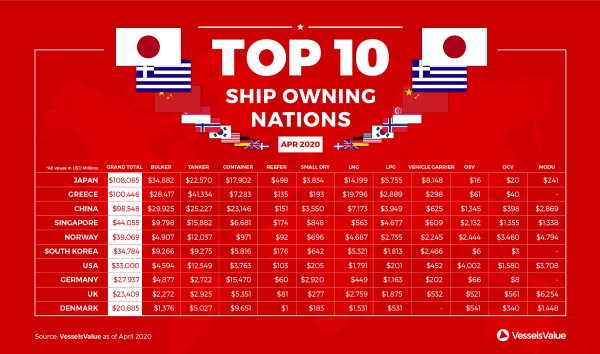
Japan remains the top ship owning nation by fleet value at just over USD 108 Bn, despite seeing USD 9 Bn wiped off from its 2019 total value. This drop has largely been due to the fall in values seen in the Dry Bulk sector, which experienced a mixed 2019 and an even worse start to 2020. Global Dry Bulk demand is generally linked to China, who account for more than two thirds of global iron ore demand. With the demand tailing off, Capesize vessels have been chartered for less than OPEX rates for most of 2020.
2. Greece
The Greek owned fleet value stayed consistent between 2019 and 2020. The total fleet value is now at USD 100.5 Bn. The consistency seen by this fleet value is due to the increase in Tanker values, which experienced a bumper end to 2019. This had much to do with geopolitical instability in the key shipping lane of the Strait of Hormuz, but also with vessels taken out of the fleet to be used as storage gambles on the IMO 2020 fuel spread. This offset the falls seen in Bulker and Container values.
Out of the 320 vessels bought by Greek owned companies in the last year (March 2019 to present), almost half of those are Bulkers. Notorious asset players, it looks as if the Greeks are taking advantage of falling Bulker prices to pick up cheaper than usual assets.
3. China
China round off the top 3, with a fleet value of over double that of fourth placed Singapore. This demonstrates the dominance of the top 3 ship owning nations have over the rest of the market. Chinese owners have seen values rise notably in the Tanker and Container sectors. The Container sector has been expanding rapidly in terms of vessel and fleet size. China has definitely played its part in this, taking delivery of 19 ULCVs in 2019. Chinese owners have taken significant losses in the MODU sector, the Offshore sector suffers the consequences of unpredictable oil prices and a number of lower than market value transactions which have reset values particularly in the Jack Up sector.
4. Singapore
Singaporean owners have seen their fleet value fall marginally to USD 44 Bn. This is particularly due to the exposure to the Bulker and Offshore markets. They are still a long way off the top three owners by fleet value. That said, Singaporean owners have seen a large increase in LPG and Container sectors.
5. Norway
Norway have seen their fleet value drop by almost USD 7 Bn to USD 39 Bn in the last 12 months. This is largely due to the fall in MODU values, particularly Jack Ups. Two of the principle transactions that demonstrate the softening in values were Ex-Dynamic Vision (350 FT, Jan 2013, Keppel FELS), sold for USD 56.00 mil from Dynamic Offshore Drilling to Foresight Drilling on 09/12/2019. VV value day before sale USD 69.52 mil. Ex-Maersk Completer (375 FT, Jul 2007, Jurong), sold for USD 38.00 mil from Maersk Drilling to Shelf Drilling on 17/12/2019, Laid Up SS/DD due. VV value day before sale USD 42.18 mil. The Offshore focused nation will be concerned over the recent oil price volatility and the long term outlook for the offshore drilling sector.
6. South Korea
South Korea have seen their fleet grow in value by USD 0.2 Bn since this time last year. This rise has been seen in the LNG sector, with South Korean companies focusing their efforts on large LNG vessels. Strong exposure to both Tanker and Bulker sectors has meant the two have balanced each other out with their mixed years.
7. United States of America
The USA have seen their fleet value fall by USD 6 Bn to USD 33 Bn, similarly to Norway, they have fallen victim to the falls seen in the Offshore market. Large exposure to the Tanker market has helped offset losses in other sectors.
8. Germany
German financiers have been steadily retreating from the shipping industry, and this is shown in the German fleet value falling between 2019 and 2020. Sticking with tradition, the German owned container fleet is third largest globally at USD 15.4 Bn despite falling by USD 3 Bn in value in the last year.
9. United Kingdom
The UK has seen its fleet contract slightly in value, but not by enough to see it drop out of the top 10. The UK fleet is very diverse, with most of the blame for the loss of value going to the offshore sector.
10. Denmark
The Danish fleet has marginally shrunk, and currently sits at USD 20.8 Bn. Denmark’s largest exposure is to the container industry, which has seen little volatility over the last year which resulted in the minimal change in value.
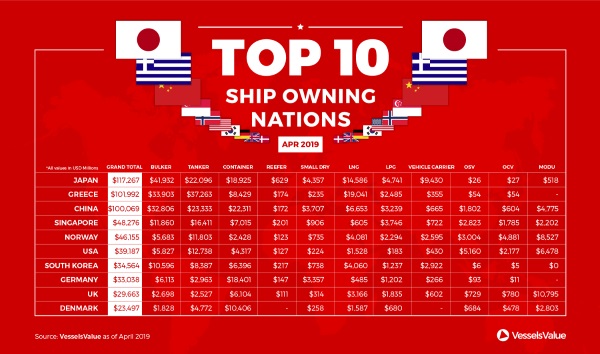
See below 2019 fleet values for comparison.
Source: VesselsValue
Sea Europe welcomes the EUu’s new industrial and SME strategies

SEA Europe – the European Shipyards’ and Maritime Equipment Association – welcomes and supports the European Commission’s New Industrial Strategy for Europe and the SME Strategy for a sustainable and digital Europe, issued in March 2020.
Today, SEA Europe issued a Position Paper on both strategies, welcoming the European Commission’s intention to “provide special focus on sustainable and smart mobility industries” and welcoming the identification of shipbuilding as one of the industries with “the responsibility and the potential to drive the twin transitions, to support Europe’s industrial competitiveness and to improve connectivity”. In this regard, SEA Europe has called upon the European Commission to make shipbuilding and maritime equipment manufacturing (known as the “maritime technology sector”) a priority of the forthcoming Strategies on “Smart and Sustainable Mobility” and on “Offshore Renewable Energy”.
In its position paper, SEA Europe has focused on policy areas, particularly relevant to the maritime technology sector in Europe, notably:
- Trade and competition: The "White Paper on a new instrument to tackle foreign subsidies” is an adequate tool to address the lack of any trade defence instruments in support of Europe’s shipyards. In this respect, SEA Europe reiterates the need for a specific EU instrument to effectively deter foreign unfair trade practices and competitive distortions. This instrument should also tackle access of foreign, state-owned companies to procurement markets and to EU funding. It should, furthermore, apply stricter rules on the use of EU funds, based on criteria of conditionality and reciprocity, with an aim at stimulating shipbuilding-related projects in the EU.
- Upskilling and reskilling: SEA Europe agrees with the need to invest in life-long-learning and strongly supports the promotion of collective action of industry, Member States, social partners and other stakeholders, and calls for a new ‘Pact for Skills’ for the sector.
- Intellectual Property: SEA Europe fully supports reinforcing the fight against IPR-violations and welcomes the announcement of measures to facilitate the knowledge and management of IP for SMEs. This type of measures should especially be considered for strategic sectors with high IP complexity, like shipbuilding and maritime technology. The fight against counterfeited maritime equipment and spare parts should also be reinforced to maximise the protection of maritime safety and the environment.
- Administrative burdens: SEA Europe calls to make urgent progress with an EU system for mutual recognition of ship classification certificates in order to reduce administrative burdens and related certification costs for European maritime equipment companies, without compromising maritime safety.
- Naval: SEA Europe sees the implementation of programs, such as the European Defence Fund (EDF), as an essential element towards the development of European critical capabilities. SEA Europe also looks forward to supporting the preparation of the “new Action Plan on synergies between civil and defence industries” and calls upon the EU to create possibilities for cross-fertilisation between dual-use technologies.
In the words of Christophe Tytgat, Secretary General of SEA Europe “To make the promising measures in the new Industrial and SMEs strategies effective and to tackle the actual challenges of the maritime technology industry properly, these measures need to take into account the particularities and specific needs of shipyards, maritime equipment manufacturers and technology suppliers. Therefore, SEA Europe has called upon the European Commission to have an open dialogue with the sector so as to ensure the adoption of adequate actions that can maximise the promising potential of the maritime technology industry for Europe”.
“In the current challenging times, Europe must do its utmost efforts to provide the maritime technology sector with effective, fast, targeted sectoral solutions aiming at safeguarding Europe’s maritime technology leadership, jobs and knowledge in Europe as well as Europe’s maritime independence”, he added. “Indeed, without any fast actions, the bridge with Asia’s maritime technology sector will further worsen and, ultimately, Europe will lose its remaining shipbuilding segments to Asia, with devastating knock-on effects on its entire supply chain of maritime equipment companies. The loss of the strategic maritime technology sector will make Europe entirely dependent on Asia for the building, repair, retrofitting, maintenance, conversion and equipment of civilian and navy ships, at a time that COVID-19 has clearly shown the big danger of such foreign dependence”, Mr. Tytgat concluded.
SEA Europe represents close to 100% of the European shipbuilding industry in 16 countries, encompassing the production, maintenance, repair and conversion of all types of ships and floating structures, commercial as well as naval, including the full supply chain with the various producers of maritime systems, equipment material, and services.
www.seaeurope.eu
The Bunker Price Differentials grid basis bunker indications of today May 13th:

Please find here below the Bunker Price Differentials grid basis bunker indications of today May 13th:

by:Prime's bunkers plus services
A Bunker Buying Management Service Provider
(as brokers only)
ECSA and ETF request Commissioner Valean for EU coordination on implementing IMO Framework for ensuring safe ship crew changes

ECSA and the European Transport Workers' Federation (ETF) sent a joint letter to the European Commissioner for Transport, requesting her assistance in ensuring EU-wide coordination on implementing the IMO's 'Framework of Protocols for ensuring safe ship crew changes and travel during the coronavirus (COVID-19) pandemic'. The IMO recently published the 12-point Framework of Protocols on 6 May.
In their joint letter, both organisations urge the Commission to actively coordinate Member States' efforts so as to ensure that all the necessary services are put in place:
"Close coordination within the Commission between the different services responsible for maritime, aviation, land transport, health, accommodation facilities (in cases of overnight stays), police and border controls, visa and external affairs is crucial and therefore an action plan to ensure their coordination action is necessary."
The EU is also uniquely placed to lead these efforts and set an example for the other regions of the world to follow. Through its External Action Service and working with Member States' diplomatic missions, the Commission can help establish seafarer corridors between Europe and the other key regions.
The letter also highlighted current barriers to the free travel of maritime transport workers, as not all Member States have declared maritime transport workers as key workers for them to travel internally and cross the border into the EU and be exempt from quarantine rules.
ECSA and the ETF also seek the Commission's help in ensuring that pre-boarding requirements can be carried out in the third countries, including medical tests and visa applications. Third-country seafarers need to be able to obtain Schengen Visas in their home countries. Unfortunately, despite the Commission's guidance of 30 March and 8 April, very few Member States are processing visa applications in third countries, or have adapted their procedures to allow, temporarily, for more visas to be issued at their borders.
"Given the complicated nature of the procedures involved, only with joint efforts of all concerned and strong leadership and coordination can we manage. There is no further time to wait - our efforts are urgently needed for the health and well-being of seafarers," wrote the organisations in the letter.
Click here to download the joint letter by ECSA and the ETF dated 12 May 2020.
LR unveils global team of remote survey champions.

Subject matter experts positioned in key marine and offshore hubs to support the accelerated transition to remote services.
Share this news item
LR has positioned a global team of remote survey champions to support the use of remote surveys within the marine and offshore industries. LR has offered remote survey capability for many years and in recent months, requests for remote services have increased as access to ships and assets in many parts of the world has become more challenging.
The team, comprising dozens of dedicated subject matter experts, are located in key marine and offshore hubs around the world; including Rotterdam, Hamburg, Bremerhaven, Copenhagen, Piraeus, Cadiz, Southampton, Hull, Houston, Miami, Kobe, Yokohama, Guangzhou, Seoul, Dubai and Singapore. The team is charged with delivering complex remote surveying capability to support client requests which not only address the immediate challenges, but also ensure a systematic and repeatable approach for the future of surveillance activities.
LR’s remote services are technology agnostic, and we provide an adaptable process to the specific requirements and preferences of our partners. In addition, LR can also provide the advanced “LR Remote App” for clients who do not have a preferred technology to provide the services. The LR Remote app enables survey requests to be coordinated and channelled to our global surveyor network. The simple to use app allows crew members to livestream and telestrate on video and audio with an LR technical specialist and other relevant parties, such as a flag representative.
“At LR, Remote is about making our people, our expertise and our solutions available remotely as well as physically. Technology is an enabler, but the value continues to be our human expertise and experience. It’s not about relaxing requirements, it’s about adapting and embracing what the digital age empowers us to achieve to provide the equivalence of services remotely. I am so excited to see LR leading the way to keep our clients and the sectors we serve moving,” said James Forsdyke, Marine & Offshore Head of Product Management.
LR Marine & Offshore Director Nick Brown said: “Classification Societies are collectively witnessing accelerated demand for remote surveys, transitioning the way we all provide our services. LR is leading this acceleration through our strengthened remote support, and our dedicated remote survey champions will ensure that our clients work with the people they know and trust as they explore this capability and drive our industry forward.”
Given the increase in demand for remote surveys and the necessity of keeping supply chains operating, LR is actively collaborating with flag states, regulators and other industry partners to drive consistency for remote working practices across the marine and offshore industries to ensure that our services provide a long-term benefit to our clients and the industry.
LR Remote. And Present. from Lloyd's Register Marine on Vimeo.
lr.org
Cruise Terminal Expansion Project (Southern Zone, Phase A)
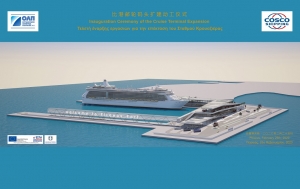
In response to the articles released and refer to supposedly licensing deficiencies in the investment plan implementation of PPA S.A., the Management of the Company, strictly applying the laws of Greece and the EU as well as the provisions for the listed companies, informs about the following:
The Cruise Terminal Expansion Project is a mandatory investment of € 103 million and actually the biggest one provided for in the concession agreement between PPA and the Greek State (Law 4404/2016). This project has obtained all licenses and approvals from all the competent authorities of the Greek State, including the Attica Region, from which this important public infrastructure is co-financed, as well as by the responsible bodies of the European Commission. More specifically, the project is fully environmentally licensed, on the basis of the decisions of the Ministry of Environment & Energy issued in 2013 and 2018. On 25/2/2020, the project inauguration ceremony was held in the presence of the Minister of Shipping & Insular Policy Mr. Ioannis Plakiotakis as representative of the Prime Minister, the Minister of Tourism Mr. Charis Theocharis, the Governor of Attica Mr. Georgios Patoulis and the Mayor of Piraeus Mr. Ioannis Moralis who greeted the project launch and highlighted its importance for the local and national economy. The notification to the competed Authorities followed (Coast Guard, Hydrographic Service, Lighthouse Service) for obtaining the necessary licenses concerning dredge disposal on the basis of the existing environmental licensing. It is noted that for the approval of the Environmental Impact Studies, laboratory tests carried out by the National Technical University of Athens on sediments samples collected from the project area and after being examined, they were described as inactive and non-hazardous materials. In implementation of the environmental licensing of the project, the Coast Guard issued a decision approving the disposal and these sediments as products of the submarine excavations are discarded in a specific sea area that has been determined by the Hellenic Navy.
The works are continuing smoothly with target a part of the project, sufficient for its stability during the winter season, to have been completed before the end of the summer season. The project has an implementation schedule of 32 months.
Based on the above data, Greek citizens and the investor community can build up a clear picture of the legitimacy and progress of the PPA S.A. investment plan.
AHHIC: Positive first quarter of 2020

American Hellenic Hull Insurance Company Ltd (AHHIC) can report a positive first quarter of 2020 in terms of growth and operating performance.
A 206% year-on-year increase of underwriting profit margin and a loss ratio of 64% as AHHIC successfully implements its business continuity plan in response to the Covid-19 pandemic
In early March, AHHIC activated its business continuity plan in response to the coronavirus pandemic. Since then, all company activities have been conducted off-site, with staff working remotely. AHHIC’s utmost priorities are to protect the health and well-being of its employees, combined with maintaining undisrupted its clients’ interests.
At 31 March 2020, the insured fleet stood at 2,637 vessels, showing a year-on-year increase of 15%. At the same time, the company’s gross earned premium for the quarter was increased by 82%.
The underwriting result (earned premium net of reinsurance cost minus claims after reinsurance recoveries) for the three-month period showed a profit margin of 26.1% compared with 15.5% in the first quarter last year. In absolute values the underwriting profit jumped by 206.1% thanks to a significant increase of premium income and the reduction of the loss ratio to 64.4%. All the company’s key performance indicators were improved.
Nearly 50% of company’s assets held in bank accounts and bonds, liquidity ratio increase to 625% provides protection against Covid-19 effects
The company holds 46% of its total balance sheet assets in cash and bond investments. This equates to 1.43 times the company’s premium receivables and 1.38 times open claims (before deduction of reinsurers’ share). The key liquidity ratio (current assets to current liabilities) increased to 625% from 490% at the end of 2019 and from 389% at the end of the first quarter 2019. This means that current assets are sufficient to meet the company’s short-term liabilities by 6.25 times. The company’s cash flow has been significantly strengthened amidst the Covid-19 crisis.
Minimal expected impact on the company’s assets from the Covid-19 pandemic – AHHIC stands ready for any catastrophic event outbreak amidst the Coronavirus pandemic
According to stress tests currently carried out by the company, negative developments in global trade and transportation during the pandemic are not expected to affect AHHIC’s financial status or growth. Some vessels are likely to be laid-up in ports and anchorages worldwide due to the pandemic’s impact on trade and as a result navigation risks and hull and machinery casualties are likely to be diminished.
Under AHHIC’s business continuity and operations plan, which is based on a hybrid structure of remote and cloud servers, the pandemic does not pose any threat to the company’s ongoing preparedness to face even another catastrophic event.
hma.com.cy
Seanergy Maritime Holdings Corp. Announces the Results of its Successful Recent Capital Raising Transactions

May 8, 2020 - Athens, Greece - Seanergy Maritime Holdings Corp. (NASDAQ: SHIP) (“SHIP” or the “Company”) today announced the results of its successful recent capital raising transactions.
In recent weeks, SHIP has undertaken a series of equity raisings beginning with an underwritten public offering which priced on March 31, 2020. Through this capital markets activity, the Company has raised approximately $30 million in gross proceeds. Based on this positive outcome, it is SHIP’s intention to pause its capital markets participation for the near term, although the Company will continue to monitor market activity in the future.
Stamatis Tsantanis, SHIP’s Chairman & Chief Executive Officer, stated:
“We are pleased to announce the successful closing of our most recent registered direct offering, which represents the culmination of our recent capital raising transactions. As a result of strong institutional interest, we raised more than $30 million and have further strengthened our balance sheet. This capital is highly accretive to our net asset value.”
“Our sector is emerging from a period of historical low rates, and as a result of our capital raising program, we believe Seanergy is in a strong position to capitalize on the improving market
fundamentals.”
Following SHIP’s capital markets activity since the end of March, SHIP’s pro-forma capitalization table is as follows:

Powered by  © Μaritimes 2019