


RINA preferred verifier for MRV by Thenamaris
 |
MRV is compulsory and is applicable to ships greater than 5000 GT that undertake one or more commercial voyages (cargo or passengers) into or out of EU ports.
By August 2017, ship owners must submit to their verifier the CO2 Monitoring Plan of each ship of their fleet and from 2018 onwards they will be required to monitor the emissions, fuel consumption and other parameters that will have to be reported and verified on an annual basis.
“We have been working on the performance monitoring of our fleet for several years now and are pleased to cooperate on this important aspect of our operations with RINA. We are happy to speak the same language with the team of experts that RINA Hellas provides next to us,” commented Minas Giaouzis, Technical Manager of Thenamaris.
“It is very important for us to work with top level companies like Thenamaris and Thenamaris LNG on this important task. We have been accredited by ACCREDIA for this activity and we are also a designated operational entity (DOE) accredited by the UNFCCC (United Nations Framework Convention on Climate Change) for the validation and verification of Clean Development Mechanism projects. RINA has all the credentials and the experience to assist the maritime industry in contributing to the global greenhouse gas emissions reduction,” said Spyros Zolotas, Area Manager, RINA Hellas.
Thenamaris (Ships Management) Inc. is a global ship manager of high specification modern ocean-going vessels. The Thenamaris fleet under management currently comprises 75 vessels: oil tankers carrying crude oil and oil products such as gasoline and diesel oil; bulk carriers which transport dry bulk cargoes such as grain, coal and iron ore; and containerships.
Thenamaris operates, maintains, crews and trades its principals’ vessels worldwide, in a safe, efficient and profitable manner. The company ensures consistently high standards throughout its integrated ship management services, covering the commercial, technical, safety and quality, and crewing aspects of managing a diversified portfolio of vessels.
Thenamaris LNG Inc. manages three 160,000 cbm LNG carriers and two 38,000 cbm LPG carriers.
RINA Services S.p.A. is the RINA company active in classification, certification, inspection and testing services.
RINA is a multi-national Group which delivers verification, certification, conformity assessment, marine classification, environmental enhancement, product testing, site supervision & vendor inspection, training and engineering consultancy across a wide range of industries and services. RINA operates through a network of companies covering Energy, Marine, Infrastructure & Construction, Transport & Logistics, Food & Agriculture, Environment & Sustainability, Finance & Public Institutions and Business Governance. With a turnover of over 450 million Euros in 2016, about 3,700 employees and 170 offices in 65 countries worldwide, RINA is recognised as an authoritative member of key international organizations and an important contributor to the development of new legislative standards.
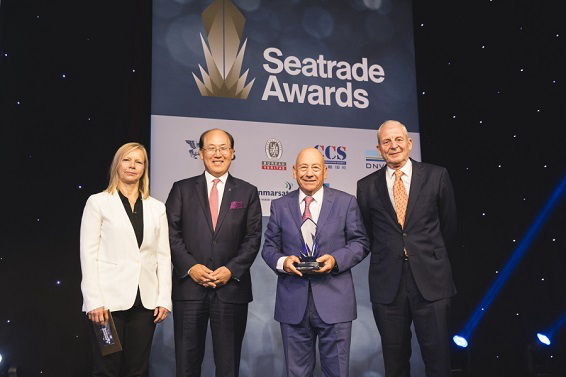
George Procopiou receives the Seatrade Lifetime Achievement Award
 |
The ceremony took place at the historic Grosvenor House on Park Lane with a new format for the presentation ceremony which drew attendance from over 300 of the maritime industry’s leading personalities. The afternoon was hosted by editor of Seatrade Maritime Review, Robert Jaques, in the presence of the guest of honour, Kitack Lim, IMO secretary-general.
Chris Hayman, chairman of Seatrade welcomed guests and made mention of the three new Intelligent Shipping Awards that have been introduced for 2017 whilst commenting that the three major Awards, for safety, clean shipping and investment in people, ‘of course remain in place, and I believe they always will’.
Hayman also told the crowded room that ‘we are, as always, indebted to the Chairmen and Directors of the seven major international associations, and their assessors, for the work they do as judges and the unique industry experience they bring to the judging process.’
Other key industry names receiving awards included:
A.P. Moller-Maersk, collected by Angus Frew, secretary-general and ceo of Bimco, received the Global Performer Award
Christian Oldendorff and Nikolaus Oldendorff, owners, Reederei Nord, were joint recipients of the Young Person of the Year Award
Paddy Rodgers, ceo of Euronav, received the Personality of the Year Award
The awards, in time old tradition, remain a secret until the presentation ceremony and the winners are unveiled to great fanfare and celebration.
A full list of the deserving Seatrade Award winners can be found below:
1. Safety at Sea
Sponsor: Lloyd’s Register
Announcer: Gwynn Lewis, Head of Data, Digital and Software, Lloyd’s Register
Recipient: Reflex Marine
Sandra Antonovic, chief operating officer, Reflex Marine
2. Clean Shipping
Sponsor: UK Ship Register
Announcer: Doug Barrow, director, UK Ship Register
Recipient: ClassNK
Mitsuhiko Kidogawa, regional manager, Europe and Africa, ClassNK
3. Investment in People
Sponsor: Inmarsat
Announcer: Drew Brandy, senior vice president, market strategy, Inmarsat
Recipient: American Steamship Owners Mutual Protection and Indemnity Association and IDESS Interactive Technologies, USA, for ‘The American Club e-Learning System’
William Moore, Senior Vice President, Shipowners Claims Bureau and Manager, American Steamship Owners Mutual Protection & Indemnity Association and Captain Robert Rayner, President, IDESS Interactive Technologies
4. Digital Technology Award
Sponsor: China Classification Society
Announcer: Zhang Hui, director, European Regional Centre, China Classification Society
Recipient: Inmarsat
Drew Brandy, senior vice president, Market Strategy, Inmarsat
5. Cyber Security Award
Sponsor: DP World
Announcer: Dirk Van den Bosch, regional commercial director, Europe and Russia, DP World
Recipient: ASPIDA
Panos G. Moraitis, ceo, ASPIDA
6. Fuel Efficiency Award
Announcer: Mary Bond, managing director, publishing and content, Seatrade
Recipient: STX France and Royal Caribbean
Arnaud Jacques, energy efficiency manager Harmony Class, STX France and Simon Zielonka, director, RCCL Marine Operation, UK Operations
7. Corporate Social Responsibility Award
Announcer: Tom Boardley, chairman, The Mission to Seafarers and Barry Bryant, Director General, Commodore, Seafarers UK
Recipient: Pacific Basin
Mr Morten Ingebrigsten, director, Asset Management, Pacific Basin
8. Deal of the Year
Announcer: Andrew Williams, general manager, Seatrade
Recipient: PAO Sovcomflot
Nikolay Kolesnikov, executive vice president and chief financial officer, Sovcomflot and Alexander Verbo, director, finance department and group treasury, Sovcomflot
9. Global Performer 2017
Sponsor: DNV GL
Announcer: Knut Ørbeck-Nilssen, ceo Maritime, DNV GL
Recipient: A.P Moller-Maersk
Accepted on behalf of A.P. Moller-Maersk by Angus Frew, secretary-general and ceo, Bimco
10. Young Person of the Year 2017
Announcer: Professor Costas Th. Grammenos CBE, chairman, Costas Grammenos Centre for Shipping, Trade & Finance, Cass Business School
Recipient: Christian and Nikolaus Oldendorff, owners, Reederei Nord
11. Personality of the Year 2017
Announcer: Kitack Lim, secretary-general, International Maritime Organization (IMO)
Recipient: Paddy Rodgers, ceo, Euronav
12. Lifetime Achievement Award 2017
Sponsor: ABS
Announcer: Dr Kirsi Tikka, vice president, Global Marine, ABS
Recipient: George J. Procopiou, founder of Sea Tankers, Dynacom Tankers Management and Dynagas
Posted 30 June 2017
http://www.seatrade-maritime.com
Building British-Greek maritime ties

 |
Ambassador Kate Smith CMG said:
“London remains the global centre for the maritime services industry, supporting Greek shipping all over the world.”
Recently appointed Maritime London chief executive Jos Standerwick said:
“This was a highly successful event which not only provided the attendees with an insight into a range of topics including the freight markets, sources of finance, future fuel technologies, arbitration and insurance, but crucially helped to reassure the community that a post-Brexit Britain remains very much open for Greek shipping business.”
The event was sponsored by the Baltic Exchange and Lloyd’s Register and featured presentations from UK Ship Register, Braemar ACM Shipbroking, Watson Farley & Williams, London Stock Exchange, Citigroup, London Maritime Arbitrators Assoc, Lloyd’s Register, IMarEST, BMT Smart and Aspida.
The UK government was represented by Rt Hon John Hayes, CBE MP, Minister of State for Transport who opened the Forum along with his Greek counterpart, Mr Panagiotis Kouroumplis, Minister for Shipping and Insular Policy.
maritimelondon.com
Ballast water treatment – SunRui becomes first Asian manufacturer to win USCG type approval
 |
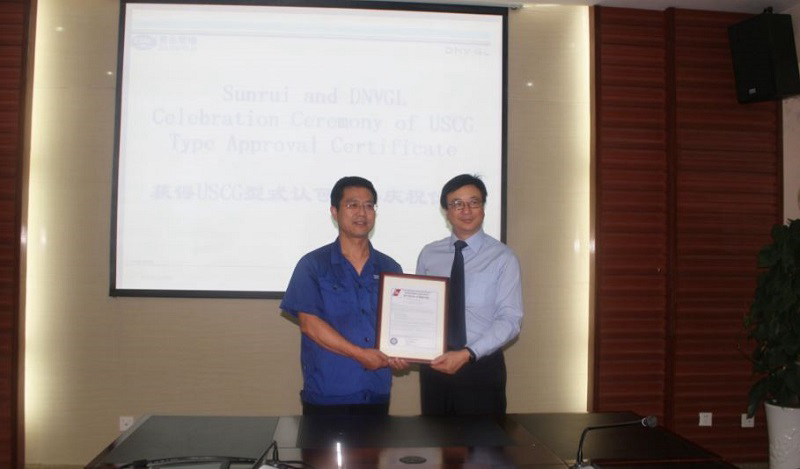
| Mr. Fu Hongtian General Manager of Sunrui (left) and Vincent Li, DNV GL’s Regional Business Development Manager for Greater China. |
Its BalClor® system treats ballast water in three steps: Filtration, seawater electro-chlorination for disinfection and neutralization. The company is the first Asian manufacturer to be awarded the USCG type approval certificate for BWTS. As one of five independent laboratories accredited by USCG, DNV GL worked with SunRui on the testing of its BWTS.
"We would like to thank DNV GL for its continuous support and assistance. Obtaining the type approval has been a long and rigorous process and we appreciate DNV GL’s professionalism and precision during this project," said Mr. Fu Hongtian, General Manager of SunRui. "After winning the IMO type approval issued by DNV GL and the USCG type approval, we will continue to invest in developing equipment for preventing marine and air pollution, with DNV GL as our classification partner. At the beginning of this year, we already applied for the type approval of a selective catalytic reduction system (SCR) to remove nitrogen oxide emissions (NOx), and we will invite DNV GL to witness emission tests soon. Meanwhile, we are also working on a scrubber to clean sulphur oxide emissions (SOx) from ship emissions and we will apply for DNV GL approval for this project in the near future.”
“We would like to congratulate SunRui on this great achievement. We are very pleased that the company chose us as a partner in applying for the IMO and US Coast guard type approval,” says Vincent Li Ping Kwong, Business Development Manager Greater China at DNV GL – Maritime. “The process has taken around three years and during this time, we were very impressed with SunRui’s commitment to making sure that their ballast water treatment system complied with the highest safety and quality standards. This was a great collaboration and we look forward to continuing this productive relationship with SunRui,” he adds.
“DNV GL and its associated sub-laboratories DHI Denmark, NIVA (Norway), Golden Bear Facility (USA) and DHI Singapore have been deep into the details of USCG testing for three years and have gained a great deal of experience in what is practical and possible to achieve in complying with the regulation,” says Martin Olofsson, Senior Principal Engineer, Environmental Protection at DNV GL – Maritime. There are now five “Independent Laboratory” accreditations for BWTS. Of 45 BWTS manufacturers who have signed a letter of intent for having their systems approved by the USCG, DNV GL is currently handling 25, making it the largest independent provider of laboratory services.
Including SunRui, only four manufacturers have been awarded a USCG type approval certificate, and all of these were submitted by DNV GL. Ballast water treatment systems must pass through an extremely stringent testing regime in order to obtain USCG type approval, including function tests, environmental tests, and land-based and shipboard testing. Manufacturers must make a significant commitment to achieving approval, as the whole process can take more than two years to complete.
About electrolytic BWTS
Electrolytic treatment systems have a market share of around 35 per cent, the second most commonly used system. Many of these systems also use a filter as a pretreatment. By passing an electric current through a small side-stream of seawater, they use the salt and the water molecules in a chemical reaction to generate sodium hypochlorite, a disinfectant, which is then reinjected into the ballast water to kill all organisms. Electrolytic treatment systems are well suited for use in larger vessels, such as tankers and bulk carriers, which have large ballast water volumes and high flow rates in the range of up to 8,000 cubic metres per hour.
About SunRui
SunRui Marine Environment Engineering Company Ltd (hereinafter referred to as SunRui) is a wholly owned subsidiary company of China Shipbuilding Industry Company Limited (CSIC). SunRui is a high-tech integrated engineering company built up in 2003, engaged in research, design, manufacture, engineering, test and project contracting of marine environment corrosion control and water treatment.
SunRui is becoming the leader of the field of marine environment engineering, makes contributions to blue economy, marine environmental protection and marine power strategy, with driving force of science and technology innovation, providing customers with comprehensive solutions, insisting on internationalization strategy, leading rapid development of industry and centered around resource saving and environmental protection.
About DNV GL
Driven by our purpose of safeguarding life, property and the environment, DNV GL enables organizations to advance the safety and sustainability of their business. We provide classification, technical assurance, software and independent expert advisory services to the maritime, oil & gas and energy industries. We also provide certification services to customers across a wide range of industries. Operating in more than 100 countries, our professionals are dedicated to helping our customers make the world safer, smarter and greener.
About DNV GL – Maritime
DNV GL is the world’s leading classification society and a recognized advisor for the maritime industry. We enhance safety, quality, energy efficiency and environmental performance of the global shipping industry – across all vessel types and offshore structures. We invest heavily in research and development to find solutions, together with the industry, that address strategic, operational or regulatory challenges. For more information visit www.dnvgl.com/maritime
Visit of the Athens Stock Exchange Management to PPA
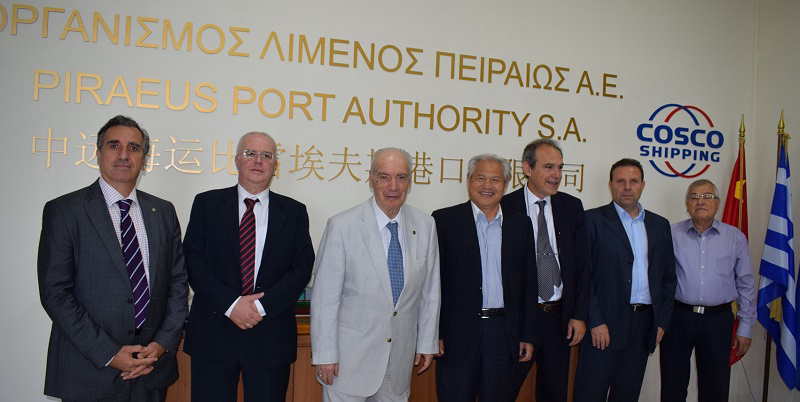
the Chief Operating Officer Mr. Dimitris Karaiskakis and the Deputy Chief Operating Officer Mr. Nikos Porphiris, visited the PPA SA headquarters and had an informational meeting with the CEO Capt. Fu Chengqiu, the Executive Management Consultants & BoD Members Mr. Athanasios Liagkos, Mr. Ioannis Kouvaris in the presence of executives from both companies.
During the meeting, constructive exchanges of views took place and were presented the opportunities and possibilities arising by the participation of PPA SA in the Athens Stock Exchange as well as the importance of further development of the company as an example of attracting investment funds in Greece.
It followed a tour at the Piraeus port facilities and discussion about the great development prospects and the progress of the company's investment plan.
 |
Who pays the damage for BDI’s volatily?
Geopoliticaly more mess is coming as more dangers loom in the background with respect Peace, Safety and Security.John Faraclas brief recap:
The Capers gained 104 points and now the BCI 2014 reads 1,170 points… Wonder if it can retain this upwards momentum…
The Panamaxes lost one points and the BPI now stands at 1,150 points; caution!
The Supras clinched four points and the BSI now stands at 761 points.
The Handies gained just one point; the BHSI@549 looks healthy in comparison with the other dry indices and might continue…
The Wets once again with mixed feelings; the last published BDTI (Dirties) and BCTI (Cleans) stoo at 671 – minus ten, and 570 – plus six points respectively.
The WTI as close to US$ 44 is interesting how it makes waves… for the benefit of the poor; tomorrow though it is another day!
The Geopolitcs continue to be simply dodgy and great caution should be observed. The tensions are too many all over Planet Ocean and wonder how many simultaneous “explosions” might take place… We have created a very dangerous environment which is very difficult to live in. The cyber attacks are despicable and wonder if Maersk will be able to find out who did it; it is a must we all know so we need to name and shame the culprits!
On another note an excellent and unique conference took place in Athens’ Divani Caravel Hotel in the heart of the city of Athens, Greece on “Development – investing in rail transport”. This two day-exceptional forum organised by Investment in Energy and k.provoli was more than interesting as the 90 centum of the day was covering issues for Ports development and the importance of rail there. Congrats to all and in particular to journalist Ada Seimanidi and her team for keeping with the momentum and ensuring the train wasn’t derailed…
Four sessions; the first one was on: “The next step in the combined transport platoon”, the second one on “The fourth financial package covering many forthcoming changes as well as investing in local services”. The third session was “Rail Development; completion of works and projects as well as the forthcoming projects”.
All sectors of the respective industries was duly represented particularly the Ports with the strong presence of the Port Authorities by its Managers and CEO’s. Very impressive deliveries of speeches – some with excellent slides.
There were quite a few challenging moments between speakers and a very tough audience with plenty of dodgy but very realistic / pragmatic questions and statements.
It is a must to refer that the first day’s programme exceeded its time schedule for two hours and the 90 centum of the delegates remained until the very end! All in all 340 delegates attended; a very successful event. Pleased to see many of the speakers and delegates “emanated2 from the UK Academia and some of them were young ones in comparison with similar forums during the last decade.
It goes without saying that the entire sector needs a complete streamlining process if we really want to see Greece getting advantage given its unique position in the Eastern med region. Petty party politics do not have a place here and eventually not a leg to stands. The damage inflicted to the entire Greek Rail System is despicable!
We were honoured to be interviewed live by www.maritimes.gr Markos Kantzios one of the media sponsors of the forum specialised in shipping; see at the end both live videos.
We also had the chance to express our views in asking questions and insisting on some issues… Good to meet a great number of interesting people there.
www.allaboutshipping.co.uk
Piracy incidents dip to five-year low
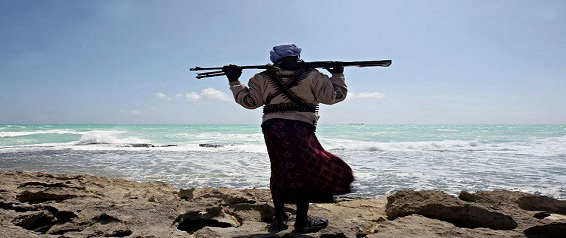
Recording some of the lowest figures seen in the last five-year period, the latest piracy report shows that in the first half of 2017, there were a total of 87 reported incidents, compared to 98 in the same period of last year.
In comparison, there were 138 incidents in the first half of 2013, 116 in the first half of 2014, and 134 in the first half of 2015.
Among the 87 incidents in the first half of this year, 63 vessels were boarded, 12 fired upon, four hijacked and attacks were attempted on another eight vessels. A total of 63 crew have been taken hostage so far this year while 41 have been kidnapped, three injured and two killed.
Also among the 87 cases, 19 were product tankers, 18 were bulk carriers, seven were chemical tankers, and 43 were other vessels.
One of the most recent case happened at end-June when six heavily armed pirates hijacked a small Thai product tanker en route from Singapore to Songkhla, Thailand.
The incident followed a similar pattern to a series of product tanker hijackings in the region which occurred approximately every two weeks between April 2014 and August 2015, according to the ICC IMB report.
“To prevent criminal gangs carrying out attacks on other product tankers, the IMB PRC is calling on Malaysian and Indonesian authorities to take robust action, in the same vein as their response which brought perpetrators of the previous spate of attacks to justice,” said Mukundan, director of IMB.
Elsewhere at the Horn of Africa, Somali pirates continue to pose grave threats to merchant ships, with the hijacking of an Indian dhow in early-April among one of five reported incidents off Somalia in the second quarter.
Pirates in Nigeria, on the other hand, continues to dominate when it comes to reports of kidnapping. So far this year they have been responsible for the abduction of 31 crew in five reported incidents. The numbers include 14 crew members taken from two separate vessels in the second quarter.
Violence against crew members continues with half of all reports of vessels being fired upon coming from Nigeria, the ICC IMB report stated.
Recognising the need to get a clearer understanding of the depth of under-reporting in the Gulf of Guinea region, the IMB in association with Oceans Beyond Piracy, has proposed the idea of a ‘Community of Reporting’, a project aimed at encouraging all stakeholders to share reports of piracy and armed robbery with the IMB.
Lee Hong Liang
Asia Correspondent, Seatrade Maritime
http://www.seatrade-maritime.com
IBIA raises concerns about new BDN text at IMO
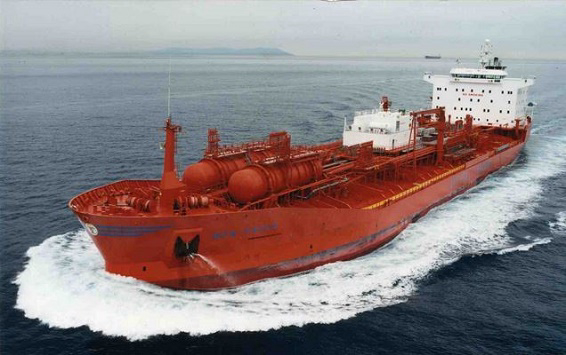
The text, which is due to be formally adopted at MEPC 71, amends the current supplier’s declaration to allow for supply of high sulphur fuel to ships equipped with abatement technology, and ships undertaking trials of such technology. While IBIA fully supports the need for amending the text, unfortunately the text that is up for adoption creates previously unforeseen issues relating to non-availability situations. Moreover, it lends itself to clerical errors, and creates confusion about the respective responsibility of suppliers and ships with regards to complying with MARPOL Annex VI.
The current BDN is required to contain “A declaration signed and certified by the fuel oil supplier’s representative that the fuel oil supplied is in conformity with regulation 14.1 or 14.4 and regulation 18.3 of this Annex.” Regulation 14.1 refers to the global limit, while 14.4 is the limit applicable in emission control areas (ECAs). This declaration therefore prevents the supply of fuel oil to ships exceeding the global limit, and this would clearly be a problem when that falls from 3.50\% to 0.50\% in 2020.
The new mandatory BDN text from the International Maritime Organization will replace the current supplier’s declaration and introduce a ‘tick box’ system as follows:
QUOTE:
“A declaration signed and certified by the fuel oil supplier’s representative that the fuel oil supplied is in conformity with regulation 18.3 of this Annex and that the sulphur content of the fuel oil supplied does not exceed:
□ the limit value given by regulation 14.1 of this Annex;
□ the limit value given by regulation 14.4 of this Annex; or
□ the purchaser’s specified limit value of _____ (\% m/m). As completed by the fuel oil supplier’s representative and on the basis of the purchaser’s notification that the fuel oil is intended to be used:
.1 in combination with an equivalent means of compliance in accordance with regulation 4 of this Annex; or
.2 is subject to a relevant exemption for a ship to conduct trials for sulphur oxides emission reduction and control technology research in accordance with regulation 3.2 of this Annex.
This declaration shall be completed by the fuel oil supplier’s representative by marking the applicable box(es) with a cross (x).”
UNQUOTE
If adopted at MEPC 71, this mandatory requirement is expected to take effect on 1 January, 2019.
Since the text was developed, the IMO has decided to implement the 0.50\% sulphur limit in 2020. IBIA has identified problems with the new BDN format that creates previously unforeseen issues with the preparation for, and transition to, the 0.50\% sulphur limit in 2020.
Looking ahead to 2020, it may be expected that, for a period, there will be times when compliant fuel is not available in some ports. Should a ship without abatement technology be in a port where it cannot obtain compliant fuel, but needs fuel to reach its next port, the BDN text up for adoption would, in effect, prevent a supplier with availability of higher sulphur fuel from delivering that fuel to the ship because it requires the supplier to declare that they were notified that the ship has a scrubber or a valid exemption while trialling abatement technology.
Another issue with the format is that, in order to comply with the 0.50\% sulphur limit with effect from 1 January 2020, ships will need to start buying compliant fuels in advance. The first tick box as drafted refers only to regulation 14.1 and hence it only guarantees the regulation limit value on the date of delivery, i.e. 3.50\% prior to 1 January 2020. This will render the document without any statutory value for ships preparing to comply with the 0.50\% limit prior to the deadline.
There is a very simple solution to both of these problems, which would be to delete the text specifying under which conditions the supplier can provide fuel with a sulphur content that is different from limits specified under the first two tick boxes. That would allow the buyer to specify a 0.50\% sulphur limit in the third tick box ahead of 1 January, 2020.
Moreover, by not specifying the conditions under which supply of higher sulphur fuel may be justified, the document does what it needs to do, which is to demonstrate the sulphur content of the fuel provided to the ship. Under the current regulation, it is the purchaser’s/ship’s responsibility to order and use fuels in compliance with MARPOL limits. There is no obligation on the supplier other than to provide fuel that meets the sulphur limit specified by the purchaser and that conforms to regulation 18.3 of Annex VI.
IBIA’s paper to MEPC 71 stresses that the BDN declaration is the supplier’s responsibility; hence it is problematic for the supplier’s representative to sign a declaration providing reasons for supply of fuel with sulphur exceeding 0.50\% which only the vessel can actually vouch for.
If the object of the BDN is to demonstrate to port state control that the ship had reason to purchase fuel oil that does not meet regulatory sulphur limits, adding text to the BDN that the supplier has been ‘notified’ that the ship intends to use the fuel with a scrubber is not sufficient to prove that the ship is compliant. Only the ship can prove this by providing the relevant documentation to inspection authorities, such as the supplement to the International Air Pollution Prevention Certificate, or notification that it is subject to a non-availability situation which it must report to relevant authorities in line with the provisions of Regulation 18.2 of MARPOL Annex VI.
The only party that can rightfully declare that the ship is permitted to use a higher sulphur fuel is the ship’s representative. Hence, IBIA has proposed that the IMO might want to consider asking for a counter-signature on the BDN by the ship’s representative that the ship is permitted to use a higher sulphur fuel in accordance with the relevant provisions of Annex VI.
IBIA is also asking that the BDN should specify the actual sulphur limits next to the first two tick boxes. This is because, although the shipping and bunkering community is very familiar with the global and ECA sulphur limits, many are not familiar with the meaning of “regulation 14.1” and “regulation 14.4”. Inserting the relevant sulphur limits next to the regulation numbers would make the document clearer and reduce the risk of clerical errors. If mistakes are made when filling in the tick boxes, the ship’s documentation would fail to comply with MARPOL Annex VI and this could render the ship liable to non-compliance actions.
When the draft amendments to the text on the BDN were up for approval at MEPC 70 in October last year, IBIA raised concerns in document MEPC 70/9/4, and proposed amendments addressing them. These were rejected because of concerns that one element of the proposal would increase the administrative burden for ships. By removing that element, IBIA remains convinced that the proposal put forward to MEPC 70 has merit, while the format up for approval risks increasing the administrative burden on all parties without achieving genuine benefits, as well as create further complications during the initial phases of the new 0.50\% sulphur regime.
IBIA realises that it will be extremely difficult to get MEPC to agree to amend the BDN text that is up for adoption, but feels it is our obligation to highlight concerns raised by our members. IBIA will also stress that the Committee has an opportunity to resolve issues expected to arise around the transition to the 0.50\% limit by adopting a BDN text that doesn’t specify the exact conditions under which the supplier may provide high sulphur fuel to a ship. If the text is adopted as it is, it will add to the workload to be undertaken on consistent implementation of the 0.50\% sulphur limit under MARPOL Annex VI.
Below is the BDN format proposed by IBIA:
QUOTE:
A declaration signed and certified by the fuel oil supplier’s representative that the fuel oil supplied is in conformity with regulation 18.3 of this Annex and that the sulphur content of the fuel oil supplied does not exceed:
□ 3.50\% m/m until 31 December 2019, 0.50\% m/m thereafter as per the limit values given by regulation 14.1 of this Annex; or
□ 0.10\% m/m as per the limit value given by regulation 14.4 of this Annex; or
□ the purchaser’s specified limit value of _____(\% m/m). As completed by the fuel oil supplier’s representative.
This declaration shall be completed by the fuel oil supplier’s representative by marking the applicable box with a cross (x).”
UNQUOTE
Source: IBIA
Asia Dirty Tanker Market Outlook Q3 2017: Caught Between A Rock and Hard Place
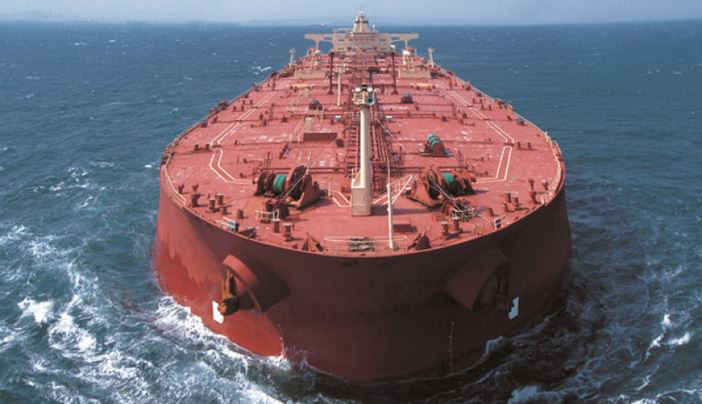
The pace of newbuild deliveries continues to be relentless while scrapping remains miminal. A more worrying trend is that according to BIMCO, VLCC orders between January and May this year hit their highest level in 9 years on the back of low newbuilding prices, which could delay a potential recovery in rates. The effect of tonnage oversupply has been clearly felt in the VLCC market. Rates for the benchmark AG/ Japan route have tumbled from w97.5 at the beginning of the year to current levels of w51. Rates have been languishing at w50 to w52 for a month as the battle between handicapped (newbuilds, ex-dry dock and old) vessels and modern tonnage rages on. A recent uptick in interest for short-term time charters for floating storage failed to move rates upwards.
On the demand side, the extension of the OPEC production cuts remains a thorn in the side of the Asian VLCC market, further compounded by the seasonal summer lull. A boost in ton-mile demand due to more long-haul trades from the Americas may offer some temporary respite to falling rates. The Brent premium to WTI widened recently to around $2.50/bbl, opening the arb for US crude exports to Asia which was previously unworkable. The release of China’s second batch of crude import quotas may also lend support to its previously flagging appetite for WAF crude. It is unlikely that we will see a substantial recovery in rates before end-September, when a pick-up in winter demand takes place. While the market was counting on the upcoming IMO Ballast Water Management Convention on September 8 to raise scrapping activity, the ongoing Marine Environment Protection Committee (MEPC 71) in London is currently discussing the possibility of a partial two-year delay.
The beleaguered Suezmax sector in Asia is likely to continue to be weighed down by lower exports from Iran and Iraq in Q3. Iranian crude exports averaged 1.83 mmb/d in Q2, down by 20.5\% from Q1. As reported by Reuters, Iranian crude exports in July are expected to drop by 7\% m-o-m to 1.86 mmb/d. Iraq’s Basra crude exports averaged 3.22 mmb/d over Q2, down by 8.5\% from December’s record high of 3.5 mmb/d. While no official July Basra program was released, loadings are expected to be lower than recent months. A potential pick-up in the WAF market on the back of higher exports from Nigeria may attract more ballasters from the East, helping to reduce the tonnage surplus. Similarly, the Asian Aframax segment is expected to remain in the doldrums due to lower exports from Kozmino. ESPO Blend exports from Kozmino are expected to fall by 2.6\% from Q2 to 2.6 mmt.
Source: OFE Insights
i-forms: SetelHellas' new engineering concept
SetelHellas has the pleasure to announce that it has successfully ported i-forms, by SEATRIX to SmartBox-V™ through a native VM environment.
i-forms, is a new enterprise engineering concept able to provide the right information at the right time and at the right format. It combines the online manual entry with the parallel collection of vessel data- pulled automatically from SeeMBox-V©, in electronic smart forms that are accessible from web pages, mobile devices, portals, software applications and visualization platforms. Incorporate this information immediately into your business process to automate actions, validate data accuracy and support human decision in a manner to improve action.
Based on the use-case modelling, i-forms is delivering a ground-breaking solution, able to truly ensure high level of integration with SetelHellas IoT shipboard platform, accuracy, integrity and transparency. User-friendly graphical interface, comprehensive and powerful real-time validation, easily configurable and user customizable forms, seamlessly and automatically data transferred capabilities, are a tremendous asset for the shoreside staff, in assisting the plan for remedies that can be assigned to the vessel in-voyage, in a port call, or in a shipyard.
i-forms technology offers the following features, benefits and advantages to support your business ambitions:
Features
- Enables any authorized person to submit i-forms and / or enter data.
- Allows authorized users to attach documents to an i-form and send them directly into a predefine repository
- Use "check formulas" and database validation rules to verify the correctness, relevance, and security of the i-form’s data
- Allows the i-form's layout customization according to the user’s role and needs, utilizing the i-form transformation tool
- Supports i-forms’ online or offline completion even from mobile smart-devices
Benefits
- Collects data entered in the i-form and / or pulled automatically from SeeMBox-V©
- Streamlines processes by simplifying or eliminating unnecessary steps, using modernizing techniques
- Enhances workflow using collected i-forms data to channelling information insightful with embedded data encryption
- Stores, organizes and manages i-forms independently, alerting operators to suboptimal operating conditions before harm can be caused
- Improves operating systems efficiency, optimized performance management, and reduced maintenance costs
Advantages
- Builds in a painless way i-forms using wizards
- Creates standards-based i-forms easily using the i-forms Designer and standard web technologies like HTML
- Converts existing forms into i-forms replicas, keeping the structure and logic of the original form
- Supports the i-forms’ design straight away and the usage of them from anywhere, even from mobile smart-devices
- Enables i-forms and cells values locks preventing users from adding or modifying values enhancing your protection
The implementation is deployed and tested in real conditions and both companies are excited about their collaboration and are engaged proving that amazing things can happen when you connect the previously unconnected.
 |

Powered by  © Μaritimes 2019