


Wreck Removal at the End of the World
 |
Twenty five (25) of RESOLVE’s custom-built 325MT hydraulic chain pullers along with 5000 meters of 76mm chain and with various other specialized salvage equipment were mobilized from RESOLVE’s warehouses in Mobile, Alabama, Fort Lauderdale, Florida and as far away as Singapore, Mumbai, Gibraltar, Rotterdam and Cork.
Upon reaching the casualty site, the first priority was establishing a hold back system to ensure the vessel did not slide into deeper water further complicating the project. A specialized hydraulic drilling system was utilized to drill 28 anchor points along the shore whilst avoiding any damage to the sensitive environment.
Due to the remote location and lack of available resources, an extensive contingency and redundancy plan was developed to ensure all logistical challenges were met and spares for all equipment were available onsite. Otherwise, a simple equipment failure could have led to project delays and subsequent cost implications.
Salvage Master Andy Butts and the crew worked tirelessly in freezing conditions for 4 months to successfully upright and refloat the vessel, ensuring the safe removal and disposal of HAZMAT cargo, residual oils, cargo, trucks, trailers and other vehicles onboard. RESOLVE’s high standards for pollution control and remediation – elevated from experience with the RENA in New Zealand – helped to comply with Chile’s stringent environmental regulations.
RESOLVE also partnered with local organizations to ensure a constant Chilean presence throughout the project. RESOLVE worked closely with all stakeholders including owners, owners P&I, authorities and consultants to ensure a successful operation.
On September 21, 2015, the AMADEO 1 was scuttled in 2,700 meters of water approximately 70 km from Diego de Almagro Island, Chile.
 |
RINA, a new identity marked by digitalisation
 |
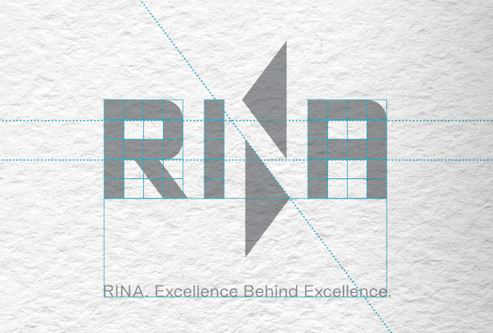
With a history of more than 150 years, RINA has transformed its logo, which captures the company’s distinctive characteristics. The new brand reflects RINA’s experience and ability to innovate, represented symbolically by two triangles that point to the past and the future.
RINA's new positioning acknowledges the new role of digitalisation. This is not only evident within the company’s own in-house processes, but also the external services it offers through the strategic application of technology, such as big data and artificial intelligence.
Cube is a cloud-based platform, created by a dedicated team of 50 people within RINA. This platform guides clients through the process of predictive asset management. In addition, this tool can interact with the most common technologies, making it easy to use for everyone, from large multinationals to companies in the retail sector, helping them to reduce costs. This new approach leverages the latent value of existing available data, through which companies gain competitive market advantage.
RINA has been recognised throughout its history for reliability, credibility and impartiality. Those values have now been incorporated within the digital platform that will convert data into useful actionable information, seamlessly integrating all parties within a system. For example, in the management of the logistics chain, the platform can be used throughout the whole process, with information being securely accessed by authorised users at all stages, resulting in the optimisation of the entire process.
Ugo Salerno, Chairman and CEO of RINA, said, “The volume of available data is growing exponentially. It is forecast that, by 2020, 75\% of companies will be fully digitalised, but only those companies able to process this data intelligently will remain competitive. RINA now has the capability to bring technical, process, and business skills together within a digital environment”.
In the oil sector, it is estimated that digital asset management, using sensor networks for example, can reduce costs by 25\% and increase production by 8\%. The advantages of digital innovation are also represented by the possibility of creating a digital twin at the design stage of an infrastructure, by predictive maintenance and by improved energy efficiency management. Training also benefits from the opportunities offered by digitalisation. RINA is already developing and managing new virtual immersive environment training programs.
Cube has been designed to operate in all the sectors in which RINA is active, including certification services for small and medium-sized enterprises, such as the periodic audits for lifts and electrical systems. For some years now, RINA has been using digital tools in order to speed up audits, reduce errors to a minimum and standardise processes.
In its move to fully embrace digitalisation, RINA is also involved in protecting data. In fact, the company has already certified a number of data centres. Recently, RINA certified a well-known player in the telecommunications sector in compliance with the ANSI TIA-942 standard. This standard defines the requirements for the resilience of a data centre and its capacity to guarantee the continuity of services provided in case of a maintenance or hardware fault.
In addition, RINA is developing a fully digitalised certification system that automatically guides the user through the online process, culminating in the issuance of a certificate. One of the first applications of this new approach relates to cyber security. “Cyber Essentials” certification enables companies to show the degree of protection they have against potential attacks.
“We chose to launch our new brand identity at this time, because this is the moment when the competence of RINA, the new scenario and market demand meet. We can now help our clients to make the critical step towards the application of new technologies, that are already revolutionising our lives, to their business,” concluded Mr Salerno.
In parallel to the company’s digital transformation, RINA has also embarked on an internal reorganisation programme. As a multinational company, RINA has grown in the last 5 years by 50\%. Going forward the company will focus on the business sectors to enhance the rate of growth of those with higher potential: renewable energy, materials and certification.
RINA’s turnover at the end of 2017 is expected to be in line with the previous year, but marked by an improvement in profitability. Going forward the company will operate in five sectors: energy, shipping, certification, transport and infrastructure, industry.
RINA provides certification, testing, inspection, and consulting services across the Energy, Marine, Certification, Transport & Infrastructure and Industry sectors.
With a turnover in 2016 of 448 million Euros, about 3,700 employees and 170 offices in 65 countries worldwide, RINA is a member of key international organizations and an important contributor to the development of new legislative standards.
Adding a new layer to shipping: DNV GL launches first class guideline for additive manufacturing
 |
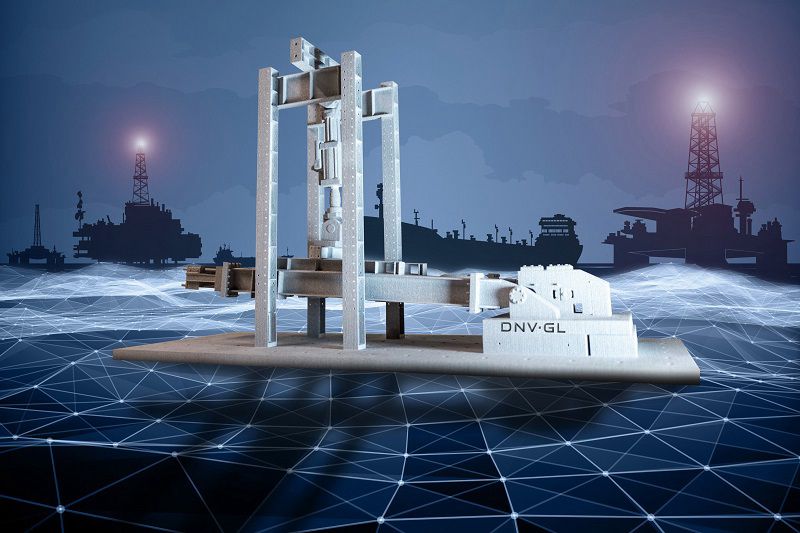
| The ability to produce metal parts in a 3D printing process anywhere holds great promise for the maritime sector. The picture shows a 3D-printed aluminium replica of a mooring chain testing bed at the DNV GL lab in Bergen |
Additive manufacturing is a catch-all term for industrial processes that create three dimensional objects by adding layers of material. It includes such technologies as 3D Printing, Rapid Prototyping (RP), Direct Digital Manufacturing (DDM), layered manufacturing and additive fabrication.
“We have been investigating the potential of 3D printing for the maritime and oil & gas sectors since 2014,” says Marit Norheim, Vice President, Material Specialist, Hull, Materials & Machinery at DNV GL – Maritime. “With the introduction of the class guideline DNVGL-CG-0197, DNV GL is now ready to certify and support our customers and industry stakeholders to take advantage of this rapidly maturing technology. It will give end users confidence in the products and allow suppliers to offer their technologies and products for use in vessels and offshore installations.”
The latest AM processes allow printing in metal, something which is of particular importance to the maritime and oil & gas sectors. A variety of products and parts have now been successfully printed for industry, including screw pins, bearing shells, box heat exchangers and propellers.
“Additive manufacturing means products and components can be printed according to local needs, or even on board ships and offshore installations,” says Knut Ørbeck-Nilssen, CEO DNV GL – Maritime. “This equates to less lead time, less cost, less labour, less logistics, and less need to keep stocks of spare parts. AM can also be used for maintenance and repair, simply adding layers of material to worn components, thus negating the need to replace them.”
“AM parts that perform the same functions as those produced in traditional manufacturing environments must offer the same levels of quality assurance,” Norheim adds. “Similarly, the companies that have designed the parts must protect their intellectual property, so that customers can be sure they are receiving genuine products that are guaranteed fit for purpose. This is why this guideline is so important to all industry stakeholders.”
With the new guideline, DNV GL has created a clear pathway for AM certification and has the processes in place to assess every parameter that will impact upon the final products – from the material used, to a technology assessment, manufacturing procedure qualification, data transfer, and the actual printing and post processing.
The new DNVGL-CG-0197 guideline can be accessed here. You can read more about AM and the DNV GL guideline in the new MARITIME IMPACT magazine, which you can download here.
About DNV GL
DNV GL is a global quality assurance and risk management company. Driven by our purpose of safeguarding life, property and the environment, we enable our customers to advance the safety and sustainability of their business. Operating in more than 100 countries, our professionals are dedicated to helping customers in the maritime, oil & gas, power and renewables and other industries to make the world safer, smarter and greener.
About DNV GL – Maritime
DNV GL is the world’s leading classification society and a recognized advisor for the maritime industry. We enhance safety, quality, energy efficiency and environmental performance of the global shipping industry – across all vessel types and offshore structures. We invest heavily in research and development to find solutions, together with the industry, that address strategic, operational or regulatory challenges. For more information visit www.dnvgl.com/maritime
BIMCO: Will the dry bulk industry become profitable in 2018?
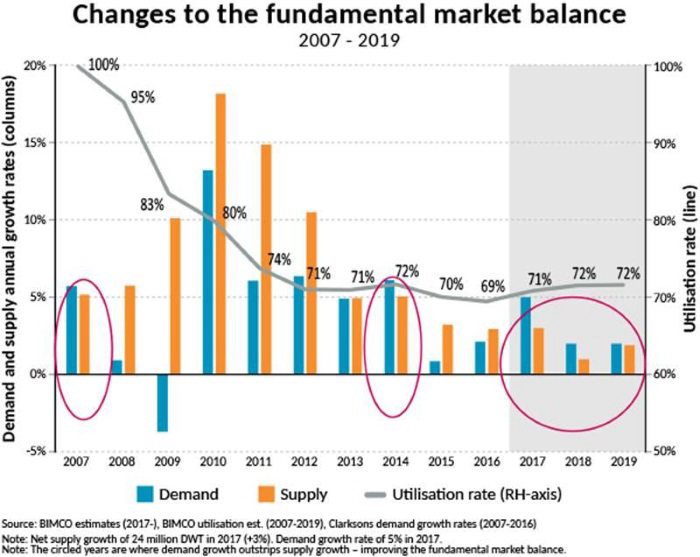
China’s imports, particularly of coal and iron ore, grew tremendously in 2017, and the second half of the year has been profitable for several bulk owners and operators. If 2018 delivers similar demand growth (+5\%), the bulk industry will see profitable business for the full year.
“But, be aware that 2018 may not be quite as strong as 2017, and profits may not come around until 2019, if the ongoing recovery is not handled with care”. says BIMCO’s Chief Shipping Analyst Peter Sand.
Particularly, the level of growth in the fleet and the extent of demolition of excess capacity are key factors in the 2018 market.
“Unfortunately, we see weakening demolition activity, and the bulk fleet keeps growing, which can hinder market recovery. As the nominal fleet growth in 2018 is expected around 1\%, focus now turns to maintaining slow steaming. If we get notably higher average ship speed the pace of recovery will slow down, if not go directly into reverse”, Sand says.
 |
In dry bulk shipping, transported volumes follow a seasonal cycle throughout the year – first quarter volumes being the lowest and fourth quarter volumes the highest. For Q1 2018, transported volumes will be significantly lower than those of Q4 2017. It is likely that the transported volumes in Q4 2017, will not be exceeded in 2018 until Q3.
“The industry has got its work cut out to avoid a prolonged dip in freight rates during the first half of 2018 as volumes seasonally decline. Therefore, ship speed needs to be the main focus”, Sand says.
The caveat here being that we are at the mercy of China’s appetite for dry bulk commodities. China’s economic growth remains the absolute key factor for the bulk shipping market, he says.
China responsible for 2017 growth
An unexpected market development in 2017 was China becoming even more dominant in the dry bulk sector. China grew its imports – of essentially all commodities – by a hefty margin. Most importantly, iron ore is expected to end in 2017 with a growth of 6.5\% and coal surges with 19\% growth. All due to a stronger than expected substitution of domestically mined ore and coal for higher quality imports of the commodities.
“Demand growth in 2017 has surely been a positive surprise. Growing at almost double the pace of our initial expectations, a demand growth rate of 5\% is a three-year-high”, says Sand.
Some of the key reasons include, a faster substitution of China’s own low-quality iron ore towards seaborne imports of a higher quality. As well as continued strong coal imports despite the suspension of the 276-working-days limitation (a reform plan put in place to limit the number of smaller high-cost miners and cut the supply glut).
An early indication of 2018 demand growth in Chinese iron ore imports is positive, up by 3\%, whereas coal is likely to remain steady.
While demand growth has improved the fundamental market conditions, the increased fleet growth has meant that the economic benefits of such a strong demand growth rate has not been fully earned, adds Sand.
 |
| Peter Sand |
The dry bulk industry is on the road to recovery and maintaining that recovery is now the key challenge.
Recovery is achieved by targeting improvements in profitability via improvement in the fundamental balance. This is done by continued demolition activity (short-term) and careful placement of new orders (long-term).
During the third quarter of 2017, freight rates turned profitable for all sizes of dry bulk ships. That means ships deployed in the spot market have been fixed at a level covering operational expenditure, and financing costs include repayment of debt. It’s the first time since 2012 that it has happened at industry average level.
The industry is clearly feeling optimistic in the wake of profitable freight rates. But rates could have gone even higher. At the start of 2017, there was only a slim improvement in the market (0.2 percentage points) as the demand growth rate (+2.2\%) was forecasted to outstrip the fleet growth rate (+2\%) by a small margin.
BIMCO now forecasts 2017 will reach a demand growth rate as high as 5\% and a fleet growth of 3\%, improving the fundamental market balance by two percentage points. Nevertheless, had the fleet growth rate remained at the initial 2\%, it would have improved the market by three percentage points, a strong level not seen since 2004. Back then, the fundamental balance improved by 3.7 percentage points (2004: demand growth rate: 10.5\% – supply growth rate: 6.8\%).
Source: Peter Sand, Chief Shipping Analyst; BIMCO
PPA provided Christmas gifts and meals to families of vulnerable groups.

 |
Also, like every year, PPA's Management organized a Christmas celebration for the employees’ children and a special award ceremony for the children of PPA employees, pupils and students, who graduated with excellent degree.
The CEO Captain Fu Chengqiu, sent wishes and stated that PPA's main priority is the positive results of the Piraeus port development to affect as many inhabitants of the local communities as possible.
Global shipping industry’s US$231 Billion CAPEX needs far exceed combined market cap
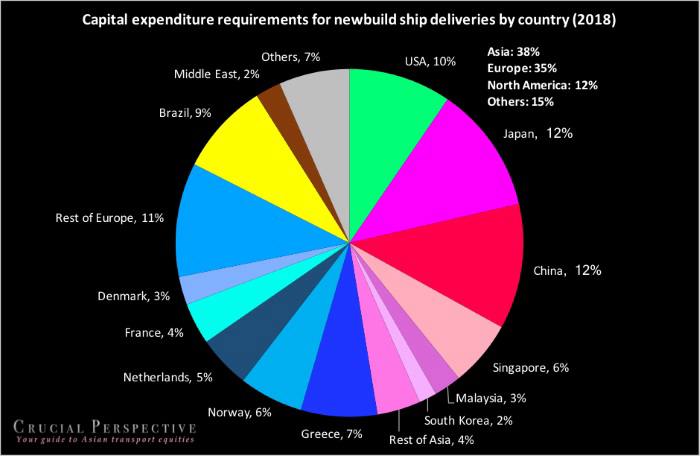
In 2018 alone, the global shipping industry will need US$114B capital to fund the newbuild ship deliveries. Asian countries are the largest ship buyers and will need to fork out nearly 40\% of this CAPEX. However, we expect equity financing to form only a small part of the global ship financing pool as investors remain cautious on the sector given the volatile freight rates and the shipping firms’ low profitability and high financial leverage. As such, shipowners will still need to rely heavily on debt and lease financing plus their internal cash flows to fund their future capital expenditure.
US$231B CAPITAL REQUIRED TO FUND EXISTING NEWBUILD SHIP ORDERS
Globally, there are 3,036 newbuild vessels on order which will require US$231B to finance in the coming years. In 2018 alone, the capital expenditure for the global shipping industry is expected to amount to US$114B. This will halve to US$52B in 2019 with the remaining US$58B in 2020 and beyond.
ASIA NEEDS THE LARGEST AMOUNT OF NEWBUILD SHIP FINANCING IN 2018
Asia has the largest capital expenditure requirements for newbuild ship deliveries in 2018, amounting to US$43B or 38\% of the global shipping industry’s capex needs for newbuild ship deliveries in 2018. Among the Asian countries, the ship buyers in Japan, China and Singapore will require the largest amount of newbuild ship financing.
European ship buyers will require US$40B to fund their newbuild ship deliveries, accounting for 35\% of the global shipping industry’s capex needs in 2018. The ship buyers in Greece, Norway and Netherlands need the largest amount of ship financing among the European nations.
US ship investors also have substantial ship financing needs, accounting for 10\% of the global shipping industry’s capex needs in 2018.
Chart: Capital expenditure requirements for newbuild ship deliveries by country (2018)

TANKER SHIPPING SEGMENT ACCOUNTS FOR THE LARGEST SHARE OF NEWBUILD SHIP DELIVERIES IN 2018, FOLLOWED BY DRY BULK
Crude, product, chemical and other specialised tankers will make up 38\% of the global newbuild ship deliveries in 2018.
Dry bulk carriers will drive 31\% of the total newbuild ship deliveries while containerships account for 19\% in 2018.
LNG and LPG carriers constitute 6\% and 1\% of the global newbuild ship deliveries while Offshore vessels will account for 3\% of the global ship deliveries in 2018.
Chart: Breakdown of newbuild vessel deliveries by shipping segment (2018)

EQUITY FINANCING LIKELY TO FORM ONLY A SMALL PART OF OVERALL SHIP FINANCING
Apart from Maersk which has a current market capitalization of US$34B, the equity market valuation of the listed global shipping lines is small, averaging only US$0.7B.
The combined market capitalization of all the listed shipping companies in the world stands at only US$191B. This falls short of the global shipping industry’s US$231 Billion CAPEX requirements.
In the past 12 months, the global shipping industry has only managed to raise US$8.2B in the equity markets. 61\% of the equity funding was raised by Asian shipping companies, 38\% by European shipping firms and 1\% by North American shipping firms.
We expect equity financing to form only a small part of the global ship funding pool as investors remain cautious on the sector given the volatile freight rates and the shipping firms’ low profitability and high financial leverage. As such, shipowners will still need to rely heavily on debt and lease financing plus their internal cash flows to fund their future capital expenditure.
Chart: Current market capitalization of top 30 shipping firms in the world (2017)


Chart: Global shipping industry equity issuance in the past 12 months (Total: US$8.2B)


Source: Crucial Pespective
MARGETIS MARITIME CONSULTING is pleased to announce the establishment of our DUBAI office in the United Arab Emirates.
 |
Both Capt. Anil and Husain, have also University Education in Nautical Science and Marine Engineering respectively and have been operating in Dubai for the last several years, being very well familiar with the local Ports, Workshops and Shipyards.
We all in Margetis Maritime Consulting welcome Capt. Anil and Husain to our Firm and look forward to close cooperation and expansion of our business.
We attach herewith a brief electronic Brochure with details of our New Office in DUBAI."
Greek Shipping Hall of Fame announces Induction Ceremony & Dinner 2018
 |
This prestigious event will include an exciting programme of content, including the unveiling of the latest Inductees to the Greek Shipping Hall of Fame. The 2017 Inductees will join 26 ‘Greats’ already inducted into the Greek Shipping Hall of Fame.
The Greek Shipping Hall of Fame is pleased to continue its support of Hellenic Hope and a portion of the event proceeds will be donated to this children’s charity, focused on helping children in Greece at risk from the crisis.
We are extremely grateful for the support of a number of leading organisations and companies that are already confirmed as sponsors of the 2018 Induction Ceremony, including ABS, IRI – The Marshall Islands Registry and Shanghai Waigaoqiao Shipbuilding Co. as Co-Lead Sponsors of the event.
Christopher J. Wiernicki, ABS Chairman, President and CEO comments:
“We are pleased to support the Greek Shipping Hall of Fame to honor exceptional individuals for their outstanding achievements and contributions that continue to influence Hellenic innovations as well as the global maritime industry. The Greek shipping community is renowned for advancing and inspiring shipping globally. ABS is proud of its history with the Greek shipping industry and salutes all Greek Shipping Hall of Fame honorees.”
Theo Xenakoudis, Director – Worldwide Business Operations & Managing Director Greece, International Registries Inc. comments:
“International Registries, Inc. (IRI) and the Marshall Islands Registry are delighted to support this important institution. As of today, approximately 20\% of the Greek controlled fleet flies the Republic of the Marshall Islands flag. The Greek shipping community is the backbone of our Registry and we are proud to be the number one foreign flag in Greece. We salute all the Inductees of the Greek Shipping Hall of Fame”.
Wang Qi, Chairman of Shanghai Waigaoqiao Shipbuilding, comments:
“As one of the world’s leading shipbuilders, we cherish the opportunity to once again reflect on Greek shipping’s impressive history and pay tribute to the Inductees of the Greek Shipping Hall of Fame. SWS is delighted to continue its support of the Greek Shipping Hall of Fame which brings us together with our Hellenic friends on the occasion of this wonderful event.
“Despite the continuing challenges of the industry SWS continues to innovate and maintain its position as a builder of first-class ships and offshore equipment for the most discerning international shipowners and oil majors. We are proud of our latest new order
achievements and the prototype vessels delivered to our clients that reflect our commitment to pursue green ships and green shipbuilding. We look forward with confidence of achieving new and continued success with our Greek shipping partners.”
The Induction Ceremony & Dinner at the Athens Concert Hall begins with a Welcome Drinks Reception sponsored by TMS during which leading personalities in the shipping business will have the opportunity to catch up with each other over drinks and canapes.
Premium Sponsors of the event so far are Bureau Veritas, Citi Private Bank, Moore Stephens and Thomas Miller.
Sponsors so far include China Classification Society, ClassNK, DNV GL, Hellenic War Risks, HSBC Bank Plc., UK Defence Club and the UK P&I Club.
This gala dinner will take place in the Megaron’s Banqueting Suite which has hosted many prestigious events including the Greek Shipping Hall of Fame’s public Inauguration Ceremony in 2013.
In recent years the Greek Shipping Hall of Fame has held highly-acclaimed major events in London in 2014 and in Athens in 2015, 2016 and 2017.
Sponsorship enquiries: This email address is being protected from spambots. You need JavaScript enabled to view it.
Table booking & press enquiries: This email address is being protected from spambots. You need JavaScript enabled to view it.
The Greek Shipping Hall of Fame resides at www.greekshippinghalloffame.org
40 Years of Excellence & Environmental Commitment
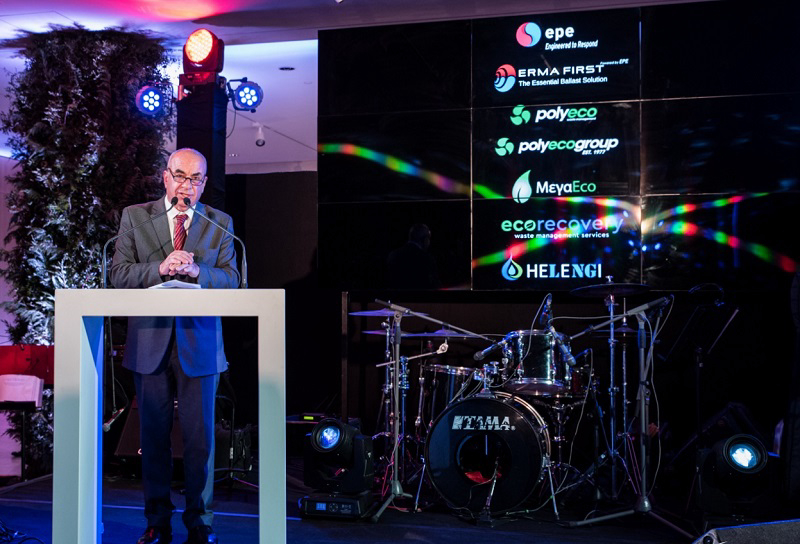
This glamorous evening was organized by Environmental Protection Engineering, ERMA FIRST and Polyeco on the occasion of the 40th anniversary of EPE and the US Coast Guard Type Approval received by ERMA FIRST for its Ballast Water Treatment System.
During this evening, a brief presentation took place, in regards to the first steps of the group, the development that followed, the new companies that have gradually emerged, as well as the plans for the next day. Plans that include, among other things, investments in new projects such as the production of alternative fuels, the creation of a hazardous waste landfill, etc., always according to the strictest conditions imposed by the international and European conditions and the national legislative framework.
In view of the wakefulness of the Group's companies regarding the future steps, particular reference was also made to the successful course of Polyeco abroad that despite facing the preconceptions of foreign companies coming from the economic situation in Greece, has managed to be the best ambassador of Greek foreign policy on the waste management sector.
On another note, special mention was made of Polyeco Contemporary Art Initiative, the initiative of the Group's companies that aims to educate younger and future generations in the sensitive area of hazardous waste through modern art as well as to contribute to the environmental awakening of the society. This innovative global action of a Greek corporate entity has attracted the interest of the international business community and has opened up new horizons in corporate social responsibility.
Finally, the investment strategy of ERMA FIRST, the only Greek company that manufactures a ballast water treatment system and the 6th worldwide system that has obtained the US Coast Guard Type Approval, was highlighted. The company’s intention is to invest in the creation of a global network of technical support stations, denying the tactics that characterized the Greek shipbuilding industry in the past and working on global standards and role models. Through this global network, every ship equipped with ERMA FIRST products can receive support and spare parts wherever and whenever they need it. Also, in its future plans, the company includes the use of modern satellite technologies, through which the operating status of a system will be remotely monitored at the press of a button.
 |
| Mr. Ioannis Polychronopoulos, POLYECO S.A. |
 |
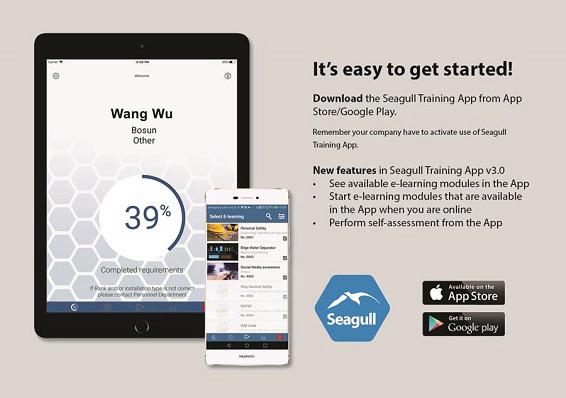
Seagull Maritime continues to update the Seagull Training App.
 |
The app is only accessible for users of Seagull Training Administrator (STA) and your company must approve use of the App before you can use your STA credentials to login.
"Seagull was the first to respond to changing seafarer needs with a mobile training app and we continue to lead the way by enhancing the Seagull Training App based on customer feedback,” says Roger Ringstad, Seagull Maritime Managing Director. “Today, recruiting skilled crews and retaining their loyalty calls on owners to demonstrate they offer a viable career path supported by modern software tools".
Seagull Training App v3.0 is available free of charge to all Seagull customers. The main new features for this release is:
· From the schedule screen, you will be able to start those e-learning modules that are available in HTML5 format & that your company has selected to be available for Online training.
· Notification functionality has been improved.
· New design with possibility to use your device in landscape mode.
· Improved support for increased set of display sizes.
For more information on how to activate use of the App contact our dedicated account managers.
Seagull Maritime AS

Powered by  © Μaritimes 2019