



Shipping industry’s CO2 proposal to IMO may be a good compromise
A proposal from the International Chamber of Shipping (ICS) and other shipping organisations offers a possible way forward. IBIA explains what’s going on.
The IMO agreed on a ‘roadmap’ for its strategy to control greenhouse gas emissions from international shipping at the 70th meeting of its Marine Environment Protection Committee (MEPC 70) in October last year and it is expected to adopt this roadmap at MEPC 71 in July. The GHG subject is such a high priority on the IMO’s agenda right now that there is also going to be a week-long intersessional meeting dedicated to it in the week prior to MEPC 71.
IMO’s GHG roadmap calls for an initial strategy to be adopted in the first half of 2018, which will be revised and firmed up in 2023 when the IMO should have sufficient data from its mandatory fuel consumption data collection, set to start in 2019, to make an informed decision.
Another important aspect of IMO’s GHG road map is that it aligns closely with key dates in the Paris Agreement. Parties to the Paris Agreement will take stock of the collective efforts and inform the Conference of the Parties (COP) on the preparation of “nationally determined contributions” (NDCs) in late 2018, and it will be important for the IMO to report its contribution to the Parties at this time. There is no NDC for global shipping, and the sector isn’t specifically covered in the Paris Agreement, but it will be expected to make a fair contribution to reducing manmade GHG emissions.
NDCs describe the contribution each country pledges to make towards achieving the overall objectives of the Paris Agreement. These contributions may take many forms; they aren’t necessarily a specified national cap on carbon dioxide (CO2). The Paris Agreement will call on parties to review and strengthen the NDCs every five years to keep the overall temperature rise limitation objective of the Paris Agreement on track.
The proposal from ICS and other shipping organisations, announced by ICS last week, is very well thought out. It would allow the IMO to report an initial ambition level for the global shipping sector to COP in 2018 in line with NDCs defined by countries. It also aligns with the IMO’s already adopted three-step process; starting with data collection, followed by data analysis, and then making policy decisions based on the data. This means any initial strategy adopted by IMO in 2018 will be reviewed as more information becomes available.
IBIA believes in finding pragmatic and practical solutions to pursuing policy aims at the IMO, and what has been set out by ICS and others looks like a good compromise between the divergent positions we have seen. It also shows major shipping organisations taking a proactive stance. The proposed targets of maintaining international shipping’s annual total CO2 emissions below 2008 levels, and reducing CO2 emissions per tonne-km as an average across international shipping by at least 50\% by 2050 compared to 2008 are ambitious, but with the pace of change we are seeing in efficiency improvements these days they may be achievable. We need ambitious targets to drive innovation. It remains to be seen if IMO member states agree with this level of ambition for the 2018 initial strategy.
We think there will be resistance to the proposal to define, by 2018, an agreed percentage to reduce shipping’s total annual CO2 emissions by 2050 as some will see this as a potential cap on international trade and development. Indeed, it is important to recognise shipping’s crucial role in world trade. The economic growth developing countries rely on to improve the standard of living for their populations would lead to an increase in shipping, so this could be a challenge.
But as ICS says in its press release, any objectives adopted by IMO must not imply any commitment to place a binding cap on the sector’s total CO2 emissions or on the CO2 emissions of individual ships. While this may look like a cop-out, it is in fact in line with the Paris Agreement.
The NDCs under the Paris Agreement are not binding either; there is only a requirement to take stock regularly to assess the collective progress. If progress is slow, the level of CO2 cuts that will be needed in the next round of targets will be more severe. The same would apply to global shipping if the sector is to contribute to the global effort to keep damaging climate change in check.
The picture will become clearer toward 2023, when the Paris Agreement will again take stock of progress and the IMO is due to adopt a final GHG strategy.
Of course, IBIA is aware that the implied impact on the bunker supply industry is that global sales volumes of petroleum-based bunker fuels will stagnate and, ultimately, decline.
At the moment, however, the bunker industry is more preoccupied with the 2020 question. How are we going to manage the transition from global shipping running mainly on high sulphur fuel oil, to fuels with no more than 0.50\% sulphur from the start of 2020, apart from the share of the global fleet that has installed approved abatement technology prior to this deadline? There is a parallel to the GHG question here, because the 0.50\% sulphur limit will drive innovation to produce cost-effective compliant fuels and accelerate technology solutions. A requirement to reduce the carbon intensity of shipping will also drive innovation, initially in technology that improves energy efficiency and then in low-carbon and eventually carbon-neutral energy sources.
Source: IBIA
Scorpio Tankers 2nd highest tanker fleet with new Navig8 vessels
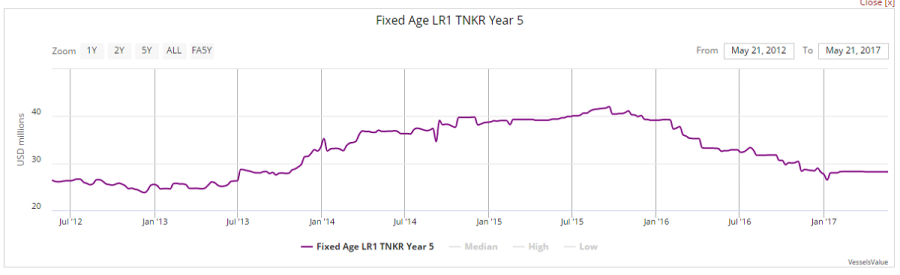
It’s interesting that Scorpio Tankers are buying now. 5 year old LR1 tanker values have been pretty flat since mid January 2017. Here is VesselsValue's Fixed Age market value for a 5 year old LR1 vessel over the last 5 years:
 |
Navig8 Product Tankers owned 10 of the vessels involved in this deal, a mix of LR1 and LR2 tankers. They are worth a total of 362.52 million USD today.
The other 17 involved in the deal are chartered in on bare boat from CSSC Shipping, China Merchants Bank, Bank of Communications and Ocean Yield ASA. These 17 vessels have a market value today of 661.64 million USD. Scorpio are going to take over the charter contract for these vessels, with the possibility of buying them once the charter is over. At this stage we are going to keep these vessels belonging to their owners until Scorpio buy them.
Here are the new rankings of the top 5 tanker owners before and after the 10 Navig8 Product Tanker vessels are bought by Scorpio Tankers:
 |
Nakilat transitions LNG Onaiza to in-house management
 |
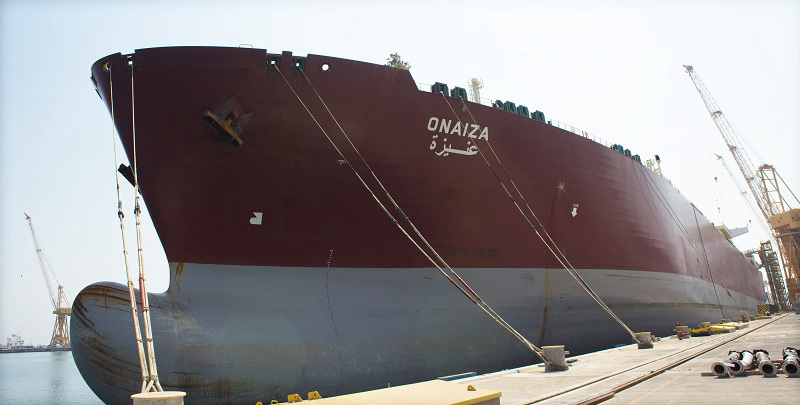
With a cargo carrying capacity of 210,150 cubic meters, Onaiza is wholly-owned by Nakilat and chartered by Qatargas. The vessel built in South Korea by Daewoo Shipbuilding and Marine Engineering was delivered in April 2009 and has been in service ever since.
Onaiza is the seventh wholly-owned LNG vessel that will come under the management of Nakilat Shipping Qatar Ltd. (NSQL), bringing the total number of vessels managed by NSQL to 15, comprising of 11 LNG and 4 LPG carriers.
About Nakilat
Nakilat is a Qatari LNG transport company providing an essential transportation link in the State of Qatar’s LNG supply chain. Its LNG shipping fleet is the largest in the world, comprising of 63 LNG vessels. Nakilat also owns and manages four large LPG carriers. Nakilat operates the ship repair and construction facilities at Erhama Bin Jaber Al Jalahma Shipyard in Ras Laffan Industrial City via two strategic joint ventures: N-KOM and NDSQ. Nakilat also offers a full range of marine support services to vessels operating in Qatari waters. For more information visit: www.nakilat.com
Dryships announces successful delivery of its newbuilding suezmax tanker and commencement of 5 year time charter
The vessel was chartered back to the seller and on May 24, 2017, commenced its five year time charter plus optional periods in charterer’s option, at a base rate plus profit share. The total expected gross backlog under the time charter, assuming an average spot market for Suezmaxes for the next 5 years of $25,000 per day is estimated to be approximately $43.1 million.
The vessel was acquired from and chartered out to entities affiliated with our Chairman and Chief Executive Officer, Mr. George Economou. The transaction was approved by the audit committee of the Company’s Board of Directors and the independent members of the Company’s Board of Directors.
Key Financial Information as of May 23, 2017:
Cash and cash equivalents: approximately $215.9 million (or $17.75 per share)
Book value of vessels, net: approximately $413.7 million (or $34.02 per share)
Debt outstanding: approximately $200.0 million
Equity, book value: approximately $429.1 million (or $35.28 per share)
Number of Shares Outstanding: 12,161,510
Mr. Anthony Kandylidis, President and Chief Financial Officer commented:
“We are very pleased to have successfully taken delivery of our sixth newly acquired vessel and to commence a time charter that is expected to provide stable and visible long term cash flow, while maintaining upside to the spot market.”
About DryShips Inc.
The Company is a diversified owner of ocean going cargo vessels that operate worldwide. The Company owns a fleet of (i) 13 Panamax drybulk vessels; (ii) 4 Newcastlemax drybulk vessels, 3 of which are expected to be delivered in the second quarter of 2017; (iii) 5 Kamsarmax drybulk vessels, 3 of which are expected to be delivered in the second quarter of 2017; (iv) 1 Very Large Crude Carrier, which is expected to be delivered in the second quarter of 2017; (v) 2 Aframax tankers; (vi) 1 Suezmax tanker; (vii) 4 VLGCs which are expected to be delivered in June, September, October and December of 2017; and (viii) 6 offshore support vessels, comprising 2 platform supply and 4 oil spill recovery vessels.
DryShips’ common stock is listed on the NASDAQ Capital Market where it trades under the symbol “DRYS.”
www.dryships.com
YES to Sea Tourism Forum
YES is the first ever forum to be held under the auspices of Ministries of Shipping, Education, Tourism, of GNTO and the majority of Greek Universities and organized by a team of 45 volunteers. The official opening of the Forum will be made by Mr. Pafsanias Papageorgiou, General Secretary for Lifelong Learning and Youth at the Ministry of Education, Mrs. Evridiki Kourneta, Secretary General of the Greek Tourism Ministry and Mr. Dimitris Trifonopoulos, General Secretary of GNTO.
It is our strong belief that the open dialogue which began at Posidonia 2016 and attracted more than 1300 delegates must continue and we hope even more people will be motivated to support our vision and effort.
The delegates of YES to Sea Tourism will have the opportunity to explore and become acquainted with Posidonia Sea Tourism exhibition, watch a yachting session, as well as submitting their enquiries in relation to sectors of cruising, yachting, and sea tourism. YES to Sea Tourism Forum will address the opportunities offered in these sectors and the required skills in order to succeed in them.
Welcome Addresses of Ilias Tsakiris , CEΟ, AMERICAN HELLENIC HULL, & Harris Daskalakis, Executive Director, BCA College, will be followed by a live discussion between forum delegates and qualified and accredited executives of the sector. Participants of the Panel will be : George Xiradakis, Managing Director, XRTC BUSINESS CONSULTANTS LTD and President of the Propeller Club (Port of Piraeus), as moderator, with speakers Diogenis Venetopoulos, Partner - Vice President Sales, VARIETY CRUISES, Emmanuel Vordonis, President of POSEIDONION GRAND HOTEL - Ex-Executive Director, THENAMARIS, Dimitris Koutsolioutsos, CEO/Founder, INSTAYACHT - FARMERS REPUBLIC, Chrissie Palassis, Partner, CTM HELLAS, Maria Theofanopoulou, Publisher of Greek Travel Pages.
The conference will be held entirely in Greek, except for the live speech and dialogue with Young Executives by Ukko Metsola, Vice President, ROYAL CARIBBEAN CRUISES LTD, which will be held in English.
YES to Sea Tourism experience does not end here. Upon completion of the panel, executives from the shipping industry will participate in 4 networking corners in order to discuss with young people regarding the sector in which they are active and answer their questions. A different topic will be analyzed at each networking corner and these are: ‘’Crew-Operations- Chartering Dept. of a Shipping Company’’, ‘’Startups – Innovation – Save Time in Shipping aAencies’’, ‘’Technical & Finance Dept. of a Shipping Company’’ and ‘’Marine Insurance & Classification Societies’’.
Forum’s program can be found at http://yes-forum.com/indicative-program/
Counting The Cost…OPEX Tops $100 Billion!
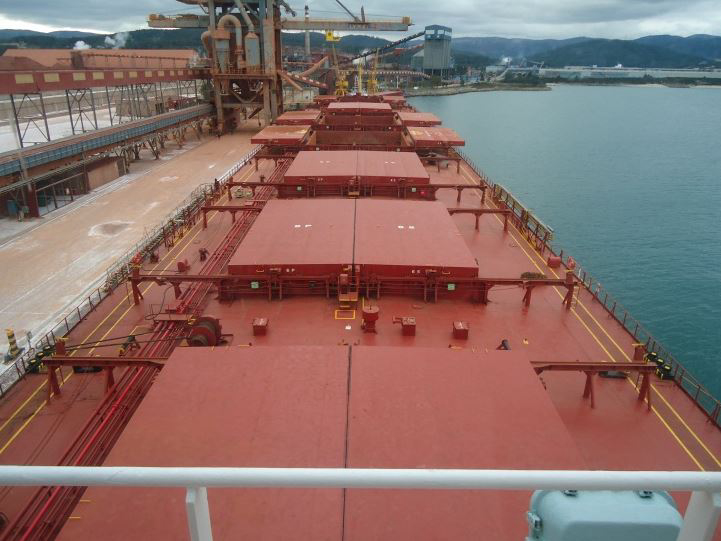
In this week’s Analysis, we review trends in ship operating expenses (OPEX) that have taken the total cost base of the shipping industry through the $100 billion barrier for the very first time.
 |
Of all global industries, perhaps few have had the extreme cost focus of shipping over the past 30 years. During the 1980s recession, any operating “fat” was largely removed with the growth of open registries and a drive to outsourcing. This helped shipping, alongside its near “perfect” competitive economic model, deliver exceptionally cheap and secure freight, in turn a key facilitator of globalisation.
Nice And Lean...
OPEX response since the financial crisis has been relatively modest. Our average OPEX index (using the ClarkSea “fleet” mix and information from Moore Stephens) shows just a 1\% decrease in OPEX since the financial crisis to $6,451/day in 2016. By comparison, the ClarkSea Index dropped 71\%, from $32,660/day in 2008 to $9,441/day in 2016 (a record low). In part, this modest, albeit painfully achieved, drop reflects upward pressures from an expanding fleet and items such as crew and ever- increasing regulation. However it also reflects the already lean nature of OPEX.
$100 Billion And Counting...
Our estimate for aggregate global OPEX for the world’s cargo fleet has now breached $100 billion for the first time, up from $98 billion last year and $83 billion in 2008. The largest constituent remains crew wages ($43 billion covering 1.4 million crew across the fleet). By comparison aggregate ship earnings for our cargo fleet fell from an eye watering $291 billion in 2008 to $123 billion in 2016!
Cutting The Fat…
One sector that has seen dramatic cost reduction has been offshore. Estimates vary, but 30\% seems a reasonable rule of thumb for reductions in OPEX since 2014. While painful, this has been part of a process of making offshore more competitive against other energy sources (offshore contributes 28\% of oil production, 31\% of gas, and 16\% of all energy) and one of the factors behind the increase in sanctioning of offshore projects.
Getting Smarter…
So shipping is one of the leanest industries around but is always under pressure to do more! It seems clear that squeezing cost in the traditional sense, offshore aside, will be pretty challenging — UK media reported on the docking of the 20,150 teu MOL Triumph, highlighting it was manned by only 20 crew! Getting smarter, collecting and using “big data” and technology and automation are all gaining traction. The industry’s fuel bill (accounted for outside of OPEX) is clearly a big target.
This will all require new technology, skills and perhaps new accounting approaches.
Monument to the Genocide of the Greeks of Pontus Unveiled in Piraeus.
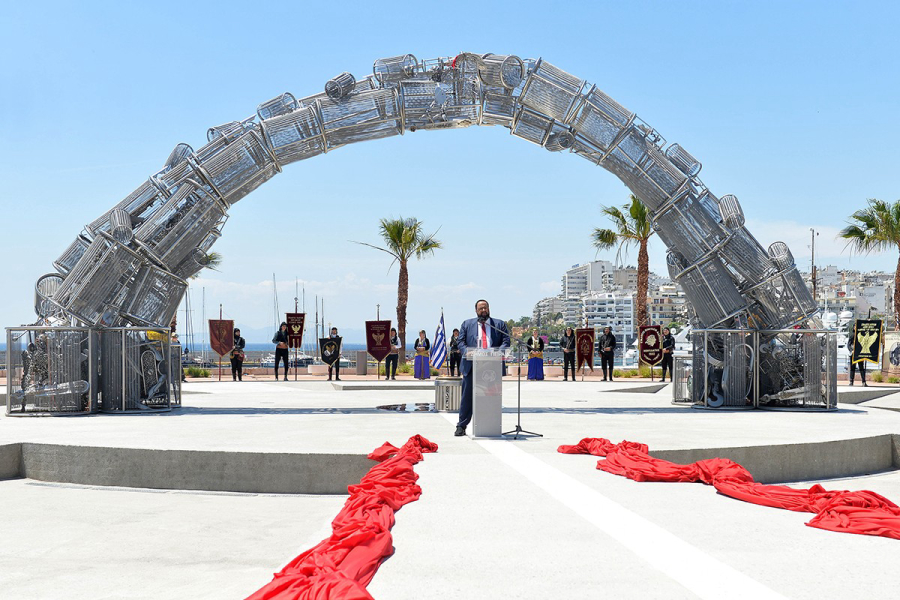
- The Monument is a contemporary work of art, titled "Pyrrhic Flight" and was created by artist Panagiotis Tanimanides
- Both the construction of this symbolic Monument and the complete reconstruction of Alexandra Square was made possible by a donation from Evangelos Marinakis
- In an atmosphere of intense emotion and in the presence of hundreds of people, a new Monument to the genocide of the Greeks of Pontus was officially unveiled today and the newly reconstructed Alexandra Square was opened.
 |
| Evangelos Marinakis donor of the Monument to the Genocide of the Pontian Greeks |
Both the construction of the Monument and the total refurbishment of the historic, 7-acre Alexandra square, with unrestricted sea views, close to the ancient walls of the city of Piraeus in Passalimani, have been made possible thanks to a donation from the Chairman of Capital Maritime & Trading Corp, President of Olympiakos FC and the first city councillor, Evangelos Marinakis.
The ceremony was part of the wider Memorial events organized by the Region of Attica and the Pan-Pontian Federation of Greece to mark the Day of the Genocide. For the first time in its history, Piraeus, the port that received the surviving refugees from Pontus, the largest port in Greece and one of the largest in the Mediterranean, was the focal point of the annual Memorial events.
The event today was attended by a great number of civic, religious and military leaders from across Greece, reflecting its great significance in national life.
The ceremony started with the arrival of a liturgical procession of the sacred icon of the Virgin Mary of Sumela which, according to tradition, was iconographed by Luke the Evangelist and is a symbol of Pontiac Hellenism. Then, Archbishop Seraphim of Piraeus delivered a memorial service for the victims of the genocide.
The Monument, created by Panayiotis Tanimanidis, is a tribute to the memory of the 353,000 Greeks of Pontus, who perished during the Genocide of the Hellenism of Pontus, perpetrated by the Turkish government of the time.
As such, the genocide of the Greeks of Pontus is a lesser known atrocity carried out by the ‘Young Turk’ Government between 1914 and 1926. It was committed alongside the Armenian and Assyrian genocides, which cost the life of millions of people overall. An estimated 353,000 Greeks perished as a result of the genocide.
The monumental three-dimensional sculpture, 15.50 m long and 7.10 m high, is made of stainless steel and has brass details. It is a contemporary work of art, presenting an imposing arch called "Pyrrhic Flight". Outwardly, it resembles a huge wave that rises from one homeland, from Pontus, to the other, with everything, memories, traditions, imprints of the ancient presence of the Greeks in Pontus.
Inside, the work is adorned with 17 sculptural compositions, successive icons depicting the flight of a "refugee bird" fleeing from Pontus to reach an unprepared homeland that sheltered the refugees' dreams.
The construction of the project and the redevelopment of Alexandras Square were carried out at the initiative of Mr Marinakis, who is connected with Pontus through ties of family. His mother, Irene Karakatsani, is a descendant of the well-known Ypsilantis family, whose ancestors played a central role in the 1821 war of Greek liberation.
Speaking at the ceremony to unveil the Monument, Evangelos Marinakis said:
"Allow me to say that today is a special day for me. Through my mother, Irene, I am honored to be a descendent of the Ypsilantis family ... The completion of this Monument is, at the same time, a fulfilment of my personal duty to the history of the Greeks of Pontus, to the history of my ancestors, and to the future generations of this country, to the young children who must not forget… This monument here, in the heart of Piraeus, will remind Greeks and foreigners arriving in Piraeus of the tragedy of the Pontian genocide, but also of their tradition and history that still holds them together united and, in spite of the hardships, still inspires them to excellence".
- Alexandra square is situated between the ancient Zea and Munichia (contemporary Passalimani and Microlimano) harbors, where Themistocles built in the 4th century B.C. the Athenian fleet that stopped the Persian invasion of Greece in the battles of Marathon and Salamis.
Cruise Lines International Association Summit at Sea 2017
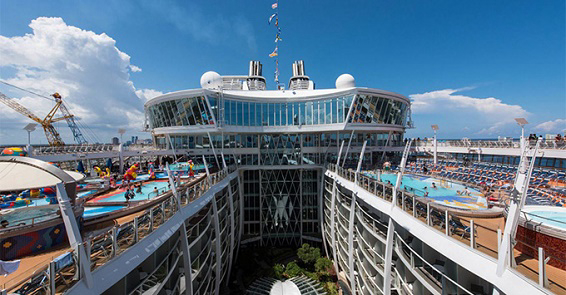
For its second international ‘Summit at Sea’ event, Cruise Lines International Association (CLIA), welcomed 175 senior cruise industry delegates from four continents, onboard the magnificent Cunard liner, Queen Elizabeth. Sailing from Hamburg to Southampton between 9-12 May, attendees included members of CLIA’s Executive Partner Programme, ranging from cruise lines, port authorities, destinations, manufacturers, shipyards and operators to legal and medical services.
After a first day of visits to the Carnival Maritime's Fleet Operations Centre and the Airbus factory, CLIA Global Chairman and President and CEO of Carnival Corporation & Plc, Arnold Donald, and CLIA Europe Chairman and CEO of Celestyal, Kerry Anastassiadis, hosted a welcome reception and dinner. The next day, the Summit started at the new Westin Hamburg, part of the impressive Elb Philharmonie concert hall, with the Presidents Panel focused on current industry topics. A high-level forum followed, focusing on the future of port infrastructure over the next decade, to accommodate the more than 70 new ships expected to be built by 2025.
After embarking on the Queen Elizabeth liner, participants were welcomed by host, David Dingle, Chairman of Carnival UK, with a traditional afternoon tea. A networking dinner in the prestigious Britannia restaurant followed the sail-away celebration.
The third and last summit day was filled with workshop sessions on technology, related safety enhancements, developing shore excursions in a congested environment, environmental policy and effectively connecting source markets with distinct cruise ship itineraries. Procurement was the focus of the last session before more networking activities, a CLIA cruise industry quiz, a farewell reception and fascinating behind the scene tour of the liner.
The Southampton shores were reached early morning on the last day, inviting guests to continue touring inspiring British tourist locations and to attend the Port Director, Alastair Welch, ABP Southampton, morning session on ‘wider port development and future opportunities in the fast-growing cruise industry’.
“This CLIA ‘Summit at Sea’ was a tremendous opportunity to share the needs operators and cruise lines have, and the ideal platform to bring together our wealth of experience to find solutions for any industry issues, and all in great comfort,” commented Marco Diodà, Group Vice President Procurement and Supply Chain of Costa Cruises.
For Kyriacos Anastassiadis, the CLIA Executive Partner programme is important for the industry, “As we need to continue building a trust between the cruise lines and stakeholders through frequent communication, to better ensure the future of all industry players”, he said.
The next international CLIA Executive Partner programme event, ‘Port and Destination Summit’, will take place in Hamburg on 5-6 September, ahead of the 2017 Seatrade Europe convention.
About Cruise Lines International Association (CLIA) – One Industry, One Voice - Cruise Lines International Association (CLIA) is the world’s largest cruise industry trade association, providing a unified voice and leading authority of the global cruise community. The association has 15 offices globally with representation in North and South America, Europe, Asia and Australasia. CLIA supports policies and practices that foster a safe, secure, healthy and sustainable cruise ship environment for the more than 24 million passengers who cruise annually and is dedicated to promote the cruise travel experience. Members are comprised of the world's most prestigious ocean, river and specialty cruise lines; a highly trained and certified travel agent community; and cruise line suppliers and partners, including ports & destinations, ship development, suppliers and business services. The organization’s mission is to be the unified global organization that helps its members succeed by advocating, educating and promoting for the common interests of the cruise community. For more information, visit www.cruising.org or follow Cruise Lines International Association on CLIA Facebook and Twitter pages.

Mr. Arnold Donald, CLIA Global Chairman and President and CEO of Carnival Corporation & Plc at “Summit at Sea”

Mr Kerry Anastassiadis, CLIA Europe Chairman and CEO of Celestyal and Mr. Arnold Donald, CLIA Global Chairman and President and CEO of Carnival Corporation & Plc during the “Summit at Sea” Presidents Panel
Autonomous Ships Will Be Great
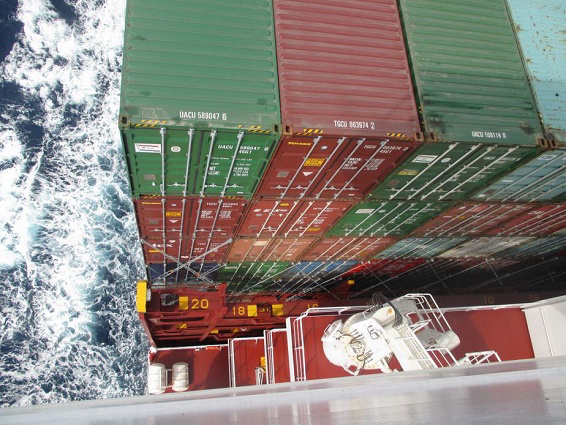
Last week, Kongsberg Gruppen ASA, a Norwegian maritime-technology firm, and Yara ASA, a fertilizer manufacturer, announced a partnership to build the world's first fully autonomous cargo containership. Manned voyages will start in 2018, and in 2020 the Yara Birkeland will set sail all on its own. It's the beginning of a revolution that should transform one of the world's oldest and most conservative industries -- and make global shipping safer, faster and cleaner than it's ever been.
The commercial rationale for autonomous ships has long been clear. The U.S. Coast Guard has estimated that human error accounts for up to 96 percent of all marine casualties. A recent surge in piracy is a grim reminder that crews remain vulnerable (and valuable) targets for international criminals. Perhaps unsurprisingly, the industry is facing a chronic shortage of skilled workers who want a career at sea.
By one consultant's estimate, moreover, carrying sailors accounts for 44 percent of a ship's costs. That's not just salaries: crew quarters, air-conditioning units, a bridge (which typically requires heavy ballast to ensure a ship's balance) and other amenities take up valuable weight and space that might otherwise be used for cargo. And that dead weight contributes to a bigger problem: Maritime shipping accounts for about 2.5 percent of global greenhouse-gas emissions. Barring a radical change, those emissions are set to surge in the decades ahead.
All this explains why eliminating a crew and its costs has been a long-time goal for companies and governments around the world. The most advanced effort so far has come from Rolls-Royce Holdings Plc, which rolled out a virtual-reality prototype of an autonomous ship in 2014. According to the company, the ship will be 5 percent lighter, and burn up to 15 percent less fuel, than a comparable vessel with humans aboard.
That effort has been the subject of considerable skepticism -- especially from seafarer unions who doubt that technology can replace experienced sailors, and note that the International Maritime Organization, the United Nations agency that oversees shipping, prohibits crewless operations. But what seemed impossible three years ago is quickly becoming reality. Most of the sensor technology for autonomous ships is now commercially available, and crucial collision-avoidance tools have been around in various forms since the early 1990s.
The Yara Birkeland is a modest but important step forward. Although it can be operated remotely by a pilot, it will also be able to cruise on its own, using an array of sensors, cameras and navigation tools, all guided by sophisticated algorithms. Back on shore, an operations center will monitor its progress.
When it launches next year, with a fully electric power plant, the ship will transport fertilizer from Yara's factory to ports about 16 miles away, thereby replacing 40,000 shipments a year that had once been carried by polluting diesel trucks. That short route will give the ship's owners -- along with regulators and other autonomous shipping aspirants -- a first chance to see such a vessel in operation.
Such trips may soon become routine. Norway has designated the waters off of Trondheim as a test site for autonomous ships of all kinds, from container vessels to tugs. Earlier this year, Rolls-Royce announced that it expects autonomous container ships in international waters within 10 to 15 years. Other groups are working to do it sooner: One U.K. organization plans to have a solar-powered autonomous research vessel cross the Atlantic in 2019. Lloyd's Register, the 250-year-old ship-classification group, has already issued guidance for crewless operations.
All this could potentially have enormous benefits for the shipping industry -- and the world. Vast amounts of real-time data from the ships will allow fleet owners to optimize their routes (and profits) based on factors such as maintenance schedules, weather patterns, fuel prices and cargoes. Eventually, fleet owners might find themselves competing with the likes of Amazon.com Inc. and Alibaba Group Holding Ltd. -- major shippers with the big data operations and deep pockets necessary to integrate autonomous ships into their logistics operations.
For those companies, "all hands on deck" already means fingers on a keyboard or a joystick. Within a decade or two, the maritime shipping industry may well be thinking the same way.
source:bloomberg.com
NAP ENGINEERING has signed with DNVGL to perform a European Commission DG Mobility & Transport (MOVE) Tender on Assessment of specific EU Requirements for Ro-Ro passenger ships
 |
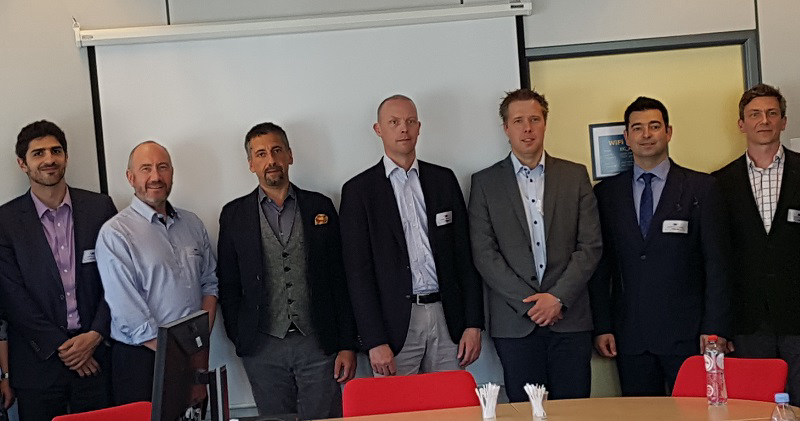
| Photo from the Kick of meeting in DG MOVE Premises in Brussels. From left to right: S. Papageorgiou / EMSA, Odd Karsten /DNVGL, L. Benedetti / DG MOVE, J. Roos / INTERFERRY, V. Øksnes / LMG, G. Pratikakis / NAP & J. Cichowicz / Brookes Bell |
The company shall provide a sample of six ships operating in Mediterranean Sea, in addition to the other fourteen vessels from the North Europe. For those ships, the attained subdivision index A will be calculated by use of the new s-factor agreed at SLF55.
 |

Powered by  © Μaritimes 2019