

-
Home

-
Maritimes NEWS
-
Ports
- maritimes


maritimes
China contributes strength to BRICS partnership for win-win cooperation
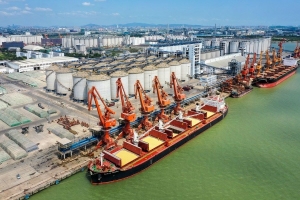
BEIJING/JOHANNESBURG, Aug. 21 (Xinhua) -- China is playing an important role in driving mutually beneficial BRICS cooperation, said experts, noting that further developments are expected to emerge as the 15th BRICS Summit takes place in Johannesburg, South Africa, from Aug. 22 to 24.
Guided by the BRICS spirit of openness, inclusiveness and win-win cooperation, member nations have enhanced cooperation to promote economic recovery in the aftermath of the COVID-19 pandemic, according to the experts.
China's foreign trade with other BRICS countries -- Brazil, Russia, India and South Africa -- soared 19.1 percent year on year to 2.38 trillion yuan (about 330.62 billion U.S. dollars) in the first seven months of 2023, data from the General Administration of Customs showed Monday. This accounted for 10.1 percent of China's total foreign trade value during the period, marking a rise of 1.6 percentage points.
Specifically, China's exports to these countries totaled 1.23 trillion yuan, up 23.9 percent year on year, while its imports reached 1.15 trillion yuan, with a year-on-year growth of 14.3 percent.
According to Dr. Kenneth Creamer, an economist from the University of the Witwatersrand in Johannesburg, "the main objective of BRICS is to encourage increased levels of trade and cooperation among member countries and BRICS has been successful in advancing this objective since its first meeting."
"Increased cooperation in sectors such as energy and agriculture can play an important role in lifting levels of economic growth and employment in BRICS member countries. Increased trade and cooperation among BRICS countries can also assist in promoting economic recovery after the negative impact of the COVID-19 pandemic," said Dr. Creamer, who is also a member of the Presidential Economic Advisory Council.
Regarding the China-South Africa cooperation, Dr. Creamer said China and South Africa should build on existing strong relations to seek to better integrate the countries' manufacturing and supply chains to aid development and opportunity in both countries.
In the first half of the year, bilateral trade between China and South Africa reached 28.25 billion U.S. dollars, up 11.7 percent year on year, official data showed. China has maintained its position as South Africa's largest trading partner for 14 consecutive years, while South Africa has been China's largest trading partner in Africa for 13 consecutive years.
"Chinese enterprises should be encouraged to use South Africa as a base country from which to manufacture, assemble and deliver products and services for sale in other countries in Sub-Saharan Africa," Dr. Creamer said.
China has remained Africa's largest trading partner for 14 consecutive years. The two sides have together constructed and commissioned over 10,000 km of railway, nearly 100,000 km of highway, and an array of important infrastructure projects, including airports, docks, bridges and power plants, according to China's Ministry of Commerce.
Speaking to Xinhua, Tshifhiwa Tshivhengwa, CEO of the Tourism Business Council of South Africa, said they are looking at the BRICS summit to bring in more tourists. "It's a major event. We're expecting it to boost our tourism."
"We need to focus on countries like China to bring more tourists to the country. That's where our growth in terms of tourists will come from; we need to look beyond the traditional areas," Tshivhengwa added.
Wandile Sihlobo, chief economist and researcher at the Agricultural Business Chamber of South Africa, pointed out that China has one of the biggest markets in the world in terms of agricultural products.
"South Africa is one of the countries that is also trying to deepen its exports into China, which is something that is part and parcel of the discussions that are happening within the various BRICS business working groups," Sihlobo said.
Themed "BRICS and Africa: Partnership for Mutually Accelerated Growth, Sustainable Development and Inclusive Multilateralism," this summit will carry forward the sound momentum of cooperation from the BRICS "China Year" 2022 and chart a brighter future for BRICS.
"The summit is of great significance for advancing practical cooperation among emerging markets and developing countries in various fields, promoting global governance reform, and enhancing the representation and voice of developing countries," said Li Wentao, a researcher with the China Institutes of Contemporary International Relations.
Li added that against the backdrop of major global changes, the solidarity and cooperation among BRICS countries will bring more certainty to an uncertain world. ■
China, other BRICS countries report rapid trade expansion in Jan.-July
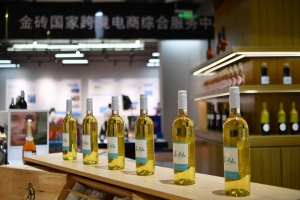
BEIJING, Aug. 21 (Xinhua) -- China's trade with the other four BRICS countries maintained rapid expansion in the first seven months of the year, official data showed Monday.
China's imports and exports with other BRICS members expanded 19.1 percent year on year to 2.38 trillion yuan (about 330.62 billion U.S. dollars) during the January-July period, data from the General Administration of Customs showed.
Exports grew 23.9 percent year on year to 1.23 trillion yuan while imports rose 14.3 percent from a year ago to 1.15 trillion yuan, the data showed.
Trade with these countries accounted for 10.1 percent of China's total foreign trade in the first seven months. The figure was up 1.6 percentage points from a year ago, according to the customs authorities.
China's trade with other BRICS countries grew 17 percent year on year to 3.69 trillion yuan in 2022, customs data showed.
China's private enterprises were the main contributor to its trade expansion with other BRICS countries. Imports and exports of these enterprises increased 29.4 percent year on year to 1.36 trillion yuan in the first seven months, accounting for 57.1 percent of the country's total.
Major export growth drivers were labor-intensive goods, and mechanical and electrical products, according to the customs authorities.
Exports of mechanical and electrical products rose 38 percent year on year during the January-July period, while that of labor-intensive goods went up 20.5 percent from a year ago, the data showed.
In particular, exports of lithium batteries and electric passenger vehicles logged a year-on-year growth of 129.5 percent and 601.3 percent, respectively.
Boosted by close cooperation, China's imports of energy products and agricultural produce saw a steady increase. The country purchased a total of 422.78 billion yuan of energy products from other BRICS members in the first seven months, up 17.3 percent from a year ago. ■
Belt and Road cooperation has made massive advances: official
BEIJING, Aug. 24 (Xinhua) -- Massive advances have occurred through jointly building the Belt and Road over the past decade, said a Chinese government official.
In a recently published signed article by Zheng Shanjie, head of the National Development and Reform Commission, China's national economic planner, the official said that over the past 10 years, China has signed more than 200 cooperation documents on the joint construction of the Belt and Road with 152 countries and 32 international organizations, covering 83 percent of the countries with which China has established diplomatic relations.
Infrastructure connectivity has become more accessible through Belt and Road cooperation, Zheng said, citing various landmark projects, such as the China-Europe Railway Express, the New International Land-Sea Trade Corridor, and the China-Laos Railway.
The China-Europe Railway Express has reached 211 cities in 25 European countries, and the New International Land-Sea Trade Corridor has connected China's central and western regions with more than 300 ports in over 100 countries, said Zheng.
From 2013 to 2022, the import and export of goods between China and countries along the Belt and Road increased by an average of 8.6 percent annually, Zheng said, adding that their cumulative two-way investment has exceeded 270 billion U.S. dollars.
In the overseas economic and trade cooperation zones built by Chinese enterprises in the countries along the Belt and Road, 421,000 local jobs were created over the past decade, Zheng said.
"It is estimated that by 2030, the joint construction of the Belt and Road would have helped lift 7.6 million people out of extreme poverty and 32 million people out of moderate poverty in the relevant countries," Zheng said. ■
Xi calls for more just, equitable world order at BRICS forum

Chinese President Xi Jinping on Tuesday expressed China's willingness to deepen solidarity and cooperation with other emerging markets and developing countries to push for a more just and equitable world order.
China's housing ministry proposes eased restriction on first-home buyer identification

BEIJING, Aug. 25 (Xinhua) -- The Ministry of Housing and Urban-Rural Development announced Friday that it is in favor of re-adjustment of mortgage lending-related policies and measures regarding the identification of first-home buyers.
The ministry said that this was in accordance with a circular that was recently jointly issued by the ministry, together with the People's Bank of China, China's central bank, and the National Financial Regulatory Administration.
According to the circular, a household whose family members do not own a house at a certain locality, should be deemed a first-home buyer when applying for a mortgage loan from a bank.
The housing ministry, however, indicated that the new policy only provides an option for cities, which means cities can either adopt it or not adopt it, based on their own choices.
The ministry added that this policy will enable more home buyers to enjoy reduced down payment ratios and lowered mortgage lending rates, help reduce house purchase costs for residents, and better meet the rigid housing demand and needs of those who wish to improve their housing conditions through a property sale and repurchase process.
Previously, home buyer classification was based on the identification of either mortgage loan usage or ownership of a house. To put it simply, in the past a home buyer would have been seen as a second-home buyer if he/she had a record of mortgage loan usage or previous house ownership. For second-home buyers, higher downpayment ratios and higher lending rates are applied compared to first-home buyers. ■
Beijing-Tianjin-Hebei region sees foreign trade growth in Jan.-July
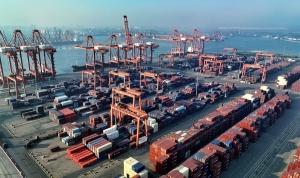
SHIJIAZHUANG, Aug. 25 (Xinhua) -- The Beijing-Tianjin-Hebei region saw its foreign trade increase by 2.9 percent year on year to about 2.86 trillion yuan (about 397.9 billion U.S. dollars) in the first seven months of this year, according to Shijiazhuang Customs.
The region's foreign trade accounted for 12.1 percent of the country's total in the period.
From January to July, the region's imports reached 2.1 trillion yuan, a year-on-year increase of 1.6 percent, while its exports amounted to nearly 754.09 billion yuan, up 6.7 percent year on year.
The region's imports and exports to the European Union (EU), the United States, Australia, and Brazil increased in the first seven months of the year, up by 2.1 percent, 0.6 percent, 12 percent, and 34.9 percent, respectively.
During the period, mechanical and electrical products accounted for over half of the region's total export value. Meanwhile, the export of automobiles reached 29.09 billion yuan, up by 115.7 percent year on year.
In terms of imported commodities, crude oil imports stood at the first place in the first seven months of the year, while high-tech products imports grew rapidly during the period. ■
Interview: China's new measures offer broader opportunities for foreign investment
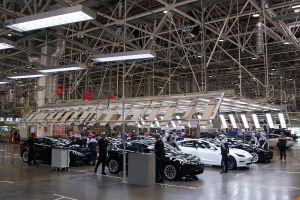
BEIJING, Aug. 26 (Xinhua) -- China considers it vital to attract and utilize foreign investment while advancing its economic development, and the guidelines the country unveiled lately aim at providing a more favorable business environment and broader market opportunities for foreign-invested companies, said an expert with the Development Research Center of the State Council.
In the guidelines outlined by the State Council in mid-August, 24 specific measures in six aspects have been put forward, which include guaranteeing national treatment for foreign-invested enterprises, increasing financial and tax support, and fostering a world-class business environment that is market-oriented, law-based, and internationalized.
The guidelines came timeously, said Zhang Qi, head of the center's foreign economic relations research department.
The COVID-19 pandemic, geopolitical conflicts, and trade and investment protectionism have led to sluggish world economic recovery and cross-border investment.
In this context, introducing and implementing the guidelines will help further boost the confidence of multinational corporations in their long-term operations in China, said Zhang.
The measures will also help provide new impetus to the recovery of global cross-border investment and stabilization of the global industrial and supply chains as they come into play, said Zhang.
The expert pointed out that some of these measures would expand China's modern services industries so that multinational corporations could enter emerging sectors, such as value-added services in the telecommunications industry, and grasp growth opportunities in the country's digital economic development.
Some measures encourage foreign investment to participate in China's innovation drive, allow new foreign products, especially those in the healthcare sector, to enter the Chinese market faster, and explore facilitated security management mechanisms for cross-border data flows, said Zhang.
Meanwhile, multiple measures are devoted to strengthening the protection of foreign investment's legitimate rights and increasing support for foreign-invested companies to provide them with a more favorable business environment.
The guidelines fully demonstrate China's confidence and determination to high-standard opening up and to attract multinational companies to participate in the construction of Chinese modernization, said Zhang. ■
Belt and Road trade conference to be held during China-Arab expo
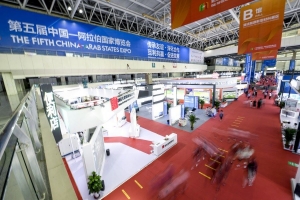
YINCHUAN, Aug. 22 (Xinhua) -- The Belt and Road Trade and Investment Promotion conference will take place during the sixth China-Arab States Expo, which will run from Sept. 21 to 24 in Yinchuan, the capital of northwest China's Ningxia Hui Autonomous Region, said local authorities Tuesday.
Starting on Sept. 21, the two-day conference will be committed to creating conditions for exchanges and cooperation between Chinese and Arab enterprises, focussing on deepening economic and trade cooperation under the Belt and Road Initiative, said the region's government.
The conference includes four parallel forums, namely, the Multinationals' Economic and Trade Cooperation Meeting in Ningxia, the Cross-border e-commerce Innovation and Development Summit, the Investment Promotion Conference for Overseas Industrial Parks of Countries Jointly Pursuing Belt and Road Initiatives, the China-Saudi Arabia (Jazan) Industrial Park, and the Matchmaking Meeting of Trade and Investment in Specialty Industries.
First held in 2013, the China-Arab States Expo has become a significant platform for China and Arab states to promote pragmatic cooperation and advance high-quality Belt and Road cooperation.
Over the past ten years, the China-Arab States Expo has attracted over 400,000 participants and 6,000 enterprises from 112 countries and regions, signing more than 1,200 cooperation projects in modern agriculture, high technologies, and biomedicine.
China is now the Arab states' largest trading partner. China-Arab trade volume almost doubled from 2012 to 431.4 billion U.S. dollars last year. In the first half of this year, trade between China and the Arab states reached 199.9 billion dollars. ■
Swedish waste collection company commits to long-term cooperation with China, says CEO
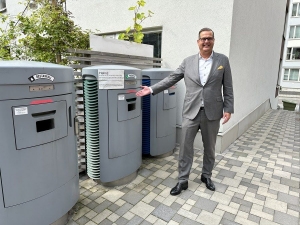
Envac is the inventor of a pneumatic waste collection system, which moves the procedure underground and replaces manual waste collection from individual refuse chutes, reducing waste-related heavy traffic and its carbon emissions dramatically. This technology has been adopted by many smart-cities and hospitals in China.
STOCKHOLM, Aug. 23 (Xinhua) -- Collaboration with China on the development of smart and sustainable cities is worth long-term commitment, the chief executive officer (CEO) and president of Sweden's innovative waste collection company Envac AB told Xinhua in a recent exclusive interview.
Joakim Karlsson said he is very impressed by China's leadership in and awareness to the pursuit of green, circular and low-carbon development.
Highlighting his Chinese partners' ambition and strong drive to use smart waste collection technologies, he said it is important to walk the talk -- "from words to ambitions actions to implement this (green development) with China speed."
Envac is the inventor of a pneumatic waste collection system, which moves the procedure underground and replaces manual waste collection from individual refuse chutes, reducing waste-related heavy traffic and its carbon emissions dramatically. This technology has been adopted by many smart-cities and hospitals in China.
Looking back on years of close collaboration, the CEO said that he understood "China speed" which he was "super impressed by." "With 'China speed', you are developing and implementing (the technology) so fast," he said.
Envac, he said, is committed to maintaining its long-term presence in the Chinese market, which in 2022 contributed to about 20 percent of Envac's total global revenue.
The CEO recalled that Envac established its business in China 15 years ago, and has already collaborated on 70-odd projects in the Chinese mainland and Hong Kong. In 2022, the company saw the number of its projects in China increase by 70 percent year-on-year.

Photo taken on Aug. 21, 2023 shows the inlets of Envac's waste collection system in Hammarby Sjostad eco-city in Stockholm, Sweden. (Xinhua/He Miao)
Market demand for the development of smart and sustainable cities and hospitals is growing, Karlsson said, adding that the company's ambition to contribute to the development of smart and sustainable cities ties in well with China's ecological goals.
"I strongly believe also in the healthcare segment, because this is actually our fastest growing business segment in China," he said.
Noting China's advances in 5G technology and its innovative applications, Karlsson said he expects Envac to "absolutely" benefit from China's 5G ecosystem.
"I think we are in the beginning of good opportunities," he said. "And if we increase the cooperation, it's good for everyone."

Joakim Karlsson, CEO and president of Sweden's innovative waste collection company Envac AB, explains the company's waste collection system during an interview in Stockholm, Sweden, on Aug. 21, 2023. (Xinhua/He Miao)
Having visited China six times, Karlsson said: "I love your history and culture, and also the interaction with customers. We are proud to be able to contribute to China's development." ■
Number of cargo ships, aircraft traveling between Shanghai, other BRICS countries increases significantly
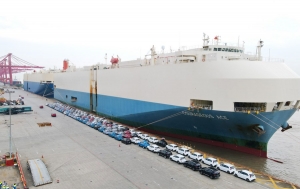
SHANGHAI, Aug. 23 (Xinhua) -- Shanghai saw a surge in the number of cargo ships and aircraft traveling between it and other BRICS countries in the first seven months of this year, as foreign trade between China and these nations maintained rapid growth, local customs authorities said on Wednesday.
A total of 526 international ships sailed directly from Shanghai to other BRICS countries, including South Africa, from January to July, according to Shanghai Customs. That was an increase of 140 percent over the same period last year. There were 602 inbound and outbound aircraft at Shanghai ports, an increase of 110 percent year on year, according to Shanghai Customs.
During the same period, the total value of imports from other BRICS countries to Shanghai and exports from Shanghai to other BRICS countries was 411.2 billion yuan (about 57.12 billion U.S. dollars), up 15.8 percent year on year. ■

Powered by  © Μaritimes 2019