




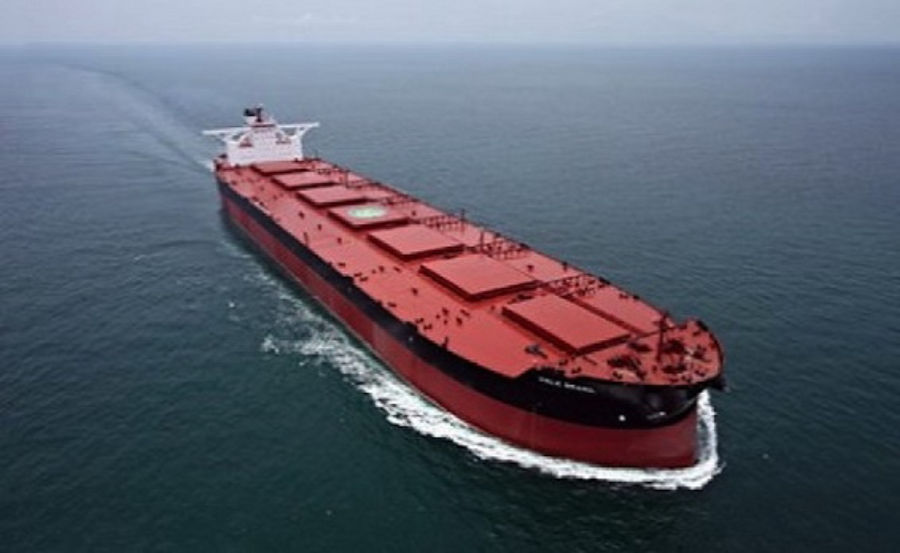
The survey conducted over August and September involved around 120 dry bulk market participants, with respondents including shipowners, ship-operators, charterers, shipbrokers and analysts. Those polled represented all dry bulk sectors including the Capesize, Panamax, Supramax and Handysize markets.

The frustration over the slow recovery of the dry bulk market is evident with most participants, a whopping 94\% of the respondents, saying the market will need more than a year to recover, while 61\% do not see a recovery over the next three years. A similar survey conducted by Platts in July 2015 showed 89\% expecting a recovery after one year and 54\% anticipating improvement in three years. With the dry bulk market showing a semblance of stability since the second half of this year, the shipowners’ camp appears to be a tad more confident. The charterers appeared more bearish compared to shipowners with 61\% of all charterers convinced that it will take more than three years for this sector to recover, while more than half of the owners (52\%) think it could recover in less than three years. On the contrary, the shipowners were more bearish than charterers during the 2015 survey. “To be realistic [the market] won’t improve dramatically even by then,” said a ship-operator source.

TOO MANY SHIPS… REALLY?
It came with a complete lack of surprise that ship recycling and fewer newbuilding orders were touted as the most important factors that would help the market recover. The overwhelming majority – 80\% of respondents – believe that tonnage supply is the main issue. Only 20\% ranked an increase in ton-mile demand ahead of scrapping and curtailed newbuilding orders, as vital factors to help the market recover. Among the various sectors of the dry bulk market, 44 \% of the respondents think Capesize vessels require the most scrapping. The Supramax vessels were chosen by 26\% of respondents, while 25\% went for Panamax. However, only 5\% chose the Handysize sector as the one that needs large-scale scrapping. “Tonnage growth has been largest for Capesize [vessels] but demand growth has been subdued for iron ore and coal,” said Jayendu Krishna, a director at Drewry Maritime Advisors, adding that demand from these would not grow as it has done historically. According to Krishna, it is difficult to anticipate that coal and iron ore will grow at the rate it did in the past. “Volumes have grown but not tremendously. Also very large ore carriers [VLOC] and Valemaxes have been ordered. This will also pressure [demand for Capesizes]. But new Capesize cargoes are not emerging. Bauxite is seen from West Africa to China. But that is not going to be a savior,” he said. Data from Bancosta Research show that during the first three quarters of 2016, 11.28 million dwt of Capesizes and 7.07 million dwt of Panamaxes were scrapped. For Supramax and Handysize segments, scrapping totaled 3.12 million dwt and 2.15 million dwt respectively.

MOVEMENT IS MONEY
During the beginning of the year, when returns across most dry bulk sectors were below operating expenses (opex), the talk of layup was big as a temporary measure to control vessel supply. According to market estimates during Q1 2016, a few hundred ships were pulled out of the market and put into hot or cold layup. With the scrapping rates getting better during the first half of the year along with improved demand, shipowner returns were able to cover opex, which saw the talks of laying up ships evaporating. Layup didn’t find much favor among the respondents with 48\% of the view that “shipowners are more worried about cash flow” — a reason why layup did not catch on as a huge trend.

Only 19\% felt that fragmented ownership deterred laying up of ships. “As rates picked up from the lows seen in Q1, talk of laying up vessels has reduced as most shipowners seek to continue operating as long as rates are still able to cover their running cost. Some shipowners also face pressure from banks to continue operation in order to meet repayment obligations,” said Chong Hui Ru at Bancosta Research. It’s a fact that shipowners are under a lot of pressure from their lenders to show that cash flow is in order for the financial
institutions to continue supporting them and refinancing the ships, a researcher with a shipbroking house said. Furthermore, because of the low concentration of shipowners in the dry bulk market, one shipowner idling his ships is perceived as helping out the neighbor, who will carry on operating his fleet, the researcher added. The strategy of running a shipping business on cash flow is unsustainable in the long run and the current environment seems to be a ripe recipe for the consolidation of the industry as shipowners play the survival game of seeing who runs out of cash first. “While this will be a painful process for shipowners, the industry would benefit in the long term as excess capacity is permanently removed. In comparison, the laying up of vessels only serves to delay the market recovery for dry bulk shipping, as vessels are able to return to operation as soon as rates pick up,” Bancosta’s Hui Ru said. The overall costs of laying up a ship, particularly in cold layup, are still very delicate to assess, specifically in regards to the damage sustained by the engine, electronics and other hardware of the ships while they are turned off. “Laying up a vessel might represent a cost saving exercise in the short term, but a mightier cost in the long term,” the researcher with the shipbroker said.

NEW LADIES IN TOWN
While Supramaxes have indeed been quite resilient, this sector is facing some internal competition as the popularity of Ultramax vessels increases. These slightly larger ships in the Supramax family boast a size of 60-64,000 dwt and an improved design, which allows better fuel efficiency. The flurry of Ultramax deliveries could apply pressure on the Supramax sector’s ability to generate cash. “It is good to see such a healthy grain season, but the trade barriers that are increasingly lifting up in the steel industry will eventually translate in fewer steel stems moved about, which had heavily contributed to support Supramax rates,” the researcher added.

Close to 150 Ultramax size vessels have been delivered during the first nine months of 2016. The effect of a burgeoning Ultramax fleet size was not immediately seen on the Panamaxes or the Supramax sectors by 65\% of respondents. They perceive these sectors either have their niche markets or that the intrinsic demand still remains for them. Considering the geographies of the respondents, 56\% of those based in the west of Suez, think the Ultramaxes are eroding demand for Supramax and Panamax vessels. Only 29\% of respondents from the east of Suez thought along the same lines. “It seems possible for the Supramax segment to give way to the Ultramaxes, due to increased fuel efficiency and cost savings when the larger carrying capacity of Ultramaxes is fully utilized.
This can make a large difference when trading margins are thin, as is the case currently with most commodity prices pressured due to oversupply,” Bancosta’s Hui Ru said. A few market sources echo that the Ultramax ships have already started to impact the Supramax vessels, while not having much of an effect on the Handysize tonnage. Expectations are rife that in the next three to four years, more Ultramax ships could eat into the Supramax vessels’ cargo share with the parcels of minor bulk products increasing. “Maybe for expensive cargoes like grains, it does not make sense to load additional volumes as we won’t know if it would get sold. But for coal, I don’t see any reason why with time, a larger vessel won’t help,” a second source with a ship-operator said.
Source: S&P Platts

