
Friday, May 01, 2026

Representatives from both the political and business constituents of the Polish and Greek maritime industries joined forces on Thursday 9th February in Athens at a high-level meeting aimed at promoting business opportunities between the two countries.

17 shipowner groups, 4 shipbuilders, 7 engineering / technology companies, 5 consultancy companies and 2 Classification Societies attended this unique and pioneering event which was co-organized by the Embassy of the Republic of Poland in Athens and Mare Forum. The meeting was chaired by Mr. Apostolos Poulovassilis, CEO Aegean Shipping Management.

The meeting proved to be a success; we were treated to well-informed speakers, excellent presentations, very good discussions and a positive atmosphere, resulting in new perspectives and ideas for the Polish Greek cooperations in maritime business. 

We thought you might be interested in the conclusions of the meeting, and the delivered presentations. 

The conclusions of the meeting can be found on http://polandgreece2017.mareforum.com  Should you wish to review the presentations please go to Presentations Poland-Greece where you will also find a copy of the final list of registrations and attendance

For more insights on “maritime Poland” we kindly point out the 2nd Mare Forum Poland 2017 organised by Mare Forum on Tuesday 16 May 2017 in Sopot, Poland. 

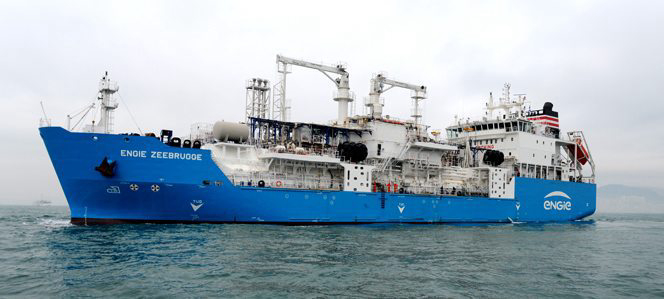
The new Gas4Sea partnership has taken delivery of the world’s first purpose-built LNG bunkering vessel from Hanjin Heavy Industries and Construction in South Korea.

Gas4Sea is made of French energy and utility company, ENGIE and Jopan’s Mitsubishi Corporation and NYK Line.

The dual-fueled Engie Zeebrugge will be hompeported at the port of Zeebrugge in Belgium. From there, the 5,000 m3 LNG capacity LNG Bunkering Vessel (LBV) will supply LNG bunker fuel to ships operating in Northern Europe. The two LNG-fueled pure car and truck carriers (PCTC) operated by United European Car Carriers will be its first customers.

She will run on LNG for her maiden voyage from South Korea after a few days of loading LNG delivered by trucks at HHIC’s Yeongdo shipyard, where the vessel was constructed.

Photo credit: ENGIE
Photo credit: ENGIE

The ENGIE Zeebrugge will load LNG fuel at Fluxys’ LNG terminal in Zeebrugge, where small carriers with capacities from 2 000 m3 can dock at the recently commissioned second jetty.

Last September, ENGIE, Mitsubishi Corporation and NYK launched “Gas4Sea”, a brand name to market ship-to-ship LNG bunkering services worldwide, first via the ENGIE Zeebrugge in Northern Europe. The brand signed its first customer, French container shipping group CMA CGM, in October. 

The delivery of the Engie Zeebrugge comes amid more stringent emission regulations for ships. As from January 2015, regulatory emission limits for SOx have been reduced by the International Maritime Organisation (IMO) from 1.0\% to 0.1\% in so-called Emission Control Areas (ECAs, which include the North Sea, the Baltic Sea area and areas around North America). More recently, according to a decision by IMO, emission limits for SOx will be reduced outside the ECAs from the current 3.5\% to 0.5\% as of January 2020.

The operation of LNG-fueled ships can result in a reduction of nearly all emissions of SOx and particulate matter (PM), compared to ships powered with conventional fuels. LNG use can also reduce CO2 emissions by up to 25\% and NOx emissions by more than 80\% compared to gasoil.

A main challenge in the widespread adoption of LNG bunker fuel is developing the supply infrastructure to support the increasing number of LNG-fueled ships that are expected to come into operation. So far LNG-fueled ships have been largely dependent on fixed bunker locations or the limited bunkering capacity of Truck-to-Ship LNG trailers.

ENGIE Zeebrugge

Length overall: 107.60 meters
Breadth: 18.40 meters
Depth: 9.00 meters
LNG capacity: 5,000 m3
Gross tonnage: 7,403 tons
Main engine: Dual Fuel (marine gas oil, marine diesel oil, and LNG)
CountryFlag: Belgium
Class: Bureau Veritas
Shipyard: Hanjin Heavy Industries & Construction Co. Ltd., Yeongdo Shipyard (Pusan)
Ship management: NYK Energy Transport (Atlantic) Ltd. (NYK LNG Shipmanagement (UK) Ltd.)

Thursday, 16 February 2017 22:20

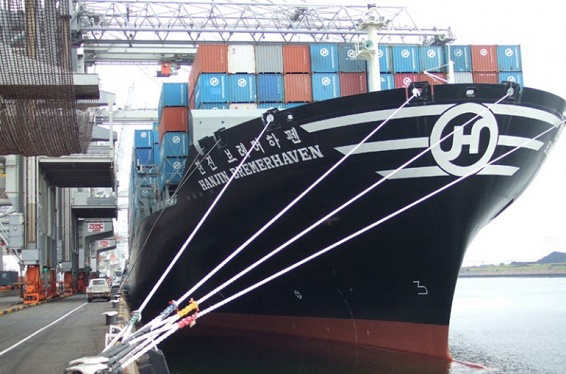
Hanjin is going to be liquidated this Friday

Following on from recent news reports that Hanjin is going to be liquidated this Friday, see the below statistics

The majority of their fleet is still listed on VesselsValue as being owned by them. Much of the sales activity has been down to financiers selling off the vessels as they tended to be leased to Hanjin. 9 vessels are currently for sale (7 bulkers and 2 boxships). We expect the others to go following the liquidation.

Hanjin Fleet


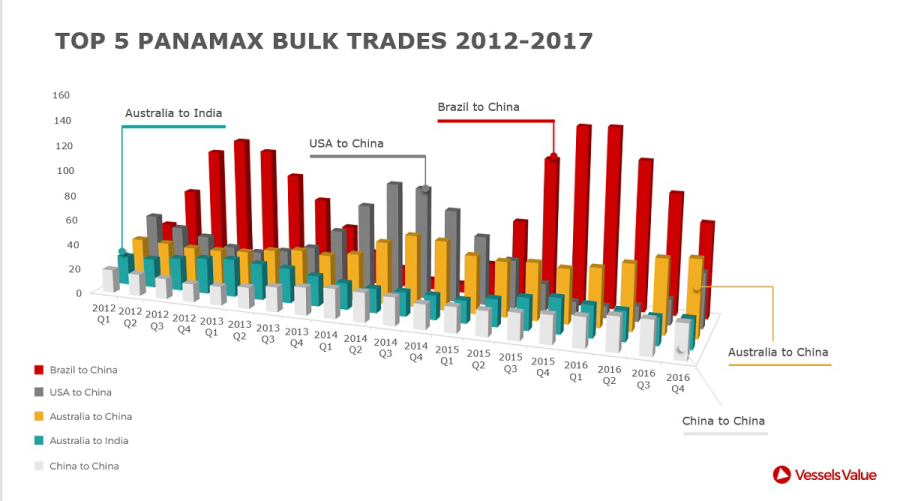
Knowing which trade routes are growing in demand and which are shrinking is key for optimising which sectors ship owners should specialise in.

The evolution of the top 5 trade routes for Panamax bulkers can be measured through the billons of ton miles (laden distance travelled multiplied by the amount of cargo carried for every vessel in the fleet) moved from country to country over time.

The Panamax bulker trade is mainly a grains trade, especially soybeans, and is very volatile. Previously, it has been dominated by vessels moving cargos from Brazil to China. However this route has been on a downtrend from a peak during the last quarter 2015.

The main soybean export competitor to Brazil is the USA. This route peaked in 2014 to 2015 when the US had better than normal harvest, which led to lower US export prices, and increased sales to China. Meanwhile, Brazil’s soybean crop that season developed slower due to weather incidents, and the US “poached” Brazil’s exports to China.

Q4 2016 saw a continuation of the reduction of ton miles on the Brazil to China route, with increases on the Australia and USA to China routes.

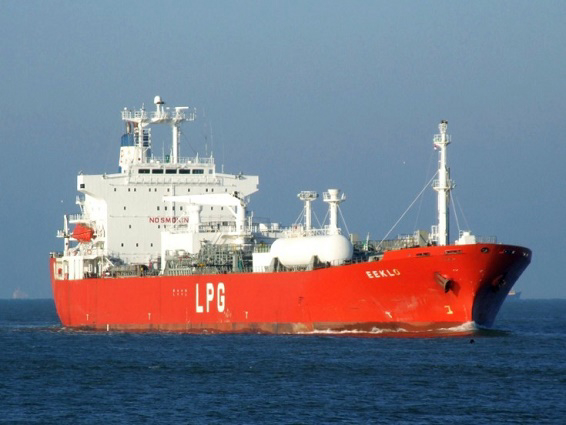
The LPG shipping trade will continue to grow at a healthy pace on the back of strong Asian demand, but fleet growth will outpace it, keeping rates under pressure in 2017, according to the latest edition of the LPG Forecaster, published by global shipping consultancy Drewry.

2016 was a tough year for LPG shipping with rates coming under pressure across all size segments. 2017 is expected to be no different with the fleet set to grow by another 16\%, on top of the 17\% expansion seen last year.

Asia-Pacific countries have been the major drivers of the LPG trade for several years, and imports to this region have grown at a robust rate of 12\% annually over the last four years. Drewry believes the region will continue to be the major driver of future LPG trade as a vast section of the population still does not have access to clean-burning LPG fuel. The LPG trade is forecast to grow at around 5\% pa over the next four years.

The mismatch between fleet and trade growth will further squeeze LPG rates in 2017. Drewry expects rates for all LPG vessel segments, except the small coasters, to decline as fleet growth will be too great for the market to absorb. The strongest fleet growth will be registered in the MGCs segment at 35\%, followed by the Handy-Size and VLGC segment, where the fleet will expand at 23\% and 16\% respectively in 2017.

Given the widening supply-demand balance, Drewry remains bearish on all the above LPG vessel sectors and expects rates to fall further in 2017.

“Currently, the LPG market is flooded with excess vessel supply but from 2018 fleet growth will slow down. This indicates a good long-term outlook, however we expect only a modest recovery in rates in 2018 as the market will require about two years to regain its balance,” commented Shresth Sharma, senior analyst for gas shipping at Drewry.
Source: Drewry
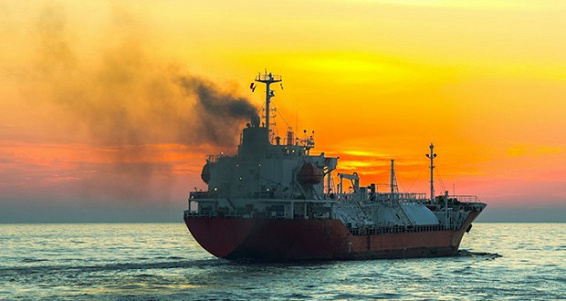
Shipping emits substantial amounts of CO2 which, without significant intervention, will rise as a proportion of our national emissions as we become less carbon dependent in other industry sectors

Full Report

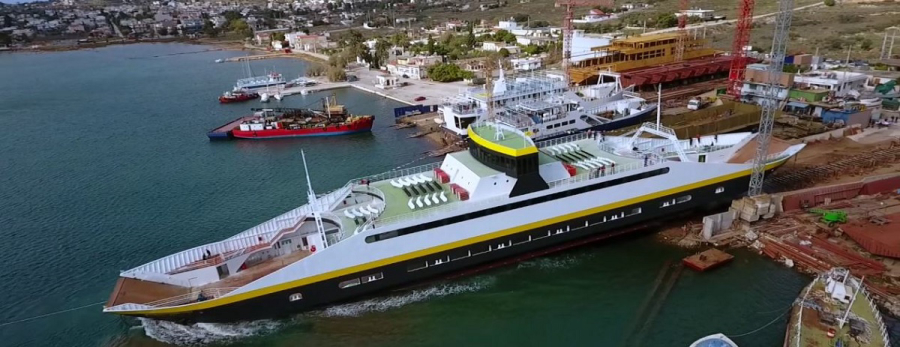
The construction of the ship had been taken place in the “Theodoropoulos Group shipyard” in Ampelakia, Salamis – Greece under the full supervision of the Hellenic Register of Shipping.

'GLYKOFILOUSA V‘ is flying the Hellenic Flag and is a two-way double ended RO-RO passenger open type ferry. Her overall length is 107 m and has a tonnage of 1304,87 GRT.

She can carry 1000 passengers and 146 Cars on Main Garage Deck or 26 Trucks of 12 meters length and 38 Cars on Lower Garage Deck.

The Hellenic Register of Shipping issued the seaworthiness Certificates following the successful completion of the technical appraisal and approval of plans and studies, to verify compliance with the applicable Society’ s Rules, Regulations and Standards as well as related National Legislation, performed by the HRS team of Naval Architects and Marine Engineers. Special consideration was given on the structural assessment based on Finite Element Analysis methods. Owners also required certification for light ice operation. 

The vessel’s construction in the shipyard as well as the attendance of shop tests for key components like main engines, generators and castings had been performed by the HRS team of Marine Surveyors in order to verify that the vessel and her components had been in accordance with the approved design plans and test standards.

Prior the vessel’s delivery, HRS Marine Surveyors attended sea trials relating to vessel and outfitting tests; proceeding to the certification of propulsion engines, auxiliary machinery and safety equipment.

Hellenic Register of Shipping wishes ‘’fair winds and following seas ‘’

Aegean Marine Petroleum Network logoAegean Marine Petroleum Network Inc. was upgraded by Zacks Investment Research from a “sell” rating to a “hold” rating in a research report issued to clients and investors.

According to Zacks, “AEGEAN MARINE PETROLEUM is a marine fuel logistics company that physically supplies and markets refined marine fuel and lubricants to ships in port and at sea. They intends to focus on growing its fleet of double hull bunkering tankers and expanding its service centers in strategic locations worldwide to further enhance the Companys extensive customer relationships and leading industry position. “

Several other analysts also recently issued reports on ANW. TheStreet raised shares of Aegean Marine Petroleum Network from a “hold” rating to a “buy” rating in a research note on Wednesday, November 30th. Clarkson Capital reaffirmed a “neutral” rating on shares of Aegean Marine Petroleum Network in a research note on Tuesday, January 10th.

Shares of Aegean Marine Petroleum Network (NYSE:ANW) traded up 2.36\% on Tuesday, reaching $10.85. The company’s stock had a trading volume of 339,413 shares. The company’s 50 day moving average price is $10.72 and its 200 day moving average price is $9.89. Aegean Marine Petroleum Network has a 12-month low of $5.00 and a 12-month high of $13.10. The company has a market cap of $427.52 million, a P/E ratio of 11.73 and a beta of 2.86.

Several hedge funds have recently bought and sold shares of the stock. Engineers Gate Manager LP bought a new stake in Aegean Marine Petroleum Network during the third quarter valued at $445,000. Airain ltd acquired a new position in shares of Aegean Marine Petroleum Network during the third quarter valued at about $833,000. ClariVest Asset Management LLC acquired a new position in shares of Aegean Marine Petroleum Network during the third quarter valued at about $161,000. Lucus Advisors LLC acquired a new position in shares of Aegean Marine Petroleum Network during the third quarter valued at about $405,000. Finally, Smith Asset Management Group LP raised its position in shares of Aegean Marine Petroleum Network by 2.0\% in the third quarter. Smith Asset Management Group LP now owns 29,670 shares of the company’s stock valued at $297,000 after buying an additional 590 shares during the last quarter. 70.50\% of the stock is owned by hedge funds and other institutional investors.
Source: Zacks

Today the European Parliament voted in favour of the inclusion of CO2 emissions from shipping in the EU Emission Trading Scheme (ETS) and the establishment of a maritime climate fund “in the absence of progress at international level” as from 2023.


Climate change being a global challenge and shipping being a global industry, ESPO strongly believes that IMO is by far the right place to introduce CO2 target and measures to reduce emissions from shipping in line with the Paris Agreement.

In that respect, ESPO believes that the roadmap agreed at the IMO MEPC meeting last October is a starting point for the discussions. On the basis of available scientific evidence, the IMO needs to strengthen its efforts and submit an initial reduction target to the stock-take process of the Paris Agreement in 2018 accompanied by short-term measures. By 2023, IMO should introduce the necessary target and measures to bend down the CO2 emissions curve.

ESPO believes that a 6-year period until EU measures are put in place, is sufficient time for the IMO to discuss and agree on the necessary target and measures. 2023 must therefore be seen as a milestone. In case this deadline is not met, EU measures will have to be introduced. It should however be clear that in case of an international agreement by 2023, the EU measures are to be repealed.    

The Paris Agreement has delivered tremendous results due to the international cooperation and the active engagement of developing and developed countries. As climate change is a global threat and shipping an international sector, it’s clear that a regional approach is not preferable. The IMO is by far the right place to introduce a target and measures for shipping emissions. Today’s vote in Parliament should be seen as an encouragement for a global solution, given that the foreseen deadline of 2023 is respected. If, however, the IMO will not deliver an emissions reduction target and measures to implement it by 2023, an EU approach seems unavoidable. We therefore hope that the IMO will speed up the process and demonstrate the same level of ambition when addressing climate change as it did on the global air pollution cap agreed last October”, says ESPO’s Secretary General, Isabelle Ryckbost. 

Ports, coastal cities and their local communities are amongst the most vulnerable to extreme weather conditions resulting from global warming. Under the Paris Agreement all countries and all sectors of the economy need to take immediate action and to contribute to keeping the increase of the global temperature well below 2°C.

The EU and national climate measures that are currently being developed to implement the Paris Agreement, will oblige ports to reduce the carbon footprint of their land-based activities. These efforts should be accompanied by measures covering emissions generated at sea. The environmental reputation of the maritime and port sector is at stake. Last October, IMO MEPC 70 agreed on a roadmap towards the development of a comprehensive strategy on the reduction of GHG emissions from ships. 2018 has been set as a milestone for defining an initial IMO strategy. This initial strategy will allow international shipping to take part in the first stock-taking meeting under the Paris Agreement in 2018 where all national reduction targets will be tested for being fit for purpose. This initial strategy would subsequently be adjusted based on the analysis of available data, and a revised strategy envisaged for spring 2023 will be finally adopted. The roadmap does not however make any commitment to setting an initial emissions reduction target as part of the strategy.

www.espo.be 


DryShips Inc., or DryShips or the Company, a diversified owner of ocean going cargo vessels, announced its unaudited financial and operating results for the quarter ended December 31, 2016.

Full Report

Page 45 of 354

logo

Subscribe to our Newsletter