


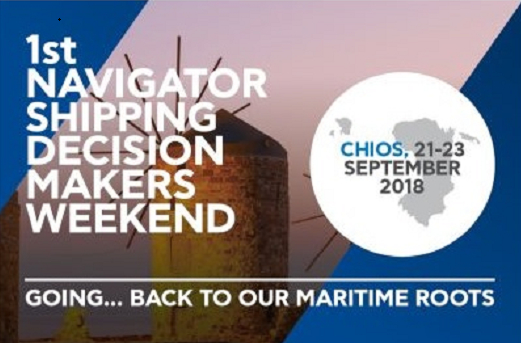
“GOING . . BACK TO OUR MARITIME ROOTS !!”
 |
Aiming at enhancement and continuation of the Greek Shipping history, the last five years, we annually honor Greek islands & places which have contributed to the development of Greek Shipping like Oinousses, Hydra, Lesvos, Chios and Pireaus. In addition, the 17th NAVIGATOR Forum 2017, where you honored us with your participation, took place at SS HELLAS LIBERTY - in Piraeus with the participation of 700 Decision Makers of the Greek Maritime Community. This year NAVIGATOR – The Shipping Decision Makers Weekend “is going . . back to the Greek maritime roots” by taking place in Chios, the island that is the birthplace of many shipowners, executives and seafarers.
With the support of Maritime Organizations, our sponsors’ contribution, the support of the entire Maritime Press and the experience of accredited speakers, the "18th NAVIGATOR 2018 - The Shipping Decision Makers Forum” this year aims to stress the importance of Logistics, Technology & Innovation, Imo Regulations, Environmental Regulations, Education and maritime trends.
INDICATIVE PROGRAM OF NAVIGATOR SHIPPING DECISION MAKERS WEEKEND
Friday 21st Sep 2018 :
Arrivals in Chios either by Ferry or by plane
Saturday 22nd Sep 2018:
11:00hrs – 16:00hrs: 18th NAVIGATOR Forum at University of Aegean
16:00hrs – 20:00hrs: Free afternoon
20:00hrs onwards: Traditional Chian Feast at “Passas” Tavern in Lagada with live music
Sunday 23rd Sep 2018:
11:00hrs – 15:00hrs : Tour at Chios Mastic Museum & Mastic Villages
Participation in NAVIGATOR FORUM, Chian Feast, Chios Mastic Museum, Mastic Villages and the transport to and from these events will be free of charge for all delegates.
Please contact us (E: This email address is being protected from spambots. You need JavaScript enabled to view it. ';document.getElementById('cloak84beb6e1494e63e084521ad8ea81776b').innerHTML += ''+addy_text84beb6e1494e63e084521ad8ea81776b+'<\/a>'; or tel: +30 210 6234000) in order to book your ferry & air tickets as well as your accommodation at Chios Chandris Hotel where we have secured special rates ( sinlge room Euro 85/ double room Euro 94).
Please confirm your free of charge attendance, by registering online here
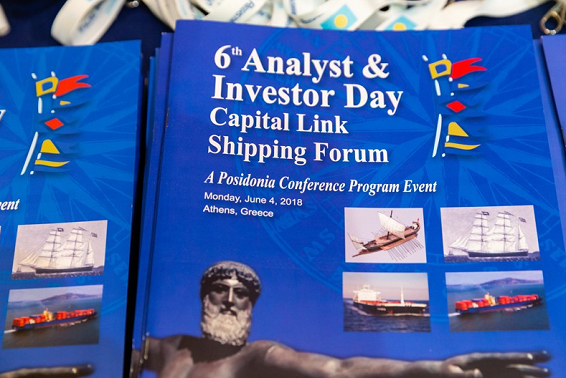
Capital Link Posidonia Forum
 |
http://forums.capitallink.com/shipping/2018analyst/
Promotion of Isidoros Chandris to Senior Bunker & Lubricant Consultant
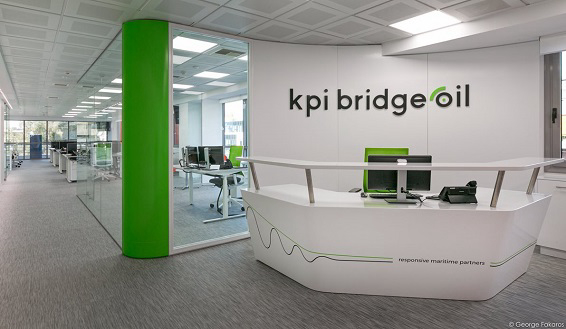
Isidoros joined KPI Bridge Oil’s London office as a Bunker & Lubricant Trader in 2014, and relocated to the Group’s Athens office as a Bunker & Lubricants Consultant in 2016. Before joining KPI Bridge Oil, Isidoros spent over four years working as an Offshore shipbroker in Houston and Oslo, and as an Operations Assistant and Bunker Trader in Piraeus, Greece. He has attained a BSC in International Business from the University of Macedonia, Greece and an MSC in Shipping, Trade & Finance from the CASS Business School City University, London. Isidoros is fluent in Greek, English and German.
 |
| Isidoros Chandris |
 |
| Michalis Manassakis |
About KPI Bridge Oil Group:
KPI Bridge Oil is a leading worldwide bunker broking and trading company dating back to 1971 with offices in Athens, Denmark, Istanbul, London, Miami, New York, Seattle, Singapore and South Korea. With a dedicated global team of more than 90 experienced professionals worldwide of which more than 60 are bunker brokers and traders, KPI Bridge Oil is fulfilling bunker and marine lubricants requirements in more than 2800 ports worldwide for the international shipping industry, covering all major time zones 24 hours a day.
"THE EU MUST ACT IN THE INTEREST OF ITS MARITIME STAKEHOLDERS"
 |
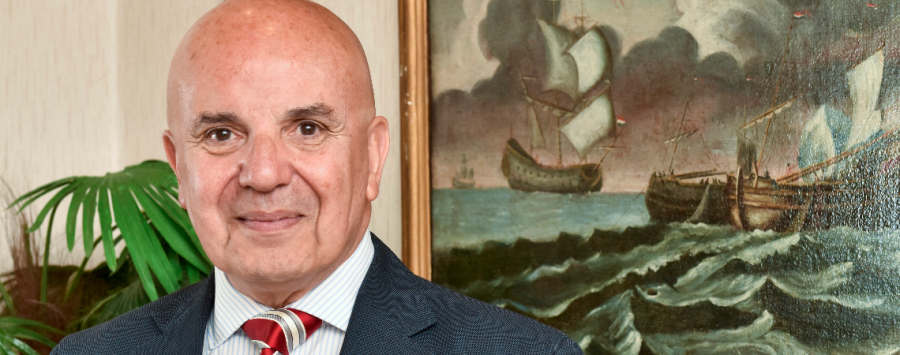
| John Gauci-Maistre. Photos by Alan Carville. |
Following the investigation, it was found that Malta’s tonnage tax procedure was, by and large, in line with the Commission’s maritime guidelines issued in 2004, which state that income derived from maritime transport vessels, such as containers, bulk carriers and general cargo, are not subject to further tax. The vast majority of vessels registered under the Maltese flag fall under this structure.
“We had a tonnage tax legislation which was no different to that of any other jurisdiction, fully approved by the EU, and either due to certain bureaucratic shortcomings or because competition among flag states within the EU is getting tougher, we were under investigation for a very long time. I was personally very disappointed, and we suffered a lot because of it,” said Mr Gauci-Maistre. “I am pro-EU, but it is disappointing when EU regulations and bureaucracy do not act or perform in the interest of the EU and its maritime stakeholders. In the words of the famous Onassis, ships have propellers: touch them and they leave. A ship can operate from anywhere in the world, it doesn’t need to be in the EU – so why scare it away?”
Despite the setback, Malta’s merchant ship registry continued to grow. In 2017, it registered a growth of over 8 per cent, and with 75.2 million registered gross tonnes, it remains the largest registry in the EU and the sixth largest globally. Mr Gauci-Maistre asserted that the industry’s success today goes back to its very beginning, when the Merchant Shipping Act was passed unanimously in parliament in 1973, establishing a solid foundation.
“Since then, there has never been political disagreement between parties on Malta’s maritime sector, and both the industry and the authorities showed that they were there to listen any time there was an issue. From then on, Transport Malta has been – and remains – a listening ear, and tries to accommodate without jeopardising safety. In fact, we have a reputation for being a bit too strict, but even though the ship owners complain, they respect us for it.”
Mr Gauci-Maistre added that, with regards to fiscal advantages, Malta is more or less on the same platform as other countries which have an open registry like Malta’s. “The biggest issue we have is that, since we’ve been growing steadily over the years, we’ve automatically been creating adversaries within the EU, which are targeting the same sector and which see us as a threat to their tonnage.”
Malta’s yachting industry has also been growing steadily, and in 2017, a 97 per cent increase was recorded in the number of new registrations. Mr Gauci-Maistre said that while the figures are certainly encouraging and the yachting industry has come a long way, it is still facing difficulties of its own. “One important issue which we will be discussing at the Malta Maritime Summit this October is Blue Flag marinas. We talk a lot about Blue Flag beaches, but what about striving to achieve Blue Flag status for our marinas? I’d like to see us get to the stage where the yacht owner and the marina regulator are on the same page, where one knows they’re entering a marina which follows regulations on one hand, and where there’s zero tolerance for pollution, waste dumping and sub-standard vessels on the other, making the marina suitable for swimming.”
With 45 years of experience in this sector, Mr Gauci-Maistre asserted that the maritime industry is a dynamic one that is constantly changing, and therefore a more proactive approach is needed from all stakeholders to remain ahead of the competition. “We’ve always had the full support of the authorities, but the biggest concern is that success could make us rest on our laurels, which is risky. The registry has to remain, at all costs, avant-garde and it has to think ahead in all sectors related to the industry, be it environmental, managerial, related to regulation, crewing, port automation or cyber security.”
Automated ports are gaining traction the world over – one of the largest automated container terminals worldwide, the Shanghai Yangshan Deep Water Port, began trial operations last December. Mr Gauci-Maistre said this is where the industry is heading, as it enters a phase of digitalisation, both for ship owners as well as ports.
“If a port is automated but a ship isn’t, then it won’t be allowed in. On the other hand, if a ship is equipped with an automated chip but the port isn’t adequately geared up, it cannot enter the port. Another concern is cyber security – if a cyberattack takes place while a ship is sailing in remote locations, it is powerless,” he explained. “A ship’s ability to reduce emissions also comes into play here – if a ship enters the harbour but the port doesn’t have a shore supply powerful enough to help it switch off its generator, then the ship owner cannot be blamed for polluting if the port isn’t adequately equipped to help it. Ships need to be run and cargo needs to be delivered, so all parties need to ensure they’re in sync in order for the industry to operate at optimal level. They’re challenging times, but very interesting times too.”
The second edition of the Malta Maritime Summit, which will be held between 1st and 5th October, will be addressing these issues and more, and will follow the success of the first edition, which took place on the eve of Malta’s Presidency of the Council of the EU in 2016.
Mr Gauci-Maistre said that, as international players in the maritime industry, it is fitting that Malta hosts a summit of this kind as other maritime countries do. But although it is being held locally, it is not about Malta. “It’s an international summit, and the theme this year is ‘The voice of the industry’. The aim is to be as diplomatically provocative as possible with heated yet constructive debate, and for questions to be answered,” he explained. “We need to address issues and call a spade a spade, which is why we’ve created a system where delegates can ask questions anonymously and without fear of repercussion.”
The summit will raise questions about the impact and effectiveness of the 2017 Valletta Declaration, the impact of Brexit on the EU maritime economy, the value of the EU’s maritime policy in light of a demanding and successful industry, the environmental sustainability of automation in the industry, and whether banking regulations, due diligence and demands are stifling economic growth. Speakers will include, among others, Nigel Lowry, Greece Correspondent at Lloyd’s List; Mohamed Zaitoun, President and CEO of Zaitoun Green Shipping Ltd; and Angelo Scorza, from online maritime and transport economics magazine, Ship2Shore.
This article originally appeared in The Malta Business Observer
DSME wins 100th order from Greece’s Angelicoussis Shipping Group
 |
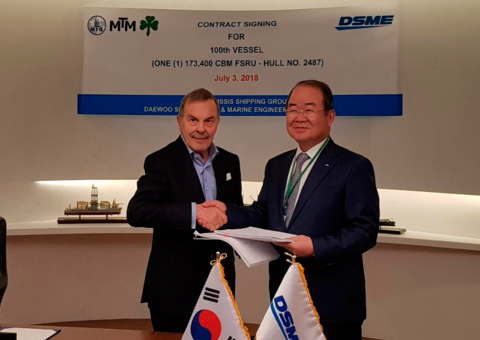
| John Angelicoussis (left), chairman of Angelicoussis Shipping Group and Jung Sung-leep, CEO & president of DSME are shaking hands after signing a contract to build an LNG-FSRU in Greece on Tuesday (local time). [Photo provided by Daewoo Shipbuilding & Marine Engineering Co.] |
Although the shipbuilder did not disclose the value of the deal, industry watchers estimated it would be worth 230 billion won ($206 million) to 250 billion won.
Angelicoussis has ordered total 100 vessels to DSME worth a combined $11 billion since its first order of 98,000-ton crude carrier in 1994. Among them, 82 have been shipped and the rest 18 are being built at Okpo shipyard. “The constant orders from the shipping group means that it has a full confidence in our technology,” an official from DSME said.
DSME has received 65 orders from Singapore’s BW and 55 from Denmark’s Maersk. It said Wednesday that it has won orders of 27 vessels worth $3.4 billion since the beginning of the year including 11 units of LNG carriers, 15 units of very large crude oil carriers and one special vessel, amounting to 47 percent of its target for this year of $7.3 billion.
Shares of DSME finished Wednesday 0.2 percent lower at 25,300 won.
http://pulsenews.co.kr
WISTA Cyprus holds its Annual Dinner 2018
 |
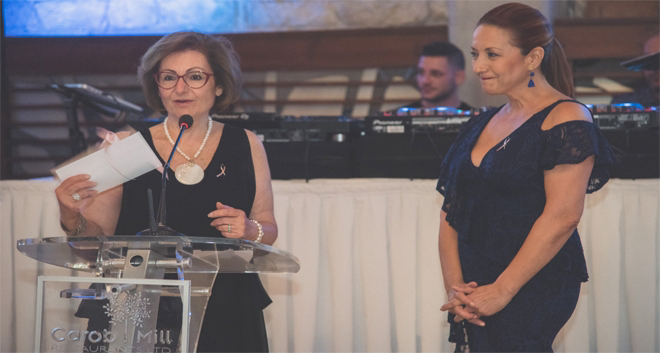
| From left to right Mrs. Evi Papadopoulou and Mrs. Anna Vourgos |
Mrs Vourgos announced that the selected charity of WISTA Cyprus for this year was EUROPA DONNA CYPRUS and welcomed its president Mrs Evi Papadopoulou to receive the donation and deliver a short address.
In his speech that followed, Mr. Costas Iakovou, Permanent Secretary of the Cyprus Deputy Ministry of Shipping, addressed the audience and congratulated WISTA Cyprus on the vital role it plays in the Cyprus shipping scene and reiterated the Deputy Ministry’s support to its work.
Closing, the association also expressed their gratitude to all supporting organisations and sponsors who made the event possible.
WISTA is a networking Association of women at management level positions in the Shipping industry, all sharing the same passion - Shipping! WISTA works towards:
- Minimizing the existing gender leadership gap in the maritime, trading and logistics sectors
- Building a community among its members, facilitating the exchange of contacts, information, and experiences
- Promote and facilitate the education of its members
- Provide liaison with other related institutions and organizations worldwide
More info on WISTA Cyprus are available at: http://www.wista.net/cy
WISTA Cyprus Official @ https://www.facebook.com/wistacyprus/
WISTACYOFFICIAL @ https://www.linkedin.com/in/wista-cyofficial-994081143/
WISTACYOFFICIAL @ https://twitter.com/wistacyofficial
@wista_cyprus @ https://www.instagram.com/WISTA_Cyprus/?hl=en
WISTACY Press @ https://www.youtube.com/channel/UCbeV8BHFXHx6RRQVTMwgczw
Photo credits: Konstantinos Georgiou Photography
Full photo album available @ https://www.facebook.com/wistacyprus/
LR1 Tankers, Handysize Bulkers and Panamax Containers: Q2 Forecast winners
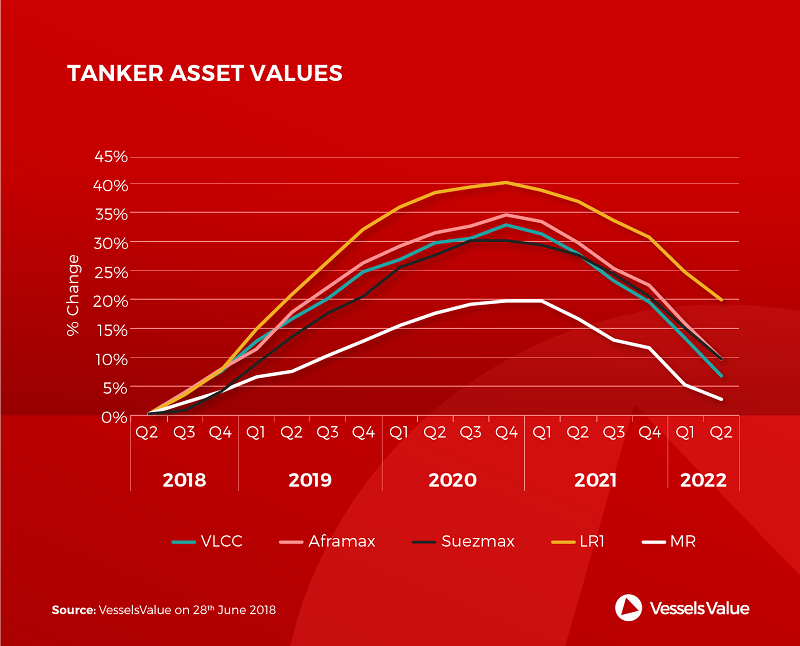
The price of prime aged vessels is expected to rise over the next two years. Putting extended trade disputes aside, most market segments have favorable tailwinds. The contraction of yard capacity is expected to support the replacement value of ships, while short term earnings have either bottomed, or started to recover in most markets. The charts below show the expected performance of a fixed age five-year-old asset. Vessel specific forecasts are available to subscribers.
Tanker asset values look set to climb as the current culling of the fleets older units will help lead to a finer balance between supply and demand. The decision by OPEC and Saudi Arabia to put more barrels into the market should increase the cargo count in the Arabian Gulf. This will lead to a rosier outlook for the second half of the year than many predicted.
 |
LR1s look poised to see the highest gains. The run up in demand for distillate flows ahead of the 2020 bunker switch over should benefit large clean product tankers. LR1s are currently seeing depressed asset values, and the expected value on mean reversion alone should benefit owners.
 |
Dry bulk asset values are seeing the benefit of a higher earnings environment brought on by a steady rise in ton mile demand and fleet recycling efforts in 2016 and 2017. Upside remains as scheduled deliveries of outstanding orders are moderate.
 |
The containership market should see a rebound as the consolidation of commercial controllers is leading to more sustainable rate structure. Asset values are expected to retain their increases through the end of the forecast window due to the small orderbooks in most segments (ULCV excluded).
vesselsvalue.com
Tanker owner Frontline buys scrubber company stake ahead of IMO 2020 marine fuel emissions cap
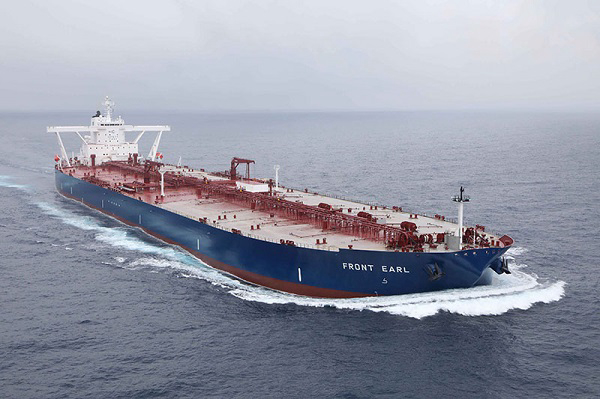
The shipowner has bought a 20\% stake in Feen Marine Scrubbers, it said Thursday without disclosing the sum it paid, and has agreed to order scrubbers for 14 of its tankers with the option to order another 22 at fixed prices.
The International Maritime Organization's global marine fuels sulfur cap is set to drop from 3.5\% to 0.5\% at the start of 2020, forcing shipowners either to switch to cleaner, more expensive fuels or to install scrubbers to clean their emissions on board the vessel.
Scrubbers have largely been regarded as a niche solution in 2020, but have increased in popularity in recent months as shipowners bet on a sharp difference in prices between fuel oil and 0.5\% sulfur bunkers.
"The economic case to install scrubbers is very compelling, particularly for larger vessels," said Frontline CEO Robert Hvide Macleod. "This transaction allows Frontline to secure the capacity to secure a large volume of scrubbers, which we believe will present a challenge to many owners as the deadline for sulfur emissions compliance approaches."
The Oslo- and New York-listed company, with main shareholder John Fredriksen at the helm, has one of the world's largest fleets of VLCC and Suezmax tankers as well as Aframaxes/LR2s, with 63 vessels in its fleet and two VLCC newbuildings under construction.
Feen Marine has also previously sold scrubbers to shipowners including Navig8 and Trafigura, the company said.
www.platts.com
EURONAV purchases ULCC Laura Lynn from International Seaways
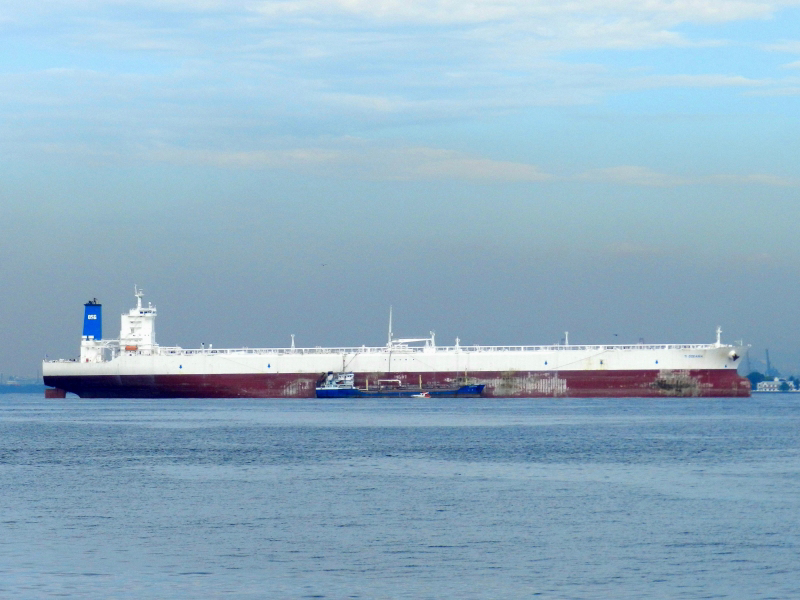
Euronav Tankers bought the Seaways Laura Lynn (2003 – 441,561 dwt) from International Seaways for 32.5 million USD. The Laura Lynn is the only other ULCC in the global tanker fleet – Euronav owns the other one, the TI Europe (2002 – 442,470 dwt).
Paddy Rodgers, CEO of Euronav, said: “Bringing the only other ULCC in the world fleet under our control will provide us with a significant strategic opportunity.”
About Euronav
Euronav is an independent tanker company engaged in the ocean transportation and storage of crude oil. The Company is headquartered in Antwerp, Belgium, and has offices throughout Europe and Asia. Euronav is listed on Euronext Brussels and on the NYSE under the symbol EURN. Euronav employs its fleet both on the spot and period market. VLCCs on the spot market are traded in the Tankers International pool of which Euronav is one of the major partners. Euronav’s owned and operated fleet consists of 2 ULCC, 43 VLCCs, 27 Suezmaxes (two under construction), 2 Panamaxes and 2 FSO vessels (both owned in 50\%-50\% joint venture). The Company’s vessels mainly fly Belgian, Greek, French and Marshall Island flags.
Rebranded ‘MAN Energy Solutions’ Replaces Former MAN Diesel & Turbo Name

 |
Dr Uwe Lauber, Chairman of the Board at MAN Energy Solutions, said: "System technologies that help our customers to increase the efficiency of their plants and reduce emissions are already a significant part of our business, and also lead the way to a carbon-neutral future. We will resolutely continue on this path of growth and increasingly become a supplier of complete solutions."
With the rebranding, the company is also taking a stand for the Paris Climate Agreement and the global pursuit of a carbon-neutral economy: "For the first time ever, the international community has set a climate target. We want to play our part in helping to achieve it," said Lauber. "With our products and services, our activities have a significant impact on the global economy. In shipping, for example, we move more than half of the global stream of goods, while energy generation and industrial production also assume key roles on the path to fulfilling the Paris Agreement."
MAN Energy Solutions sees great potential in Power-to-Gas technology, which allows energy generated from renewable sources to be converted into synthetic fuels, such as natural gas. Lauber said: "Using Power-to-Gas technology, we can produce a number of completely carbon-neutral, synthetic gases that can drastically reduce the CO2 impact of logistics and energy generation when used as fuel."
MAN Energy Solutions' vision also sees electrical energy in the future generated either from renewable sources or by decentralised, flexible power plants that will increasingly be powered by such carbon-neutral fuels. Lauber said: "In addition, there will be storage solutions in a range of sizes. In this way, we will build the intelligent energy system of the future."
In relation to this, and together with ABB, MAN Energy Solutions recently introduced ETES (Electrothermal Energy Storage), an innovative storage solution that can supply entire neighbourhoods with electricity, heating and cooling. "ETES is the only system in existence that allows us to use, store and redistribute these resources all at the same time," said Dr Lauber.
In shipping, MAN Energy Solutions has publicly spoken out in favour of a ‘maritime energy transformation’ for some time now, which draws on the increased use of low-emission gas as fuel. Lauber said: "The path to decarbonising the maritime economy starts with fuel decarbonisation, especially in container shipping." The company also offers a number of alternative drive technologies, including hybrid drives, in order to further reduce the share of heavy-fuel engines in shipping traffic, among other applications.
The great importance of energy and its handling is inherent in all customer segments that MAN Energy Solutions targets. "Whether we are talking about a marine-drive system, smart energy networks or efficient industrial-process solutions – converting energy into concrete economic and social benefits lies at the core of our business," said Lauber. "By rebranding as MAN Energy Solutions, we are taking the next logical step and making that focus clear in our company name as well."
As part of the new branding, MAN Energy Solutions new brand claim is "Future in the making".

Powered by  © Μaritimes 2019