

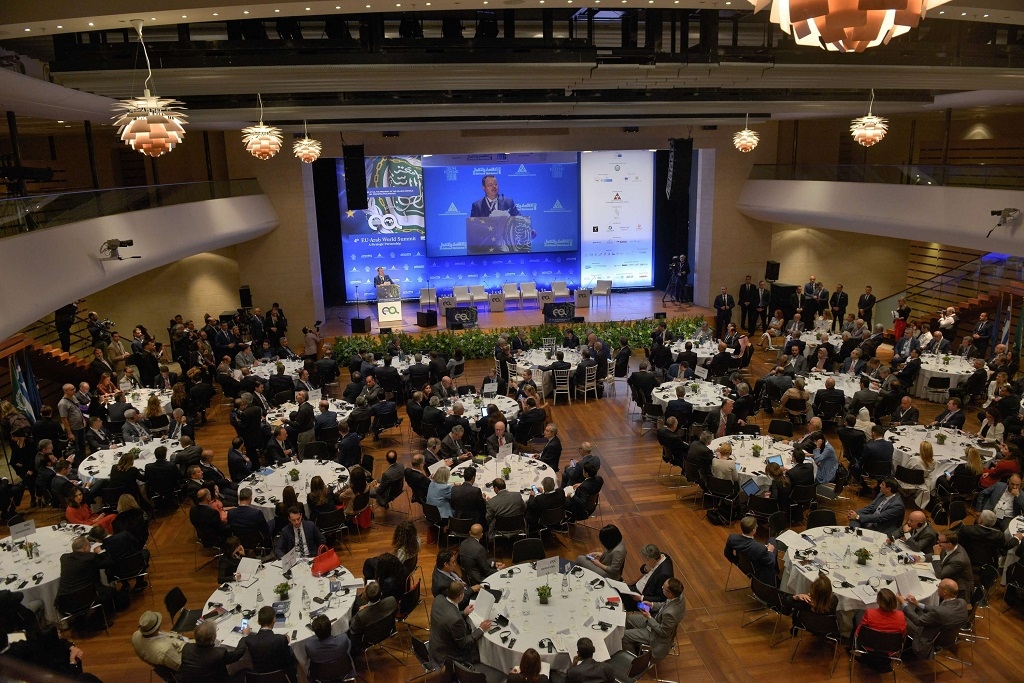
The 4th EU-Arab Summit, an initiative of economic and political dialogue between European countries and the Arab world, took place in Athens on 29-30 October with the participation of prime ministers, ministers, senior government officials and executives of major European and Arab companies.
At the 4th EU-Arab Summit organized by the Delphi Economic Forum in collaboration with the think tank based in Lebanon Al-Iktissad Wal-Aamal and with Strategic Sponsor the Consolidated Contractors Company, the key themes that were presented were the climate change, challenges that arises from migration, sustainable development, energy security, the prospects for many sectors of the economy as well as the common horizons of Europe and the Arab world.
In his speech, Greek Prime Minister Kyriakos Mitsotakis stressed the historic “bridge of friendship” between the two geographical parts of the Mediterranean. As the Prime Minister has pointed out, the immigrants-refugees issue is a top challenge for both Europe and the Arab world. Speaking of this topic, he described it as a "top challenge", noting that "it is not a problem that is limited to geographic regions, but extends to the boundaries of global consciousness and becomes the field in which solidarity is tested together with the determination to tackle global crime and to protect international borders”. Referring to Turkey's provocations in both the Aegean Sea and the Cypriot Exclusive Economic Zone, Mr. Mitsotakis said that Turkey should act as a better neighbour. Greece is a pillar of stability and security in the wider region of the South East Mediterranean region and at the same time it establishes partnerships with many countries in the region. The prime minister spoke about climate change, stating that it has to do with the present and future of humanity and the fact that it is a difficult equation problem. As the Greek prime minister said, "the critical aspect of climate change is also to be incorporated in the reflection of the summit, as it is the key to many of the problems that concern us and is becoming a regulator for the global economy”.
His determination to move forward as planned with his country’s plans on energy stressed the President of the Republic of Cyprus, Nicos Anastasiades, in his speech during the 4th EU-Arab World Summit in Athens. The President of the Republic of Cyprus said that Nicosia intends to exploit the natural gas reserves that are found in the Southeast Mediterranean sea. Concerning the immigration, he said that Cyprus is the number one country in asylum application per capita. Mr Anastasiades also sent a message to everyone saying that Cyrpus’ global cooperations do not target any third country and added that his country is very thoughtful of her Turkish-Cypriots compatriots.
Ahmed Aboul Gheit, Secretary General of the League of Arab States, has argued that there are many more elements that unite the Arab world and Europe than separate them. "There are no major differences between the peoples of the Mediterranean," said Ahmed Aboul Gheit. Key challenges that Europe and the Arab world must face are the enormous changes resulting from climate change and a “time bomb” on the foundations of several countries, exemplifying Egypt, which is experiencing water scarcity. Referring to the Arab Spring political phenomenon, Mr. Gheit stressed that unfortunately it was not a "spring" but a disaster for the Arab world as many countries are facing major problems such as Syria, Yemen and Libya.
The Prime Minister of Serbia, Ana Brnabic, stressed the challenges and the opportunities that rise from the procedure of integration to the European Union. During her speech to the 4th EU-ArabWorld Summit in Athens, the Prime Minister of Serbia talked about the agreements signed by her country with others, the close cooperation with China at the initiative of the President Xi Zinping, but also about the trade relations with the European Union – the destination of 65% of Serbia’s exports. She also added that Serbia has traditionally good relations with the Arab World countries and according to a Financial Times report, Serbia is the first country – by size – in attracting foreign investment.
Croatian Prime Minister Andrej Plenkovic said new channels of communication need to be opened and the dialogue between Europe and the Arab world should continue. According to the Croatian Prime Minister, the Mediterranean countries face common challenges in the fields of economy, security and migration, making it more than ever necessary to have an ongoing dialogue agenda for resolving ongoing crises. The Croatian Prime Minister stressed that the dialogue and cooperation of the Mediterranean countries should be continuous in order to strengthen the security and economic cooperation ties. In closing, Mr. Plenkovic said that Croatia would help the countries of the western Balkans (Serbia, Montenegro, Albania, North Macedonia) to join the European Union.
“Whatever happens to the Arab World is also affecting Europe”, said the Prime Minister of Albania, Edi Rama, while speaking to the 4th EU-Arab World Summit and stressed the interaction between both areas in a series of issues like the economy, politics, the environment and security. Edi Rama said that his country’s policy on immigration is very friendly to migrants and asylum seekers. He stressed that his country is experiencing a very special situation concerning security, because thousands of Iranian dissidents have found refuge in his country. He added that Albania has very good relations with the Arab World and that he hopes that these relations will strengthen.
Mr. Nabil Aburdeineh, the deputy prime minister of the Palestinian state, stressed that if the Palestinian issue was not resolved, the wars would continue in the Middle East and refugee flows to European countries would increase. Mr. Aburdeineh said Europe and the Arab world have historical and traditional ties and stressed how Europe should help achieving peace and stopping the endless wars. Referring to the Jerusalem issue, Mr Aburdeineh stressed that Jerusalem is a city sacred to both Christians and Muslims, and the settlement of both the Palestinian issue and Jerusalem are essential prerequisites for a peaceful Middle East.
“A call to work for peace” was the message of former Prime Minister and Foreign Minister of Italy, Massimo D’Alema, at the 4th EU-ArabWorld Summit. Massimo D’Alema spoke about the Mediterranean sea stressing that “our sea is at the center of the world’s attention” while also speaking about the silk road and the great opportunities for the region. He also talked about the challenges, the dead migrants and refugees in the sea, adding that the West is partly responsible for this situation. He also noted that the security in Europe depends on the peace in the Middle East.
Former French Prime Minister Francois Fillon emphasized that before Europe redefines its relationship with the Arab world, Europe itself must have answers to key issues that shake up geopolitical chess, such as Brexit, tensions between Iran and Saudi Arabia, and the rising of fundamentalism. Mr. Fillon stressed that US foreign policy mistakes have caused chaos in the wider Middle East and endless war conflicts. In these challenges, Europe must remain united, Mr. Fillon said, while sounding the alarm as Europe has entered a dangerous introspection spiral. He stressed that Europe must redefine its identity and answer key questions such as security, protecting European borders, securing energy supplies, technology-innovation and the challenges posed by the US-China trade confrontation. According to Mr. Fillon, the political mistakes that Europe has done with Russia, have alienated Moscow and led to the issue of Ukraine, but also to the strategic relationship between Russia and China. In closing, Mr Fillon stressed that Europe must first respond to its own existential dilemmas in order to be a reliable partner of the Arab world.
The Minister of Petroleum & Mineral Resources of Egypt, Tarek El -Molla, stressed the need to strengthen the relations between European countries and the Arab World. Speaking at the 4th EU-Arab World Summit, Tarek El -Molla underlined the historic relation between Egypt and the European countries and the need to complete the structural reforms of the economic program in Egypt. He also said that these reforms will transform Egypt to an energy center of the region.
The speakers of the panel “An area of realignment: The need for a new European – Arab world approach”, noted the inter-connection between everything that happens in Europe and in the Arab World. The Alternate Minister of Foreign Affairs of Greece, Miltiades Varvitsiotis, stressed the enhanced cooperation of Greece with the Arab countries and the great presence of Greek companies in the area, while Carmelo Abela, Minister for Foreign Affairs and Trade Promotion of Malta also stressed the need for cooperation. State Minister for Foreign Affairs of Qatar, Soltan bin Saad Al-Muraikhi, and Nasser Kamel, Secretary General, Union of the Mediterranean, both asked for more dialogue between Europe and the Arab World. Eurico Brilhante Dias, Secretary of State for Internationalisation, Ministry of Foreign Affairs of Portugal noted the “common history” of Portugal and the Arab countries adding that “we need common solutions to achieve prosperity of the people”.
In the discussion "Europe and the Arab World: A Strategic Economic Partnership" the panel was composed of Adonis Georgiades, Minister of Development and Investment, Algeria's Minister of Commerce Said Djellab, Mohammed Mukhlif Al-Enezi, Al-Enezi's Deputy Minister of Commerce and Kuwait's Abdul Bin Abdul -Harbri, commander of the Saudi Arabian Foreign Trade Organization. As it has emerged from the discussion Europe and the Arab world may face significant challenges, however, new channels of communication are being opened and significant investment opportunities are being created. Minister Adonis Georgiades stressed that the time to invest in Greece is now. As Mr. Georgiades underlined, much has been done in Greece in recent months and the country's image has changed and the adoption of the investment plan creates a favorable environment for investors. "Investments that have been stalled for years are starting to take shape, for example Hellenic, and Greece is beginning to be an investor-friendly destination," Mr. Georgiades said. As Said Djellab underlined that the free trade zones, which will start in 2020, will create new economic environment and that will enriches further the cooperation between Europe and the African states. As Mr. Djellab said, there must be close cooperation between countries in order to address the challenges posed by migration and climate change. Mr. Mohammed Mukhlif Al-Enezi, deputy secretary of state at the Kuwaiti Ministry of Commerce, said the emphasis should be on youth employment, not only to reduce unemployment but also to promote innovation and create new jobs in a new digital economy emerges rapidly. Mr. Al-Enezi emphasized that all countries should be aware of and make drastic changes in order to tackle climate change. Mr. Abdulrahman bin Ahmed bin Hamdan Al-Harbri stressed that the kingdom of Saudi Arabia is evolving into a business and investment hub, changing the ever-changing world of finance with the Vision 2030 program. According to Al-Harbri, significant investment opportunities are being created in Saudi Arabia as privatizations and reforms change the image of the Kingdom towards the international investment community.
The monumental challenge of the immigration issue was discussed at the panel, “Challenges of migration: The vision”, at the 4th EU-Arab World Summit. The Alternate Minister of Citizens' Protection of Greece, George Koumoutsakos, said that the immigration issue is the biggest challenge not only for Greek government, but also for the European Union and sent a message to Turkey saying that “when the EU makes decision, these decision can not be the result of blackmail”. On the other hand, George Katrougalos, MP and former Minister of Foreign Affairs of Greece noted that population movements are part of the globalization process, while Blanca Moreno-Dodson, Manager of Center for Mediterranean Integration of the World Bank did a detailed presentation of immigration stressing the social parameters of the phenomenon – from education to skills, age and destination of migrants. Alfonso Lucini Mateo, Special Ambassador for Middle East and Mediterranean Affairs of Ministry of Foreign Affairs in Spain noted that we need a vision for the future concerning migration, while Mohanad Hage Ali, Fellow at Carnegie Middle East Center made a detailed presentation of migrant flows during the past few years that came from countries in crisis, like Syria.
In the thematic discussion "Building Climate Coalitions: An EU-Arab Response to Climate Change" the panel was composed by Elina Bardram, Head of the European Commission's Directorate-General for Climate and Climate Change, Enrico Granara, Ambassador-in-Chief Activities at the Ministry of Foreign Affairs of Italy, Nicolo Sartori Program Officer, Energy, Climate and Resources of the Italian Institute of International Relations, Christos Zerefos in charge of the Atmospheric Research Department, Physics - Climatology of the Academy of Athens and Saida Neghza president of the Algerian General Confederation of Business. As has emerged from the debate, the Paris Agreement on tackling climate change is a key objective that must be supported by both governments and citizens. Mrs Bardram underlined that the transition to a more sustainable energy future constitutes major structural changes, which require significant capital in addition to political and social will. The new European Commission has an ambitious plan for the 'Green Deal' aimed at zero gas emissions, but structural reforms are needed to achieve this, Mrs Bardram stressed out. Mr. Granara said that governments should not succumb to micro-political considerations in order to continue strategies to tackle climate change as there is no time to waste because "we are facing the effects of climate change every day". On his part, Mr. Sartori said that unfortunately many people are still unaware of the existence of climate change and cannot understand or even deny the impacts of climate change. According to Mr. Sartori, enormous changes are expected as economies based on fossil fuels are now moving to economies based on Renewable Energy. This, according to Mr. Sartori, also creates new political challenges as several countries in the Middle East are expected to change the structure of their economy and not only rely on fossil fuels. Energy transformation and climate change will require major structural changes and reforms by governments and citizens alike. Christos Zerefos emphasized that the new climatic conditions created threaten the aquatic horizon of Africa, which will affect the wider Mediterranean region, affecting Europe and the Middle East. According to Mr. Zerefos, the European Commission should increase the resources allocated to programs such as 'Copernicus', which capture and forecast extreme weather through satellites, in order to prevent and save lives threatened by impacts of climate change. According to Mr. Zerefos, Renewable Energy will play an important role in tackling climate change. Mrs.Neghza stressed that Europe and the Arab countries should work closely with the exchange of know-how, aiming at increasing Renewable Energy Sources to help meet the challenges posed by climate change. At the same time, Mrs. Neghza said that there was no time for complacency and that governments and citizens of the countries should step up their strategies to tackle climate change.
In the thematic discussion “Sustainable development goals: investing with a purpose’ Mr. George Kirtsos, member of the European Parliament, underlined that the European Union emphasizes on sustainable development, adding that we should increase social benefits. Mrs. Janet Heckman, Regional Director for the EBRD's Southern and Eastern Mediterranean Countries, outlined the investments approved in 250 projects in the context of sustainable development and environmental protection, while Marina Wes, Regional Director for Egypt, Yemen, the World Bank's Djibouti, Middle East and North Africa, stressed that the World Bank's strategy is focused on sustainable development and added that billions have already been invested. Benjamin Godel, Director of International Markets at the Association of German Industries, clarified that United Nations objectives may have been incorporated into national strategies, but often companies do not invest on this basis. Invest Cyprus President Michael Michail said the key point is co-operation between Europe and the Arab world.
At his Opening speech on the second day of the Summit, the president of SYRIZA Alexis Tsipras stressed that the Euro - Arab Summit has now become an important institution that highlights the important role that Greece can play in the geopolitical scene. Mr. Tsipras said that Greece is at a crossroad of three continents and that constitutes the “bridge” between Europe and the Arab world. As Mr. Tsipras said, Europe and the Arab world must decide on a more dynamic framework of dialogue. According to the president of SYRIZA, Europe and the Arab world must work together in four key areas. First in the field of diplomacy as "only with political solutions under international law will there be peace in the region. A second important area is a wider cooperation in innovation, research, digital economy, infrastructure, tourism and energy. A third area of cooperation is managing the great challenge of migratory/refugees flows and tackling the causes of this phenomenon. The fourth area of cooperation is the big issue of climate change. The credibility of the EU, according to Mr Tsipras, will be judged on whether it will be able to secure the accession perspective of the Western Balkan countries by drawing on the Prespa Agreement. At the same time it will be judged on the Middle East solution by the creation of a Palestinian state with a capital city in eastern Jerusalem but also on the issue of Turkey's challenges with both the invasion of Syria and the violation of the Cypriot Exclusive Economic Zone.
The perspectives and challenges facing Europe and the Arab world in the field of energy were discussed by the panelists at the 4th EU-Arab Summit on “Energy Security Prospects and Challenges: Developing a Positive Cooperation Agenda”. Gerasimos Thomas, Undersecretary of State for Environment and Energy, stressed that Greece is a country of stability in economic and political terms. Christos Folias, former Minister of Development and former President of the Arab-Hellenic Chamber of Commerce, emphasized that during most of the 20th century, Greece was dependent on lignite, but for the last 30 years a renewable energy revolution has taken place. Mr. Deividas Marulionis, Lithuania's Deputy Minister of Finance, stressed that energy security is a top priority of Lithuania's agenda, while Mohamed Shoeib, Managing Director of Egypt's East Gas company, emphasized energy security. Mr. Symeon Kassianidis, Chairman of the Cyprus DEFA Board of Directors, spoke about the future of energy in his country, while Hisham Ayoub, Director of Bahrain's Eurotex, presented the picture of the energy market. Mr. Roudi Baroudi, Managing Director of Qatar's Energy & Environment Holding, said all energy projects need the rule of law to make the necessary investments and called on states to work together to reap the benefits of the blue economy (hydrocarbons, renewables, solar power). Mr. Kostas Andriosopoulos, Professor of Economics and Energy at ESCP Europe Business School and Vice President of DEPA, emphasized that EastMed "is a very ambitious project", while Dinos Arkoumanis, former Greek Ambassador to Greece for Energy Policy, spoke about the by the transfer of liquefied natural gas (LNG).
The thematic debate "Maritime, Ports and Logistics: The New Perspective in the Arab World" was attended by the Minister of Maritime and Island Policy, Mr Ioannis Plakiotakis, Khalid Hanafy, Secretary General of the Arab Chambers Union and the 2nd President of the Chamber of Commerce Dawood, Honorary President of Maritime Relations, Arabian Academy of Sciences, Technology and Maritime Transport, Egypt. As it emerged from the discussion, there should be a function of pooled ports with a clear strategy for the development of trade and investment. Mr. Plakiotakis stressed that shipping, which is an important sector for the Greek economy and that national port policy is being revised and privatized for the 10 regional ports. According to Mr. Plakiotakis, "the ports of Alexandroupolis and Kavala in northern Greece and the ports of Igoumenitsa and Corfu in western Greece undoubtedly have a strong role to play, contributing to the upgrading of the country's infrastructure and Greece has also developed into a transport and trade gateway to Europe”. At the same time, the Minister of Maritime made special reference to the port of Piraeus, a port that leads to Europe's markets and the port of Thessaloniki, which is evolving, upgrading its port facilities, linking rail networks with opening new business opportunities. Khalid Hanafy added that the Chinese Belt Road initiative is creating new opportunities, but the development of logistics is needed to maximize profit and reduce costs. A key factor, according to Mr Hanafy, is to have strategic alliances and countries to think and act collectively to maximize benefits. "Not a fragmented but holistic approach" as he pointed out. According to Mr Dawood, shipping is entering a new era, where technology, digitization and crew-free ship management will play a key role. Communications will be remotely managed. "The use of new technologies entails the development of new skills by the workforce, while reducing accidents and transport costs will completely change the maritime transport model in the coming years”, Mr Dawood emphasized. He also stressed the need for holistic shipping cooperation in order for the industry to meet the new challenges.
Aiming at the development of Greece and the Arab world, the participants presented their views at the 4th EU-Arab Summit in the thematic discussion "Pathways for Shared Growth: Advancing Cooperation between Greece and the Arab World". Greek Minister of Tourism Mr. Haris Theocharis stressed that for Greece, the shift to sustainable development is necessary and added that the government has put the development of low environmental footprint tourism is a top priority of the government agenda. Mr. Konstantinos Fragogiannis, Undersecretary of State for Foreign Affairs, said that the common history of Europe-Middle East is full of challenges and opportunities, while Nikos Pappas, former Minister of Digital Policy, Telecommunications and Information, mentioned that the Summit highlights “our country's special relationship with the Arab world”. Mr. Konstantinos Michalos President of EBEA said that many Greek companies are already operating successfully in the Arab world, while Rashad Mabger, General Secretary of the Arab-Hellenic Chamber of Commerce, stressed the importance of Arab investments in Greece. Mr. Vassilis Apostolopoulos, President of the Hellenic Association of Businessmen, Managing Director of the Athens Medical Group, emphasized in his speech that there is still a huge scope for investment, while Yiannis Sfakianakis, Chief Economist and Research at the Saudi Arabian Gulf Research Center, emphasized the opportunities that Middle East can provide for Greek investments.
Mr. Mohamad Al–Issis, Minister for Planning and International Cooperation and responsible for Jordan's Economic Affairs underlined that it is imperative for Europe and the Arab world to work together in order to encounter the enormous challenges that arise from changes in the geopolitical scene, climate change and technological revolution. Mr. AlIssis explained that the regional turmoil was the key issues for Jordan in order to made changes to its economy to encounter the challenges posed by the war in Syria and the increase in migration flows. At the same time, as Al-Issis said, it was Jordan's strategic plan to invest in human capital, services and the development of new technologies, helping to create an important startup ecosystem. Mr. Al-Issis explained how Jordan handled the issue of refugee welcoming refugees with a humanitarian role, as it is characteristic that one in three people in Jordan are refugees. Mr. Al-Issis emphasized that Jordan's economic size is not reflected in the strategic position of the country and therefore structural changes and reforms are needed in order to attract investments.
The thematic discussion "Navigating the Technological Revolution: An Interregional Approach to Sustainable Digital Transformation" was attended by Christos Dimas, Deputy Minister of Research and Technology, Ministry of Development and Investments, Hussain Mohammedu Technology & Innovation Park in the United Arab Emirates and Lykourgos Antonopoulos ICT Director of OTE Group. The debate showed that investing in new technologies such as blockchain, artificial intelligence, hydroponic cultivation to create new jobs to combat youth unemployment is a major problem for many Mediterranean countries. Analyzing government policy, Mr. Dimas stressed that "the key objective is to improve the country's competitiveness. "We have important scientists and research centers and there must be a proper interface so that innovation and business can grow," Mr. Dimas said. At the same time, Mr. Dimas added that the goal is to create digital-hubs in order to help grow the start-up ecosystem by giving them financial and tax incentives. Mr. Dimas said that strategic planning is to build innovation parks in Greece in the coming years and look for the best practices that can be applied in our country. For his part, Hussain Mohammed al Mahmoudi said that the strategic goal of transforming the Emirates economy and its dependence on oil is a strategic goal and therefore invests in innovation by creating investment parks and connecting the workplace with the university community. At the same time, al-Mahmoudi proposed a similar program of Horizon 2020 between the EU-Arab countries, focusing on education-innovation-development and interconnection of universities. Lykourgos Antonopoulos, ICT Director of the OTE Group, said that the OTE Group is one of the most robust groups in the region. OTE, as Mr. Antonopoulos said, invested in technology with one of the largest ICT networks, digitized its services and began offering new technologies to its customers.
Investment opportunities were the subject of a panel discussion on "Financing and investment opportunities between the European and Arab world countries" at the 4th EUArab Summit. The speakers pointed out that there are a number of areas to consider for investments, such as shipping, real estate, banking, etc. with speakers - Imad Ghandour, Founder and Managing Director of CedarBridge in the United Arab Emirates, Aya Burweila, Founder and CEO of Code on the Road, Daniela Herrmann, Founder and CEO of Topan in Switzerland, Amal Daraghmeh East Business News and Magazine and Salem Abukhaizran, board member of the Palestinian Businessmen's Union - to talk about their own experiences and successful collaboration experiment.
The thematic debate on "The development of the healthcare industry" was attended by Vasilis Kikilias, Minister of Health, Jenny Matsiota, Professor at the Haukuk University of Foreign Studies in Seoul, and Healthcare Executive at Lenus Medical. Prem Jaqyasi, Prem and Associates India / United Arab Emirates/Ukraine and Justin Abu Anza, Health & Wellness unit manager at the Jordan Tourism Organization. The debate has shown that medical tourism has existed for thousands of years and is now one of the most important sectors that will drive the global economy in the coming years. Mr. Kikilias underlined that an important prerequisite for the provision of better health services is public-private partnerships. Referring to the present and future, the health minister emphasized that "the government is changing the data by creating a growth leap to reduce the impact of the clawback". According to Mr. Kikilia, EUR 50 million will be made available by the end of 2019 to companies investing in research and technology in the health sector, thereby reducing their clawback. Regarding medical tourism, Mr. Kikilias underlined that Greece is an ideal destination as it has highly qualified scientific staff and a very good climate and as a result it will be able to lead in the coming years.
Mrs. Matsiota stressed out that Thailand, India and Latin American are the leading countries in the field of medical tourism. As Mrs. Matsiota emphasized, for the development of medical tourism, better services, faster access, lower costs, advanced technology should be available in order for a country to have a competitive advantage. Dr. Jaqyasi emphasized that Gulf countries spend huge sums on health issues, which opens new avenues for the development of medical tourism in both Greece and Europe. However, the provision of high quality health services is a prerequisite. Mr. Anza said Jordan, in the context of the evolution of its economy, had developed health tourism and is now offering a variety of services. Mr. Anza said that a key prerequisite for the development of the industry is qualified staff, a good climate, transparency in pricing, accreditation of hospital units and the speed of the services provided. According to Mr. Anza, health tourism operates in support of several sectors of the economy, resulting in the benefits to businesses as a whole.

